

Burning the Beast’s Skin: Disenchantment and Rebirth (D721.3)
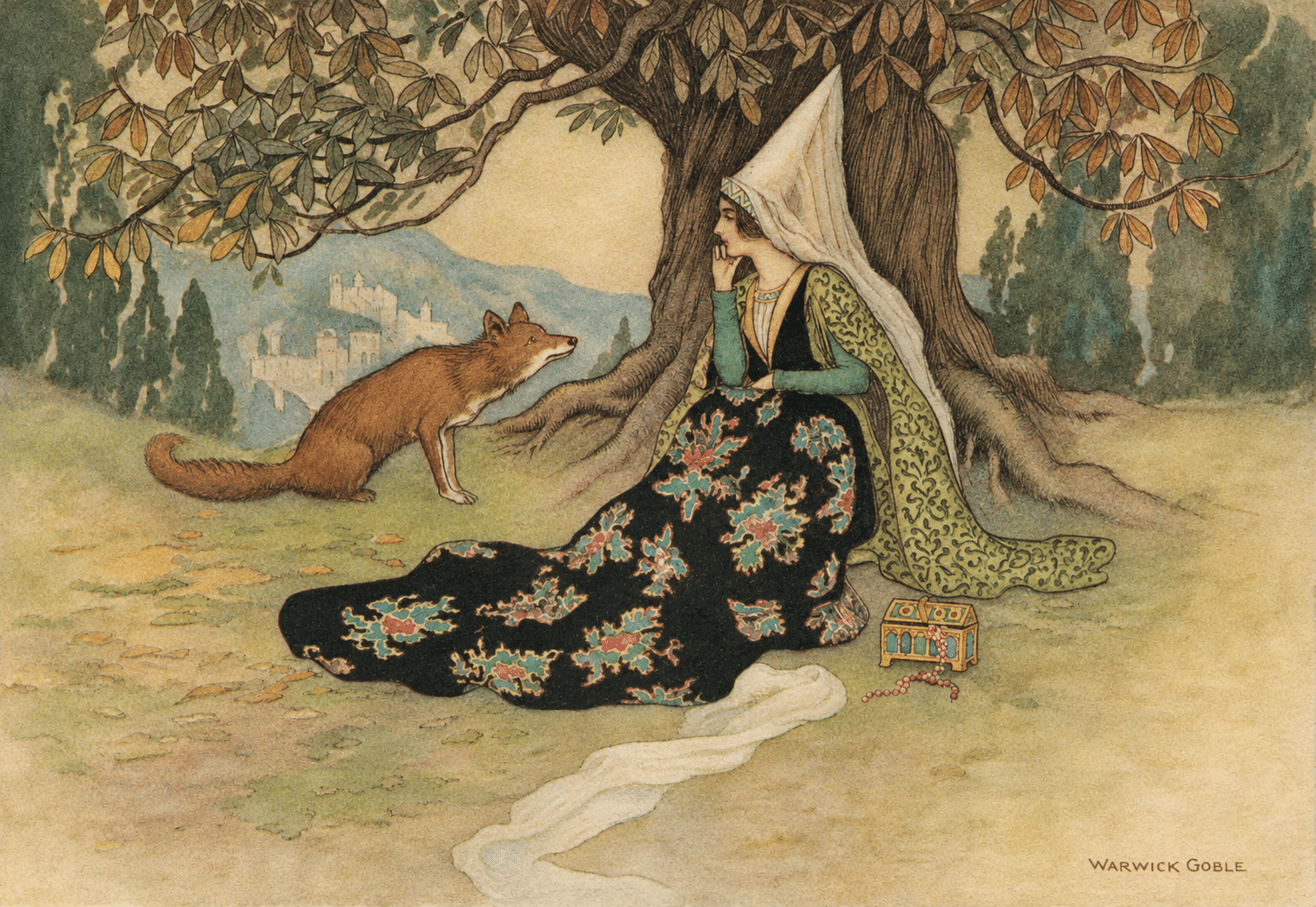
Warwick Goble, Grannonia and the Fox, illustration for Giambattista Basile’s “The Serpent”, published in Stories from the Pentamerone (1911). After the burning of the snakeskin causes her husband to flee, the brave and resourceful Grannonia sets out on a marvellous journey to recover him. Her encounter with the fox, a kind of tutelary spirit, opens the way to the knowledge she needs to heal him: the fire has not ended the story, but begun a new ordeal. Public domain.
A prince born in a donkey’s skin, a husband who sheds his serpent’s appearance at night, a princess living beneath a frog’s skin. In many fairy tales, the distance between beast and human is no thicker than a skin. Removing it reveals another nature, hidden from the community or known only to the person who shares the shapeshifter’s intimate life. But this beast’s skin can also end up in the fire, and it is this detail that I want to explore today. Sometimes burning it breaks the enchantment for good; at other times, doing so too soon makes the loved one disappear and sets in motion a long journey to find them again.
Stith Thompson catalogued “Disenchantment by removing skin (or covering)” as motif D721. Within this group, D721.3, the subject of this article, is “Disenchantment by destroying skin (covering)”: breaking an enchantment by destroying the skin, usually by burning it. This is a small detail, yet one capable of shaping stories with very different meanings. Release from a curse, acceptance by the community, the passage into adulthood or the possibility of rebirth.
I invite you to follow the trail of this beast’s skin from a story in the Panchatantra to European fairy tales, by way of the medieval donkey prince, the courtly versions of Straparola and Basile, and an enchanted dragon from Mallorca. Along the way, you will see how love, magic, taboos and fate shape the characters’ transformations. And how, beneath the apparent simplicity of burning a skin, we can discover rich ways of understanding the person, the bonds with our ancestors and what must be left behind before a new life can begin.
Fate and the Beast’s Skin
Transformation into an animal, a plant or a monster, whether through a curse or by choice, is a familiar motif in the tales and myths of cultures throughout the world. In Europe, some of the best-known ancient examples are Odysseus’ companions, turned into pigs by Circe; Niceros’ werewolf in Petronius’ Satyricon; and Lucius, transformed into a donkey in Apuleius’ Metamorphoses. But none of these contains D721.3. In the Odyssey, Circe restores the sailors by anointing them with an ointment, just as she transformed them. Petronius shows the werewolf regaining his human form, but does not explain how the return takes place. And poor Lucius becomes a donkey after applying the ointment of the witch Pamphile, which turns her into an owl, because he wants to experience her powers. He will not become human again until he eats some roses. All these examples draw on popular tradition and magical practices, but they lack the detail of “destroying the skin” to break the spell.
Nor will I discuss here the variant in which the character can put on and take off an animal skin at will. Or the one in which somebody steals their skin, human or animal, forcing the witch or sorcerer to obey the thief: D721.2. This last variant appears in old versions from around the world and is very common in Catalonia in the fragmented, folkloric form of stealing a witch’s or sorcerer’s clothes or shirt. Like the examples above, these variants are also associated with harmful or benevolent witchcraft.
One of the earliest known versions of D721.3 appears in The Girl Who Married a Snake, a tale from the Indian manual for the education of aristocrats known as The Five Principles, the Panchatantra. Its dramatic structure is the same as, or very similar to, those you will encounter in much later tales. Its tale type would correspond to the former AaTh 433, The Prince as Serpent, subsequently incorporated into one of the variants of ATU 433B, King Lindorm.
A brahmin and his wife cannot have children, but a mysterious voice tells him that his wife will conceive. When she gives birth, her child is a snake. Yet rather than driving it away or killing it, as the whole family advises, the brahmin’s wife loves it and “paid no heed to their words. She took her son, had him bathed and, out of love for him, laid him in a large, clean box. She fed him good milk, fresh butter and other fine things of that kind, so that within a few days he had grown quite large and healthy.” She then asks the brahmin to find a maiden for him to marry. He refuses, thinking it an abomination to marry a girl to a snake, but his wife begs him and, after much insistence, he agrees to please her. He travels to a distant land, to the home of some relatives, and arranges a marriage with a young woman of “extraordinary beauty, endowed with every grace and virtue”. Neighbours and relatives try to stop him, saying that he must be “possessed” to marry such a beautiful, intelligent and wise girl to a creature like a snake. But the young woman stops them and speaks the tale’s central words: “what fate has ordained, determined by the deeds of a previous existence, cannot be changed”. Nor does she want it said that her father has broken his word. The story ends like this:
With the consent of those who accompanied her, she married the snake. Then she began to serve her husband devotedly, offering him good milk to drink and caring for him in many other loving ways.
One night, the snake came out of the great box they had prepared for him in the bedchamber and climbed onto his wife’s bed.
“Who is this in the shape of a man?” she wondered.
Thinking him a stranger, she rose, trembling from head to foot, opened the door and made ready to flee.
“Stay, my beloved,” he said. “I am your husband.”
To prove that he was telling the truth, he went back into the body he had left inside the box and came out of it again.
The girl threw herself at his feet when she saw him shining, so handsome, with his diadem, earrings, bracelets and the bands adorning his strong arms. Then the two of them enjoyed the pleasures of love.
The father, who had risen before them, saw what was happening. He took the snakeskin that had been left in the box and thought:
“Let him never enter it again.”
Then he burnt it in the fire.
At daybreak, full of joy and accompanied by his wife, he presented their son to everyone: a fine young man, wholly absorbed in his love for the wise girl.
Here we do find disenchantment through the destruction of the beast’s skin. But unlike the examples I have mentioned, the tale places its emphasis neither on witchcraft nor on the magical procedure of transformation, but on another theme: rebirth and fate. We should remember that the stories of the Panchatantra contain lessons of many kinds. Here, the girl declares that what fate has ordained, determined by the deeds of a previous existence, must be fulfilled. Yet I think the story allows us to understand this fate as a path running in two directions: it has been foretold, but the characters’ actions make its fulfilment possible. The mother must welcome and care for her snake son; the girl must accept him as a husband and keep the promise that has been made. What is to happen also needs someone to make it possible. It is neither solely a matter of predetermined fate nor solely of people creating their own destiny: both are happening at once.
From this perspective, the foods used to nourish the snake man, milk and fresh butter, can take on a propitiatory meaning. Feeding him keeps him alive, but also prepares the conditions in which his human nature can be revealed. This possibility has a specific religious and folkloric context: in India, offerings of milk to snakes form part of practices of worship and propitiation, such as those associated with the festival of Nāg Pañcamī. In other historical and geographical contexts, such as European antiquity, milk offerings to snakes have been linked to the belief that they can house the souls of the dead and represent human beings still in an embryonic state, ready to be born again. Milk can express devotion, love and care towards a being that is at once an animal and a supernatural power; it is also associated with fertility and the capacity to give life. It is a maternal liquid that leads from the world before birth, the world of the soul before it is born, towards formation and growth in the present world. In other words, it helps a being not yet fully formed, the baby, attain the condition of a fully formed person, in a process that echoes the formation of souls before birth. As a curious parallel, European legends, including Catalan ones, also abound in snakes that steal the milk of pregnant women.
Within this comparative context, I think the milk in the tale can be connected with the imagery surrounding Surabhi or Kamadhenu, the divine cow of abundance who can grant wishes. In one Indian mythic tradition, Kamadhenu emerges from the churning of the ocean of milk, from which Lakshmi, goddess of prosperity and good fortune, also arises. The Indian folklorist M. D. Muthukumaraswamy has observed how these associations between Kamadhenu, motherhood and abundance also appear in her iconography, sometimes explicitly linked to Lakshmi. Milk and butter also occupy a prominent place in the imagery surrounding Lord Krishna, an avatar of Vishnu.
Moreover, first the mother and then the wife care for the snake man through love and good deeds. They do more than wait for fate to be fulfilled: they help prepare and reveal it, proving wiser than those who see only a beast. Care and acceptance can thus be understood as the actions that make possible the rebirth of the man beneath the snakeskin.
Asinarius, the Donkey Prince
The Five Principles was composed at an uncertain date; various studies place it in the third century AD, drawing on an older oral tradition. Over the centuries, it was transmitted in new versions, and the first in which the tale of the snake man has been identified is medieval: Pūrṇabhadra’s recension of 1199, where it may be an addition of unknown origin and date.
The Five Principles reached Europe by several routes. One of these, the principal one, was the Arabic version known as Kalila and Dimna, translated into Greek in the late eleventh century and into Castilian in 1251, at the request of Prince Alfonso, the future Alfonso X the Wise. But none of these versions contains the snake-man tale. During the thirteenth century, an Italian Jewish convert, John of Capua, translated a Hebrew version into Latin, an alternative to Kalila and Dimna: the Directorium humanae vitae, which likewise lacks the story. Two incomplete Hebrew versions have come down to us, and the tale cannot be found in either. In the second, however, dating from the early thirteenth century and attributed to the scholar and philosopher Jacob ben Eleazar of Toledo, some tales correspond to those surrounding the Indian snake-man story, but the place it would occupy has been lost. Whether it was once there cannot be known.
Around the same time, between the late twelfth and early thirteenth centuries, we find a European version of an alternative story containing D721.3: the anonymous poem Asinarius, The Donkey Prince, belonging to ATU 430, The Donkey. Its composition is usually placed in southern Germany, with affinities to the burlesque world of French wandering scholars. Whether it drew on earlier oral tales is unknown, though probable. Like the previous story, it begins with a king and queen who cannot have children. The deeply unhappy queen “unceasingly importuned the merciful gods, begging them day and night to make her a mother”. The gods hear her, but she gives birth to a little donkey. The queen orders him killed, but the compassionate king thinks very differently: “By no means! Let this creature not die! On the contrary, I command that this son of mine shall live. Whichever god has given him to me as an heir, he shall be king upon the throne of my kingdom. His head shall bear his father’s crown, and all his father’s glory shall be his”.
By the king’s command, he is educated and brought up with love and great honours. “In his father’s kingdom he was known as the Young Lord, and all the courtiers respected and feared him. He travelled through the kingdom’s towns and cities and took great delight in games and amusements; but what he loved most was the art of string musicians, and he longed to learn it if fortune favoured him.” He has a celebrated minstrel summoned to teach him, but the frightened musician says he cannot, because the prince has no hands with which to play. The donkey prince flies into a bestial rage and threatens him, invoking his noble lineage. The minstrel teaches him and, astonishingly, the beast prince learns to play the cithara beautifully, surpassing his own master.
One day he sees his face reflected in a river. Discovering that he is a beast, he grows sad and, in despair, flees the kingdom, carrying the musical instruments that bring him such happiness and accompanied by a faithful servant who loves him. They reach a distant kingdom whose heir is a princess. The donkey prince goes to the palace and is refused entry, but when he begins to play, the astonished gatekeepers receive him with honour. The king welcomes him and seats him at his table beside his daughter, whom he treats with such care and elegance that everyone is delighted, including the princess, who falls in love with him. To keep him from leaving, the king offers him his daughter’s hand. He accepts, and so does the young woman.
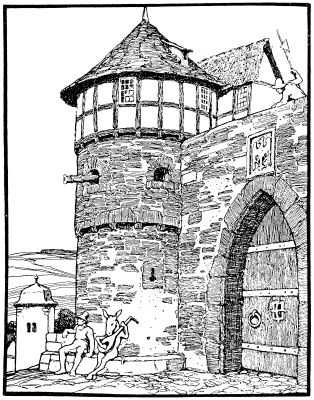
Otto Ubbelohde, illustration for The Little Donkey by the Brothers Grimm (1909), a later version of the donkey-prince story. At the castle gates, music allows the seemingly monstrous creature to be heard and welcomed. As in the medieval Asinarius, before the beast’s skin disappears, what lay beneath it has already been revealed: the protagonist’s wit, sensitivity, kindness and gifts. Public domain.
They marry amid great festivities, and on their wedding night this scene takes place:
When Hesperus brought the well-fed guests the hour of sleep, when woman and man may lawfully surrender to Venus, the young donkey entered the maiden’s bedchamber without fear, to caress his wife. The king had ordered two lamps to be placed in that room. He had also stationed a servant behind a curtain to watch what the donkey and the maiden did during the night.
When everyone had left and he believed no one remained, the door was barred. At once, the husband removed his donkey covering: he laid aside the old skin and became a new man. Where there had been a misshapen creature, the maiden saw the noble body of a handsome man. Marvelling at her husband’s incredible beauty, she immediately fell into the snares of Venus.
They put their arms around each other’s necks and joined their lips. He leapt into bed, and the maiden followed him. What happened next they know, and so does the bed. Nor do I think the hidden man could have failed to notice what games, and of what kind, were played there during the night. He then soothed his ardour, and she answered her husband as a wife.
When shining Aurora returned and dispelled the darkness, he rose from his wife’s embrace. He covered himself once more in the donkey’s skin and became again the young donkey he had been before.
The next day, the young woman is very happy and tells her father: “There is no one in the world I love more. I truly love my husband with all my heart”. But she tells him neither of her husband’s true form nor of the change of skin. The servant who spied on the lovers at the king’s command, however, reveals the whole truth. To see for himself, the king hides in the bedchamber that very night. The story ends like this:
The king approached the bed softly and saw a handsome man lying there. He immediately took away the donkey’s skin and left without his son-in-law noticing. He ordered a furnace to be lit with plentiful fuel, and at his command the skin was reduced to ashes.
Eager to learn what his son-in-law would do, the king remained awake outside the door all night.
In the morning, his son-in-law rose refreshed and wished to cover himself in the donkey’s skin as before. Unable to find it, he was overcome with distress and could think of nothing but flight. He went out, but the king barred his way and said:
“Where are you going in such haste, my son? What has happened? What is the matter? This intention of yours shall come to nothing, and you shall be prevented from leaving. I do not want you to grieve over the loss of a donkey’s skin when you are a handsome, well-formed man. From this day, while I live, I share my kingdom with you; after my death, possess it all yourself.”
His son-in-law answered:
“So I shall, and I shall stay with you. And I pray that these happy beginnings may have an equally happy ending.”
This story has an unmistakably burlesque tone, at times satirical and bawdy, but it also has moral intentions. Far from the idea of reincarnation in the previous version, here there are several subtexts. The first is that, however monstrous someone’s appearance, following the period’s rules of courtesy and refinement, in other words through kindness and a good education, can take them a long way. The tale tells us that appearances do not make a person: their actions do. A second lesson is that, rather than giving up his passion for music, he embraces it and works hard, becoming a great musician. The story tells us that it does not matter whether others say we cannot do something, or what our circumstances may be: with passion, we can achieve it. It is a notably optimistic tale, full of a zest for life.
Parallels have been drawn between the Asinarius and the snake-man tale in the Panchatantra, but I do not think the relationship between them is direct. It seems more likely to me that, if the Indian story reached Europe, it encountered an existing body of tales using the same motif, D721.3, for different purposes. We can see this in various examples. To mention what I consider the most striking, in The Saga of the Volsungs, the hero Sigmund and his son and nephew Sinfjötli find magical wolfskins in the forest, put them on and use their powers to carry out their violent revenge. When the time comes when they can remove the skins, they burn them to prevent them from doing further harm. The Saga of the Volsungs was written down in the thirteenth century, but its stories are much older and derive from oral tradition. We must distinguish, however, between the age of the Volsung tradition and the demonstrable age of this particular episode: the former does not automatically date every motif in the saga, some of which may be far older than others.
The wolfskin episode in The Saga of the Volsungs has also been read as a process of initiation, in which bodily transformation is linked to identity, kinship and obligations to the lineage. Ancestors and family demands shape the descendants’ actions, and fate can be fulfilled through the characters’ own decisions and behaviour. These readings connect the magic of the skins with the shapeshifter’s place in the community and, above all, with the lineage and its dead ancestors. In any case, the motif here is associated with witchcraft and traditional European shapeshifting practices, like the other European stories I mentioned at the beginning. We find the same in The Saga of Áli flekkr, whose protagonist, cursed and turned into a wolf, is freed when he burns the beast’s skin. There are further examples.
The Asinarius would thus be a kind of bridge between an older European tradition, represented by examples such as The Saga of the Volsungs or the story of Lucius in Apuleius’ Metamorphoses, with motif D721 associated with witchcraft, and a learned literary tradition drawing on Eastern, Indian and Persian sources through Arabic and Hebrew transmission, with the motif linked to fate, moral education and reincarnation.
The Courtly Versions of Straparola and Basile
As with many other tales in the European tradition, the most important versions for the spread of motif D721.3 across the continent are Giovanni Francesco Straparola’s (1480–1558) King Pig, included in The Pleasant Nights, and, above all, The Serpent, from Giambattista Basile’s (1575–1632) The Tale of Tales. Straparola’s story, belonging to ATU 441, Hans My Hedgehog, is very close to the Asinarius and the Indian snake-man tale, but we cannot be certain whether it derives from that story, from a distant shared tradition or, more probably, from both. Queen Ersilia, who cannot have children, gives birth through the magic of three fairies to a son with the appearance and habits of a pig. He can leave this condition behind only after marrying not once, but three times. When the time comes, the prince takes the three daughters of a poor woman as his wives in succession: he kills the first two, who intended to kill him, but the third, Meldina, welcomes him with love. He then reveals that he can remove his pigskin and appear as a remarkably handsome young man. After they have a child, Meldina confides the secret to her parents-in-law, who enter the bedchamber at night and discover the prince’s human form. The king orders the skin torn to pieces and eventually gives his throne to his son, who lives happily with Meldina.
Basile’s tale offers a particularly interesting counterpoint to the versions we have seen so far. A peasant couple who likewise cannot have children adopt a talking snake who, on growing up, asks to marry Princess Grannonia. After meeting the king’s impossible demands with marvels of gold and precious stones created through his powers, he wins the young woman’s hand. In the bridal chamber, he removes his skin and reveals himself as a young man of great beauty and wisdom, but Grannonia’s parents spy on them and burn the animal covering. The prince turns into a dove and flees, grievously injuring himself as he passes through a glass window. The princess sets out to find him and, with the help of a fox who understands the birds, discovers that she can cure him with their blood mixed with the fox’s own. Having obtained it through her cunning, she heals him. Once she has established that he remains true to his love, she reveals who she is, and the two are reunited.
These two tales emphasise the passage from childhood into adulthood, through self-acceptance and acceptance by the community. As a rite of passage between childhood and the adult world, the inward and outward transformation takes place through the ennobling action of love, a rite embodied in marriage. Although this theme was already present in the earlier versions, it is even more pronounced here, bringing them closer to ATU 425, The Search for the Lost Husband, especially ATU 425A, The Animal as Bridegroom, and ATU 425C, Beauty and the Beast, in which motifs such as D721 often appear. Written for a courtly audience and bringing together many different influences, these literary variants offer an original and delightful mixture of motifs, especially in Basile.
The beast princes of these two versions are not tenacious adventurers with the roguish wit and zest for life of Asinarius. In King Pig, the prince is a sinister beast child who responds to the community’s rejection with equal violence, because he does not know how to behave in society and is governed by his instincts; that is what makes him frightening. In some ways he recalls the brutal yet innocent Perceval in the opening chapters of Chrétien de Troyes’ The Story of the Grail. When the beast child is accepted through love and marriage, he can reveal or develop his full human condition. There are also surviving traces of motifs associated with fate, such as the familiar three fairies, ladies of destiny or Fates, and the three brides, two of them false, before the true one appears. These brides mirror the three fairies who protect the lineage and set the tale in motion by making the protagonist’s incarnation possible.
Basile’s tale is more complex and combines ATU 425A, AaTh 433 and ATU 432, The Prince as Bird, moving towards tales of magic and destiny with elements of other traditional variants skilfully woven together. When his snakeskin is burnt, the protagonist can still turn into other animals and does not lose his magical powers. As often happens in ATU 425, with echoes of Eros and Psyche, he is a sorcerer endowed with supernatural powers. The young woman takes the leading role and, through the intervention of a magical fox or tutelary spirit, recovers her beloved, an episode found in many other tale types. I discussed it in connection with ATU 313, The Magic Flight, and the loss of memory. In any case, as in Straparola’s tale, it is through acceptance and union with the second protagonist that the animal youth can leave his bestial condition behind and enter society, welcomed by the whole community.
European Versions and Antoni Maria Penya’s The Enchanted Dragon
From here, we find many more tales containing motif D721.3 across Europe and the world. The Grimms, for example, adapted the Asinarius in their tale The Little Donkey. They also include the motif in Hans My Hedgehog, which has its own tale type. Adolfo Coelho, the leading nineteenth-century Portuguese folklorist, whose version of Snow White I published, collected The Toad Prince, a very classic example. Especially fascinating is King Lindorm, a Scandinavian tale with a famous Danish version, which I will explore in detail in a forthcoming article. One particularly interesting feature of the Scandinavian versions is that the skin is not destroyed: shedding it requires an elaborate and compelling ritual.
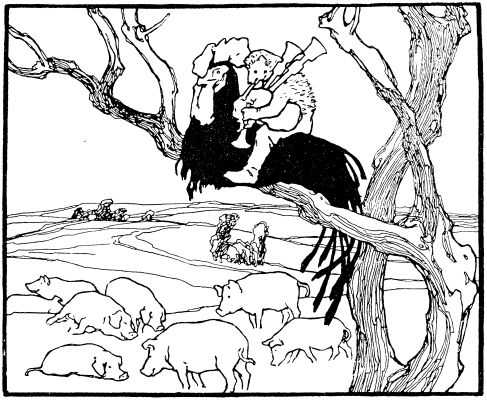
Otto Ubbelohde, Hans My Hedgehog, by the Brothers Grimm (1909). Musician, swineherd and hybrid creature, the endearing Hans brings together in a single figure what we tend to keep apart: the human and the animal, community life and the marvellous world. His liminal nature reminds us of who we are, or might become. His prickly skin makes that ambiguous condition visible, until the tale resolves it through fire and transformation. Public domain.
Apart from the Scandinavian versions, my favourite tale containing this motif is The Frog Princess, collected by the great Russian folklorist Aleksandr Afanasyev, whom I discussed in connection with his brilliant version of Snow White. In this Russian tale, rich in animistic elements, the roles are reversed and we encounter a beast maiden. A tsar orders his three sons to shoot an arrow and marry wherever it lands. The youngest son Ivan’s arrow reaches a marsh, where a frog picks it up and becomes his wife. Despite his brothers’ mockery, she passes the tsar’s tests and appears at the banquet as Vasilisa the Wise, an enchanted princess, skilful, magical and highly intelligent, who appears in several Russian tales. Ivan secretly returns home and burns the frogskin, but does so before the spell has run its course. Vasilisa turns into a swan and disappears, telling him to seek her in the realm of Koschei the Deathless, a wicked sorcerer who also often appears in Russian tales. Filled with remorse, young Ivan sets out and spares or saves the lives of several animals, who later give him crucial help. With guidance from the charismatic, powerful and always ambiguous Baba Yaga, he discovers that Koschei’s death is hidden at the tip of a needle, inside an egg concealed within several animals and a chest. With his animal allies’ help, he obtains the egg, breaks the needle, kills the wicked Koschei and recovers Vasilisa, with whom he returns home and lives happily.
I could give many more examples of tales containing D721.3, but there is no need. I will end this journey with a short Mallorcan version collected by Antoni Maria Penya in Palma in 1894. I give it here in full, translated from the Mallorcan original.
The Enchanted Dragon
This was and shall be; may the finch have a fair journey.
There was a man who had three daughters. They had an oven, and every day their father went out to gather a bundle of firewood for it. One day he went towards a cave, and a dragon came out and asked whether he had any daughters. He said he had three, and the dragon asked whether one of them might enter his mouth. If she did, he would give the man a purse of money that would never run out; if she did not, the man would have a stomachache for ever. The man went home and began to groan, and his eldest daughter said:
“Father, what is the matter?”
Her father answered:
“Ah, my daughter, if only you knew. I went to a cave, and a dragon came out and told me that if one of you would enter his mouth, we would be rich for the rest of our lives. If not, I would have a stomachache for ever.”
She said:
“Yes, Father. Let us go and see him.”
When they arrived and she saw how enormous the dragon was, the daughter said:
“No, Father. If you want a stomachache, you can have one, because I am not going in.”
She went home, with her father groaning, and his second daughter said:
“Father, what is the matter?”
“Ah, my daughter, if only you knew. I went to a cave, and a dragon came out and told me that if one of you would enter his mouth, we would be rich for the rest of our lives. If not, I would have a stomachache for ever.”
She said:
“Yes, Father, let us go and see him.”
When they arrived and she saw how enormous the dragon was, the daughter said:
“Oh, Father, what a great mouth! I do not want to go in.”
Her father returned home, furious and groaning with his stomachache, and his youngest daughter said:
“Father, what is the matter?”
“Ah, my daughter, if only you knew. I went to a cave, and a dragon came out and told me that if one of you would enter his mouth, we would be rich for the rest of our lives. If not, I would have a stomachache for ever.”
“Come, Father. I would do anything for you.”
They went to the dragon’s cave, and when the daughter saw him, she said:
“Father, he is very large, but so that we may live well, I shall go in.”
She went in and found herself inside a palace, where she saw no one but two shadows that always waited on her. The dragon gave her father the purse of money he had said would never run out, and she lived very comfortably in the palace: she did whatever she wished. If she wanted to work, she worked; if she did not, she did not. Those two shadows served as her maids. When she slept, a shadow always kept watch at the head of her bed. One night she struck a match to see who that shadow was, and looked so long and closely that the match burnt down and its charred tip fell onto the shadow’s eye. The shadow said:
“Little girl, it is all over!”
The next morning she found herself in an open field, with no path to follow, and began to walk without knowing where she was going. Very late, at nightfall, she saw a little light and made her way towards it. She found a great house surrounded by sentries guarding it, and said to them:
“Will you give me shelter for this holy night?”
The sentries told her they had orders to let no one into the house, for it was the king’s house. Just then one of the king’s servants came out, and she said again:
“Would you give me shelter for this holy night?”
The servant took pity on her, for he saw that she was about to give birth, and said:
“Let her in. We shall hide her so that the king does not know.”
He let her in and gave her shelter. That night she had a baby boy and asked the servant whether he had any old cloth to wrap him in. The servant said:
“I have nothing, unless I give you an old pair of breeches!”
He gave her the old breeches, and she wrapped the child in them. Just then a door began to rattle, tupatratap, tupatratap, and from behind it came a voice that said:
“Oh, my dear little son,
if your grandparents knew,
they would wrap you in cloth of gold,
and now you lie wrapped
in the servant’s breeches.
If the dragon’s skin were burnt,
the bells fell silent
and the cocks did not crow,
the enchantment would be ended.”
When the servant heard this, he went straight to tell the king and begged forgiveness for having given the woman shelter on that holy night. When the king heard the voice, he forgave him and ordered the dragon’s skin to be burnt, commanded that the bells should stop ringing and killed all the cocks so that they would not crow. The enchantment ended, and the woman became queen.
The man who collected this tale deserves a few lines. Antoni Maria Penya i Gelabert (Palma, 1863–1948) was a Mallorcan poet, teacher, archivist and folklorist, the son of the writer Pere d’Alcàntara Penya. In 1894, at the request of Archduke Ludwig Salvator of Austria-Tuscany, he travelled around Mallorca collecting tales, legends and anecdotes from oral tradition. He assembled a corpus of 169 narratives, of which 54 were published in 1895 in two parallel editions: Rondayes de Mallorca, in Catalan, and Märchen aus Mallorca, in German. Among the stories he collected was “Es drac encantat”. He also helped preserve the island’s folk songs with his collection Cançons populars mallorquines (1896). Ludwig Salvator and Antoni Maria Penya’s Rondalles de Mallorca was the first collection of Mallorcan folktales and one of the earliest in Catalan.
The Enchanted Dragon is a highly distinctive version containing D721.3 and, as we shall see, a small masterpiece of oral storytelling. Professor Caterina Valriu classifies it as ATU 425E, “The Enchanted Husband Sings a Lullaby”. An earlier literary parallel is Basile’s The Padlock. Its protagonist, Luciella, loses her enchanted husband by breaking a prohibition. After she gives birth, he visits the child and sings a song revealing how to break the spell: this is the characteristic episode it shares with The Enchanted Dragon. Here the transformation is into a mythical monster, the dragon, rather than an animal. But when the protagonist is inside his belly, the mysterious magical palace, he appears as two shadows. The whole tale has a delightful ambiguity and preserves the mystery of what it is saying. The two shadows are introduced as servants, and later one is said to watch over the protagonist. It is not established that both are the husband, but from what follows it becomes clear. As in Eros and Psyche and many versions of ATU 425 and its variants, the desire to see the appearance of the sorcerer or enchanted husband makes the magical palace vanish: “One night she struck a match to see who that shadow was, and looked so long and closely that the match burnt down and its charred tip fell onto the shadow’s eye.”
As in Straparola’s King Pig and many other tales, the episode in which the first two sisters refuse to enter emphasises the importance of fate. And, as in the Indian snake-man tale, it is through one’s own actions and acts of propitiation that this fate is created or prepared. It is a path running in two directions, an apparently circular thought or “chicken and egg” paradox, broken only by taking fate into one’s own hands while recognising one’s own qualities, who one really is, one’s true will and identity. The girl in the Indian story transforms the snake through the very qualities she herself possesses: intelligence, wisdom, beauty and courage; both are predestined. Like the magical girl in Basile’s The Serpent, or the mother and wife in the Indian tale, these women create a destiny that has nevertheless already been written.
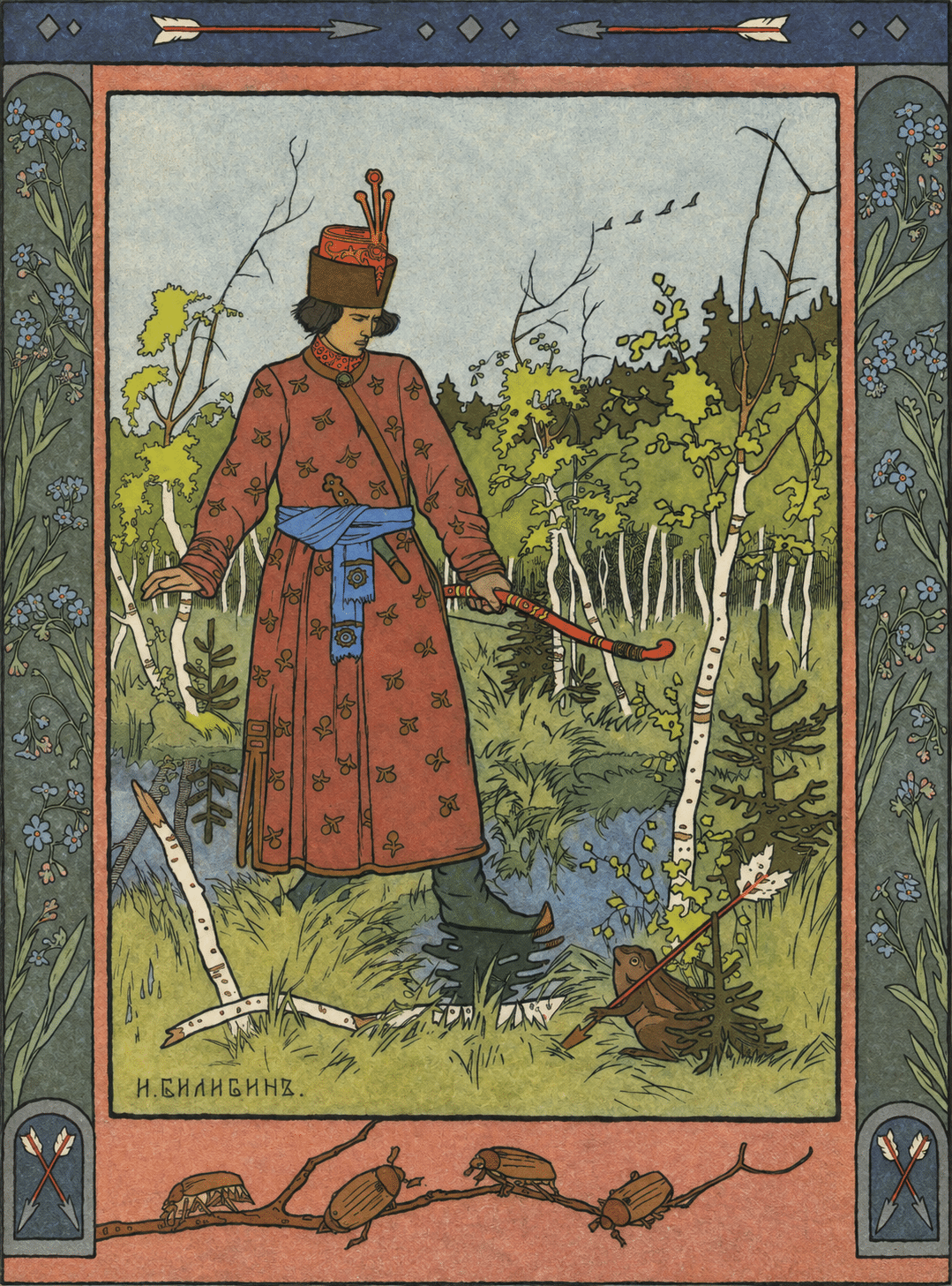
Ivan Bilibin, The Prince and the Frog (1900), illustration for The Frog Princess. Ivan’s arrow has led him to a wife no one would have chosen for her appearance. Beneath that frogskin, however, is Vasilisa the Wise. Burning it too soon will not hasten the disenchantment: it will force the prince to seek what his impatience has lost. Public domain.
Gathering Up the Beast’s Skin
You have seen how a single folklore motif can run through different tale types, such as AaTh 433, ATU 425, 441 and 430. It can also be linked to different themes and interpretations: moral education, acceptance by the community, the passage from childhood into adulthood, overcoming one’s limitations, or the idea that what we carry within us and the things we do matter more than our physical appearance.
Another possible reading is that, by becoming what you most fear, find repulsive or reject—or by recognising the monster you are or the monstrous, bestial parts within you—and then shedding your perception of yourself and burning the old identity, you can become human, or something more than human. As in the Asinarius, before shedding the beast’s identity, the person wearing it may make peace or come to an understanding with it. This identity may bring great magical powers and abilities. Rather than fighting it, they may accept or integrate it. And when the shapeshifter is another character rather than the protagonist, the transformation can also take place in the eyes of the beholder, as happens with the female protagonist of Basile’s The Serpent. When she accepts or comes to terms with the other’s bestial nature, she stops fearing or rejecting him and begins to love him. The accursed man ceases to be a beast in her eyes, and in this way she helps to transform him.
These are only a few of the many possible interpretations, showing us once again the endless possibilities and inexhaustible wisdom of folktales. But there is one theme that runs through the great majority of the versions we have seen, more or less explicitly and with varying importance, through direct references or the unintentional survival of other motifs’ subtexts: fate and reincarnation.
Consider the Mallorcan tale, which is relatively explicit in this respect and therefore especially interesting to me. The magical song that lifts the curse, the story’s most important episode, evokes ideas of messages from the otherworld, as in The Singing Bone. And the child she is carrying could be the enchanted man himself. He is not explicitly identified as such, but only when she gives birth does the mysterious voice, probably that of the enchanted man, sing the song that provides the key to breaking the curse: burning the old dragonskin, the former covering or shell that held him captive, so that he can be reincarnated in the child. Moreover, the voice says “oh, my dear little son”, supporting a reading of a paternal relationship and transmission or continuity within the lineage. This resembles what happens in Basile’s The Padlock. The husband visits his son, and knowledge is passed on. They appear to be two distinct but connected characters, and the ending brings the husband together with his mother and his wife. The coincidence of the child’s birth and the disenchantment seems clear enough to me, allowing us to read the episode as an image of renewal or rebirth, with a possible background of reincarnation.
Nor is it accidental that many of the versions you have seen contain the motif of the couple who cannot have children, often associated with tales in which fate is an important theme—T510–T540, miraculous conception and birth. It is through the intervention of the gods or God, mysterious ancestral voices, the dead or other supernatural powers that this birth is marked as extraordinary and determined by fate. Sometimes this intervention takes place through the magic or spell of a benevolent witch, fairy or lady of destiny, such as the three fairies or Fates—T548, Birth brought about by magic or prayer; T548.2, Magic rites to obtain a child; T548.3, Magic elixir to obtain a child; T511–T511.1, Conception caused by eating something or a magical fruit. Reincarnation is sometimes linked to this birth. This is no ordinary person being born: the heroine must help with or carry out a series of steps we might call “rituals” so that this particular person can be incarnated again. In The Enchanted Dragon there is no childless couple, but there is a miraculous birth.
As you will see in the article on King Lindorm, when I explore various European myths and beliefs about the relationship between children and snakes, the serpent or dragon in this kind of tale allows us to examine a very old relationship between fate, the continuity of the lineage and the world of the dead. In different traditions, a snake can be a protector of the household, a manifestation of the ancestors or a being associated with fertility and the return of life. In the Greek world, for example, the Agathos Daimon, connected with ancestors, individual protection and the prosperity of the home, could be represented as a serpent. We see this, to give a nearby example, in the Serapis of Empúries. These figures are not always equivalent in all their meanings: they depend on their context, but they show how readily the snake can stand between the home and the underworld, between the living and the dead.
The possibility of connecting the snake with reincarnation also has folkloric parallels. Andrei I. Behr-Glinka and Hilda Ellis Davidson, among other scholars, have studied beliefs and narratives in which the dead become snakes and snakes, in turn, are connected with the arrival of a newborn child. Destroying the old skin could represent the end of a previous existence and the possibility of a new incarnation, associated with the renewal of the lineage. In this reading, the person need not previously have been an animal: rather, the beast, especially the snake, may symbolise the soul in the world of the dead, representing the ancestors who must be incarnated again.
As we have seen in almost every version, this renewal requires female mediation. The woman is the one who has crossed to the other side and returns bringing new life. By giving birth, she acts as an intermediary between the world of the dead, before rebirth, and that of the living, in a role we might almost call priestly or directly magical. She gives milk and, through the growth and nourishment it provides, helps give definite form to what is still potential in the newborn. Her intervention also makes it possible for the old funerary skin to be destroyed, sometimes by the parents, and for what is to be to be born. Thus the three ladies of fate, among the most powerful goddesses in myth, are represented as women. Archaeological examples speak to this relationship between femininity, snakes, the dead and births, and to the continuity of life between generations. One example of this mediation between worlds, found throughout Europe and the East, is the woman with a snake from Cerrillo Blanco at Porcuna. This figure has been interpreted as an image of mediation with the underworld, linked to the memory of origins and the prosperity of the lineage (Herranz Sánchez).
The fragility of a newborn, not yet fully in this world, especially at times when infant mortality was extremely high, brings with it the desire to protect a life that is only beginning, by whatever means are available. Having a child is therefore more than conceiving one: it also means asking for the child to arrive, trying to keep it alive, feeding it, protecting it, presenting it to others, defending it from evil spirits or giving it a name. The baby as a being whose formation is not yet complete also has parallels in the ways some ancient societies understood early childhood. A newborn did not always immediately receive the same recognition as other members of the community. As Gusi and Muriel put it: “In the Roman world, newborns and infants were called infans nondum homo, that is, ‘inhuman children’, and therefore unfinished or incomplete human beings.” This social and ritual condition can help us consider, from the perspective of antiquity, that passage between birth and full incorporation into the world of the living.
To return to our starting point, the Mallorcan tale, for all its apparent simplicity, offers a remarkably clear synthesis of the tale type and one of the most precise images of what it means to burn the beast’s old skin. This is why there are variants in which burning the animal skin prematurely is a grave taboo, motif C757.1: from this perspective, depending on the context, if we understand it as a process of rebirth, it can prevent or hinder the new incarnation. We have seen this in Afanasyev’s Russian The Frog Princess. Trying to see too soon what has yet to take shape, what belongs to the realm of the dead, a shadow, as in the tale collected by Penya, can likewise break or damage that process. In turn, the journey into the earthly, subterranean palace recalls a katabasis, a descent into the otherworld. This idea of a journey into a liminal realm close to that of the dead recurs in many versions of ATU 425.
This brings us to a final question. What is the beast’s skin, and why must it be burnt? I have been suggesting one answer throughout this article: reading the skin as a shape or covering of the person, associated, in certain contexts, with the soul and the world of the dead. This reading can also be explored in versions that do not explicitly address fate and reincarnation, such as the sagas of the Volsungs and Áli flekkr. The old skin, the beast’s skin, could represent the old soul or, more precisely, a part of the soul associated with the world of the dead. By burning it, you shed what prevents you from being incarnated again, the burden of a reality submerged in the dead’s world of undefined forms. What gives it power and magic that seem supernatural to human eyes, because it belongs to the daimon of the lineage, is also what must be left behind to acquire a defined, bounded form and be alive in a physical sense.
In the sagas, this relationship between skin and person can be explored through the hamr, the shape or covering, useful at a particular moment or imposed on another through hostile witchcraft. The hamr affects more than appearance: in some narratives it also involves the shapeshifter’s mind and identity (Jakobsson). From it comes the term hamrammr, characterising the shapeshifter’s power, and it is linked with the fylgja, a manifestation of the lineage’s tutelary spirit or double, associated with the person’s soul or understood as part of it, which can take human or animal form. Motif D721.2, the theft of a witch’s or sorcerer’s skin or shirt mentioned above, points in the same direction. Thompson defines it as disenchantment brought about by hiding a skin that the enchanted person has temporarily removed. They remain disenchanted until they recover it, losing their powers, and may often become subject to the thief’s will or suffer terrible misfortunes.
A single idea, the beast’s skin as soul, part of the soul or the person’s form, can serve themes such as fate, reincarnation and witchcraft. Burning it can break a curse, allow someone to enter the community or give shape to the destiny their own actions have been preparing. But it can also bring about a separation and a long journey to recover the loved one.
And how does all this speak to us, people of the twenty-first century? Tales speak not only of the past, but of human experience, then and now. I think the strength of the motif explored in this article lies in everything that happens before and after the fire consumes the skin that embodies the soul: in love, trials, taboos and the decisions the characters make, in their rich and expansive understanding of fate. Between the skin left behind and the new life beginning, the tales invite us to look at what lies within a being we find monstrous and what must be done to let it emerge, whether that being is ourselves or someone standing before us. And beneath the differences between an Indian snake, a medieval donkey and a Mallorcan dragon, we can recognise very old questions that remain with us all: who we are, what transforms us and how far we can take our destiny into our own hands.
© Arnau Folch / Llegendàrium. This article may be shared by linking to the original publication. Reproduction, translation, adaptation or distribution in full is not permitted without prior authorisation.
