

Snow White. Pau Bertran’s The Innkeeper’s Daughter (ATU 709) — Fairy Tales IV

Illustration by Joan Vila i Pujol (1890–1947), known as Joan d’Ivori, for The Innkeeper’s Daughter, included in the first edition of Rondallari català, published in 1909. It depicts the moment when the king discovers the heroine in her glass coffin while hunting and mistakes her for an image of the Virgin Mary.
In this second article on Snow White, I present The Innkeeper’s Daughter, a Catalan version collected by the folklorist Pau Bertran (1853–1891). Despite the originality and interest of his work, Bertran languished in obscurity for decades. I will devote a separate article to him in due course. Here, we turn to his version of tale type ATU 709, which shares certain elements with Afanasyev’s version, discussed in the previous article, but takes us into a very different setting.
Collected among the farmsteads and villages around Montserrat, The Innkeeper’s Daughter incorporates motifs and beliefs from the Catalan rural world of its time, particularly those associated with the Devil and witchcraft. These elements bring Snow White closer to tales of terror and witchcraft, to the point that this version can be read as a kind of Catalan rural Gothic.
Much of its power comes from the coexistence of the supernatural with everyday scenes that its listeners would have recognised. Demons enter a world of inns, roads and family relationships, where envy, manipulation and deceit drive a mother to persecute her own daughter. Fear arises both from diabolical intervention and from abuse at the hands of someone who should care for us.
The Innkeeper’s Daughter
Once upon a time, there was a very beautiful innkeeper whose daughter was even more beautiful than she was. The mother was so jealous of her daughter that she would not rest until she had brought about her ruin. Her great envy arose because the people who stopped at the inn always said to her,
“What a beautiful daughter you have!” Yet they never said that her mother was beautiful.
And what did the mother do? She locked her daughter in the cellar. She shut the door so hastily that she caught the girl’s long braid in it, leaving a little of it hanging outside.
People asked the mother,
“Where is your daughter?”
She replied that some relatives had taken her away.
One day there was a heavy snowfall, and the men at the inn were chasing one another about to keep warm. One of them noticed a braid of fair hair sticking out through the gap in the cellar door. He opened it and saw the innkeeper’s daughter. The girl said,
“Shut it again, or my mother will kill me.”
They went to her mother.
“I thought your daughter was away…”
She realised that they had found her and said,
“Yes, but she came back yesterday and did something very wrong, so I locked her in the cellar as punishment.”
To avoid a scandal, she let her out. But once the men had left, she summoned the Devil and asked him how she could bring about her daughter’s ruin. The Devil told her,
“Go and see your neighbour, who has given herself to me, and she will take care of it.”
The innkeeper went to her neighbour. Just as she was about to explain, the neighbour said,
“I already know everything, [there is no need to tell me]. Send the girl to me.”
The innkeeper called her daughter and said,
“Go with our neighbour. The two of you have somewhere to go.”
The woman took her away. [They walked and walked], and when they reached the deepest part of a great forest, she said,
“Wait here a moment, my girl. I will be back very soon.”
The girl waited and watched, but the woman never appeared. She cried and cried. She tried to find her way out of the forest, but the farther she walked, the more trees she found. It was well past midnight, and you can imagine how frightened she was!
At last she saw a light far away. She went towards it and came to a house. She knocked, but no one answered. She pushed the door and [found that] it was not quite shut. By now she was very hungry, so she went inside. She walked through the house but could find no one anywhere. She looked for something to eat, found some food and ate her fill. Then she made the beds, swept the floor and put everything in order. After a while, she heard a commotion. She did not know where to hide. At last she went down to the cellar, saw a barrel and climbed into it. She had barely got inside when a whole crowd of men arrived. They thought it strange that the floor had been swept and everything put in order, but paid no more attention to it. The next day, the girl heard one of them call the others together and say,
“You will go and rob that house, and we will go to the other one. Everyone must be back here at the appointed time.”
“This is a band of robbers!” she thought in terror. Yet she also thought, “How can you leave when you do not know the way or even where the road is? Come now, whatever God wills. You will hide here in the barrel.” Once the robbers had gone, she climbed out, tidied the house again, lit a fire and laid the table, setting out a plate for each man. She already knew how many there were and when they would return. She prepared their supper, made the beds and attended to everything. When she heard them coming, she climbed back into the barrel.
When they saw all this, they said,
“There must be someone in the house. There is no other explanation!”
They searched the whole house but found no one. They did not look in the barrel. How on earth could they imagine that someone was hiding in there? They ate their supper and went to bed. The next day, the captain gathered all the robbers and gave them their orders. Once they were outside the house, he told one of them,
“Go back to the house without being seen. If you find anyone there, give a shout. We will hide in these brambles and come in.”
Meanwhile, hearing the robbers leave, the girl had climbed out of the barrel. Suddenly a man appeared before her and said,
“You will be mine.”
She gave a loud scream, and all the other robbers rushed in when they heard the signal. The girl protested to the captain that the man had said she must be his. The captain replied,
“Then you will stay and look after the house, and we will kill him.”
She said,
“If you kill him, I will not stay. But if you spare him, I will.”
“Then we will spare him.”
So she stayed, keeping the house in order and preparing the meals.
Now the girl’s mother did not know where her daughter was, so she summoned the Devil and asked him. The Devil told her,
“She is in a house, and doing quite well.”
“And how can I bring about her ruin?”
“Go and see your neighbour. She already knows.”
She went to her neighbour, who said,
“I will see to it.”
The woman took a pair of very pretty slippers and, dressed as a beggar, came to the robbers’ house and asked for alms. The girl came out, and they recognised each other.
“Why, what are you doing here?”
“And what about you?”
“Oh, my girl, I have come to ask you for alms!”
The girl gave her something. The [false] beggar secretly left the slippers in a corner. While sweeping, the girl noticed them and thought that perhaps the robbers had stolen them. She sat down, tried them on and fell under a spell. When the robbers returned, they found her seemingly dead. They called to her and touched her.
“Dead!” they said. “What shall we do with her now?”
The captain had a white dress and a coffin with glass panels made for her. They left the slippers on because they looked so pretty. They laid her inside, had her carried to a distant forest and ordered four torches to be lit around her. Dressed all in white, with her fair hair spread out like golden thread, she looked just like an image of the Virgin Mary.
One day the king found her while hunting.
“Oh,” he said, “what a lovely, beautiful image of the Virgin!” He had her taken to his home, believing that was what she was.
Another day, the king went hunting again. The maids had been examining the image of the Virgin and could not resist taking off one of her slippers. As soon as they removed it, she stirred a little, but they thought this was simply because they had touched her. They took off the other slipper, and she stood up with a loud cry.
“Where am I?”
The maids fled and shut the door. She climbed out of the coffin and sat on a chair. When the king returned, the maids told him what had happened. He went to the room and asked the girl to explain.
“What has happened here?”
She told him that she had been living in a house in the middle of a forest, explained what she did there and said that she had put on some slippers she had found in a corner. The king told her how he had found her. Then the girl said,
“Now I understand. The slippers brought me misfortune.”
The king said,
“No, they brought you good fortune. Now, if you wish, you shall marry me.” And they were married.
Then her mother wanted to know where her daughter was. She summoned the Devil and asked him.
“She is doing very well. She is married to the king.”
Her mother said,
“How can we bring about her ruin?”
“Tell your neighbour.”
She told her neighbour, who said,
“Soon they will have a son, and the king will be very happy. She carries a sword, and I will kill the boy with her own sword. The king will think she did it and kill her.”
Once the boy was born, the neighbour went to the king’s palace. She entered and killed the boy with the queen’s sword. The king wanted to kill his wife, but she protested that her mother might have had it done. Then the king spared her.
Time passed, and they had another son. She said to the king,
“Now I am afraid they will kill this boy too.”
The king posted guards at the room. One night the neighbour came to kill the boy, but a guard caught her. She protested that the innkeeper had made her do it. Then the king had the innkeeper arrested. They brought her to the palace, and both she and her neighbour were burned.
The girl remained queen and lived happily ever after.
(Bertran i Bros 1989, “La filla de l’hostalera”. Translated from the modern Catalan adaptation.)
A Brief Note on Pau Bertran
Born in Collbató, at the foot of Montserrat, Bertran was influenced above all by two leading figures of the Catalan Renaixença, his university teacher Manuel Milà i Fontanals and the poet and folklorist Francesc Pelai Briz, a man of strong patriotic convictions. Encouraged by them and by other friends, he began collecting songs, anecdotes and traditional stories in his native Collbató and the surrounding Montserrat area. He was regarded as a highly knowledgeable folklore scholar, owned an extensive specialist library and spoke several languages. He established contacts with folklorists across Europe, but died prematurely in 1891, aged thirty-seven, leaving most of his works unpublished (Pujol 1989).
His Rondallari català, containing many of the folktales and legends he had collected, did not appear until 1909, almost twenty years after his death. Nevertheless, it is arguably one of the most important Catalan folktale collections published before the Spanish Civil War, alongside those of Francesc Maspons, Valeri Serra and Sara Llorens, and Marià Aguiló’s unfinished collection. One feature that makes Bertran particularly interesting in comparison with some of his contemporaries is that, despite his religious faith and conservative outlook, he did not alter the tales he collected. His working methods were influenced by the most advanced folklore scholarship of his time, including the French journal Mélusine and the English Folk-Lore Society (Pujol 1989).
In keeping with his patriotic and Romantic ideals, he regarded the material entrusted to him as a treasure inherited from earlier generations, to which he must remain faithful, rejecting alteration or censorship. He sought, moreover, to record his informants’ accounts with the greatest possible fidelity to their vocabulary, grammar and manner of telling (Pujol 1989, Oriol and Samper 2018, pp. 53–56). He did so without technical aids such as the recording equipment available to later generations of folklorists. This helps explain why Bertran’s tales can seem unfinished or disjointed, contain colloquial vocabulary and grammatical forms that stand out even by the standards of Catalan before Pompeu Fabra’s reforms, or include passages whose meaning is not immediately clear.
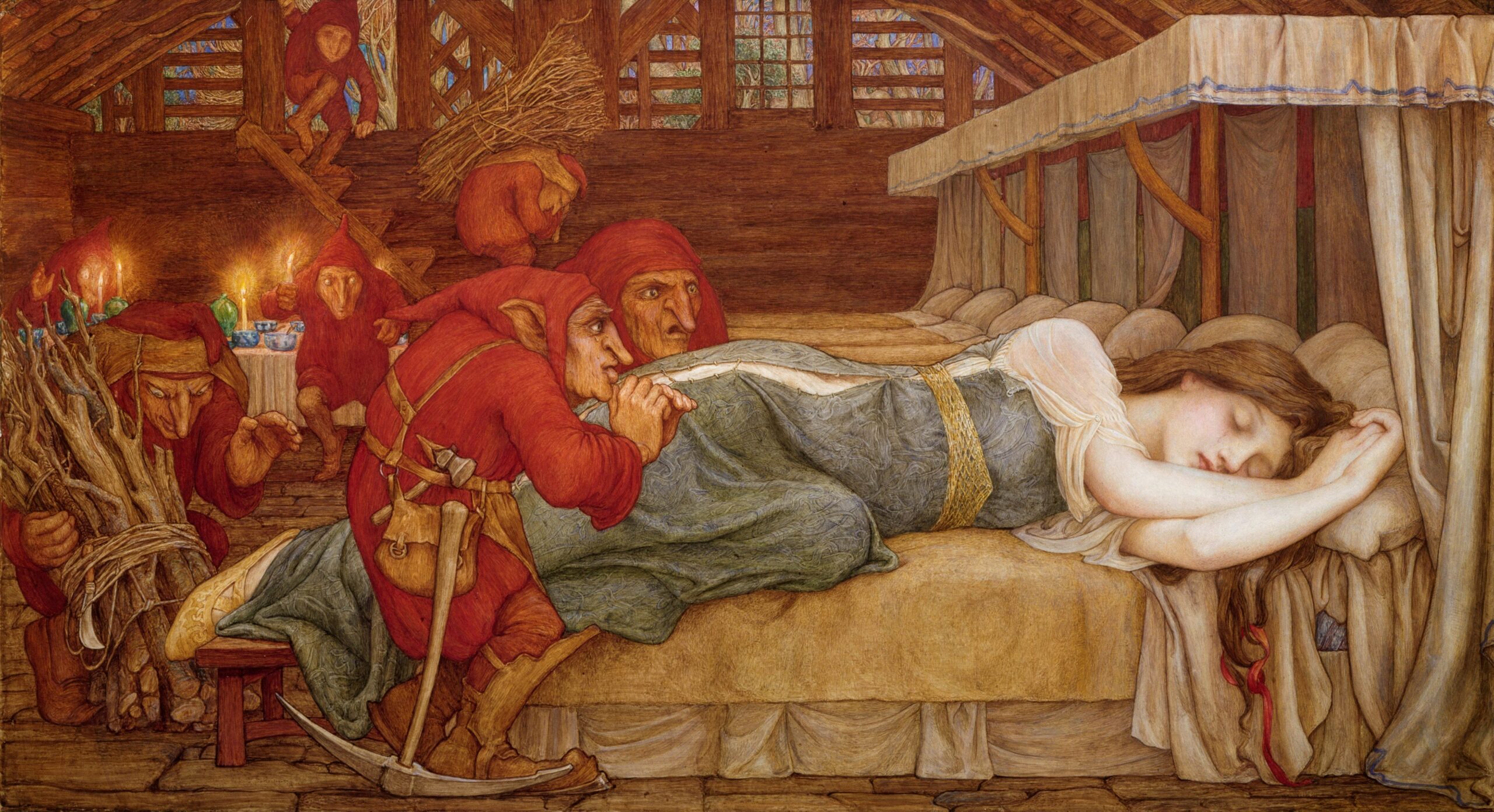
John Dickson Batten (1860–1932), Snowdrop and the Seven Little Men, 1897. Art Gallery of New South Wales, Sydney. Public domain
Identification and Punishment in Folktales
As we have seen, The Innkeeper’s Daughter also features the abuse within the family that I examined in the article on Afanasyev’s version. Here, a mother abuses her daughter out of envy (motifs L52, M312.4, S31), in particularly cruel scenes whose familiarity makes them all the more disturbing. One example is the moment when she locks the girl away and catches her braid in the door. The Russian version, however, has a more expansive aesthetic and narrative scope, encompassing adventure, epic action, humour and romance. Bertran’s version, by contrast, was collected among the farmsteads and villages around Montserrat. Its rural setting includes scenes that would have been recognisable to those who told and listened to it.
One possible interpretation draws on Bauman’s classic approach to oral storytelling as a communicative event involving storyteller, audience and context, in which a tale’s reception also depends on the circumstances of its telling (Bauman 1975). This idea is crucial to understanding how listeners may identify with characters in orally transmitted tales. The Catalan Snow White is not an aristocrat but an innkeeper’s daughter, just as her Russian counterpart is a merchant’s daughter. Both come from families engaged in trades and commerce. This does not necessarily mean that they are poor, but neither belongs to the aristocracy. Their connection to an everyday world might make it easier for some listeners to identify with them, including girls and young women from farming, artisan or trading families. The heroine’s lack of a personal name and her limited individual characterisation might also encourage such identification.
In another classic study, Lüthi examines the abstract style of the folktale and its tendency to avoid individualising detail. Even when protagonists have names, these are often generic or invented, such as Snow White, or familiar names in the language of the tale, such as Joan or María. Keen, approaching the question through written narrative, observes that empathy with characters can arise from minimal indications of identity, situation and feeling, without requiring elaborate characterisation or a complete match between character and reader. In other words, identification depends above all on what characters experience and the empathy those experiences evoke in listeners or readers, rather than on the specific details that distinguish them (Lüthi 1986, ch. 3, Keen 2006, pp. 213–214). Similar techniques for encouraging audience identification have subsequently been widely used by artists, including screenwriters and novelists.
We encounter one such everyday scene when the wicked mother uses appearances and deception to conceal her actions, locking the Catalan Snow White in the cellar and releasing her only when others discover her. We may assume that punishments of this kind were not commonplace, but unfortunately neither were they unknown. There are documented examples of children confined within the family home. We need not go back to the nineteenth century. In a 2012 article, the Galician journalist Xosé Carreira recalled the case of a disabled girl in Galicia who had spent nine years locked in a pigsty, a story that came to public attention in 1984 (Carreira 2012). In an urban setting, Luis Fernando Durán reported in 1995 on the rescue of five siblings, aged between three and twelve, who had spent four days locked in a Madrid flat (Durán 1995). Many similar cases exist elsewhere in Europe and on other continents. The grim punishments in The Innkeeper’s Daughter could therefore be entirely realistic, even if today they strike us as exaggerated or excessively cruel, as indeed they are.
As in the Russian version, the tale retains its use of contrast (Lüthi 1986, ch. 3). One example is the opposition between the robber who wants to abuse the girl and those who protect her. She forgives him because, as in the previous version, she does not succumb to cynicism or allow the evil in the world to destroy her inner equilibrium. The themes discussed in the first article on ATU 709 therefore remain relevant, and I refer readers back to that discussion.
Snow White Meets the Devil
One distinctive feature of this version is the directness of its supernatural element. This also relates to the setting in which Bertran collected the tale, the Catalan countryside. The Innkeeper’s Daughter is thus closely connected to widespread Catalan folk beliefs, including those concerning witchcraft and the Devil (Roma 2007, pp. 156–165). Such beliefs remained abundant in rural Catalonia until relatively recently, at least into the period following the Spanish Civil War. The mother does not consult a magic mirror, as in the Grimms’ version (motifs D1311.2, D1323.1, magic mirror). Instead, she makes a pact with the Devil, who acts through an old woman who has given herself to him. In other words, she serves the Devil and embodies the stereotype of the malevolent witch.
It is particularly interesting to consider how this character is constructed, the attributes associated with her and the way she acts. Her supernatural abilities, for example, include powers that Catalan and European folk culture attributed to the stereotypical witch. Both the wicked mother and the witch are burned, a form of execution commonly associated with witches in the nineteenth-century popular imagination, when this version was collected, although historical evidence suggests that in Catalonia they were more often hanged (Castell Granados 2013, pp. 210–213). More striking still is that the old woman knows everything before the mother tells her anything. She knows what the Devil knows. This shared knowledge allows us to interpret her as a figure closely bound to him. One might hypothesise that she has a demon, or the Devil himself, within her, seeing what he sees and knowing what he knows. Perhaps she is not entirely human, or is a demon inhabiting a physical body.
The Catalan expression donar-se al Diable, “to give oneself to the Devil”, is both clear and distinctive. Just as magical animals, hunters or dwarfs may act as Snow White’s helper spirits, as I discussed in relation to Afanasyev’s tale, the old woman may, depending on the version, be someone serving the wicked mother, stepmother or queen, or the antagonist herself in another guise. In other versions, the distinction is ambiguous, and both possibilities remain open. In The Innkeeper’s Daughter, the old woman who helps the wicked mother is someone who has sold her soul. She also presents herself as the mother’s servant, just as the protectors serve Snow White. Ambiguity is part of the construction of this stereotype. To outsiders who do not understand how a pact with the Devil works, it is uncertain whether the malevolent witch is a demon, a human being or both. For this and other reasons, folktales and legends often describe such witches as demons.
Another intriguing parallel appears in The Sorrowful Girl, collected by Apollon I. Shadaev in his Buryat-Mongol Folktales of 1950. In this version, the wicked shaman disguises himself as an old woman, kills the baby and smears the heroine’s mouth, nose and hands with blood. He then accuses her, before her father-in-law, of having eaten her child’s liver and kidneys. This accusation of cannibalism invites comparison with the mangus, a monster belonging to the sorcerer-demon tradition of Mongolian folklore (Shadaev 1950, pp. 42–49). Related motifs include smearing an innocent person with blood to accuse them of murder, K2155.1, accusing someone of killing their own children, K2116.1.1, and accusing them of eating their own children, K2116.1.1.1. The Catalan version contains a comparable motif, since the old witch says that she will use the heroine’s sword to kill the child and make his father believe that she has murdered him. I will return to these motifs when I present Siberian and Mongolian versions of Snow White in a forthcoming article.
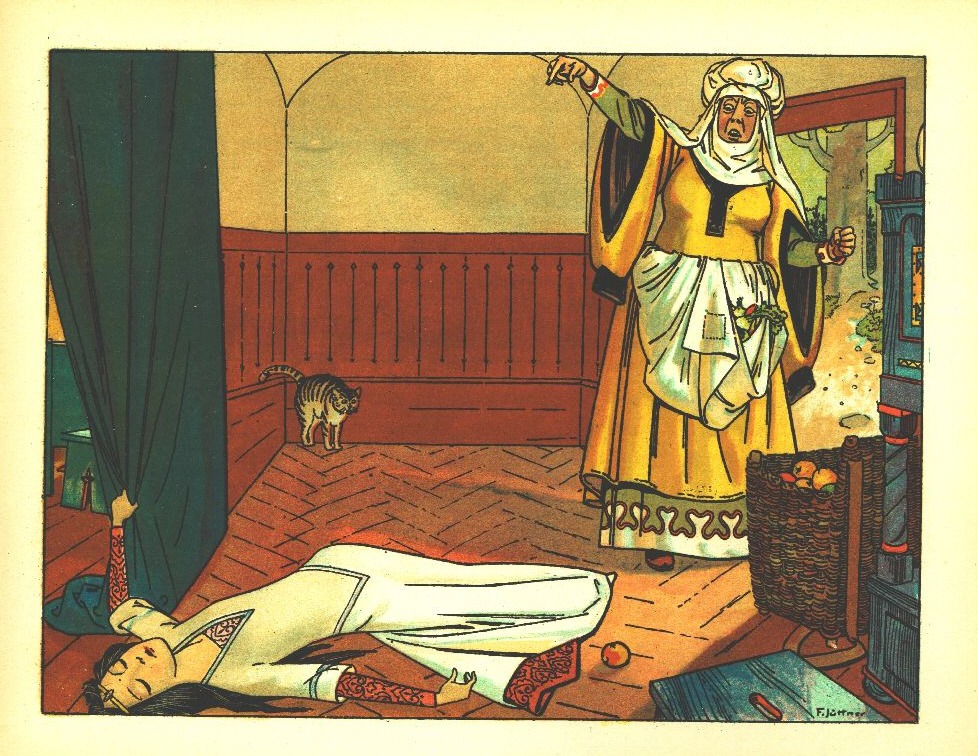
Snow White collapses after eating the poisoned apple. Illustration by Franz Jüttner (1865–1926) for Schneewittchen, c. 1905–1910. Public domain
Poisons, Sacrifices and Demons
As we saw in the previous article, the relationship between the heroine and her protectors involves an interesting form of reciprocity. They provide the laid table, she eats from their dishes and drinks from their barrel, and in exchange for food she puts the house in order. The robbers have the impression that someone comes and goes whenever and however they please. This may recall older European folk beliefs about spirits, benevolent or destructive, that enter through keyholes and consume food and drink from the pantry, beliefs associated with witchcraft. At the same time, the robbers protect her from the outside world without being able to prevent her “death”. The dwarfs in the Grimms’ version and the bogatyrs in Afanasyev’s protect her twice but fail on the third occasion. Here, there is only one attempt.
In most versions, an old witch is the character who poisons Snow White, a detail also linked to folk traditions about witches (Roma 2007, pp. 173–175). They were popularly believed to be capable of cursing through a glance, a touch or a caress, and above all by pricking someone with a poisoned needle or giving them a mal bocí, a poisoned morsel that might take the form of a sweet, a piece of fruit, a drink or something else. The objects used to poison the heroine of ATU 709 vary considerably between versions (Nassau 1904, pp. 337–346, Schmidt 2008). The most familiar are the laces, the comb and the apple (D1264.4.1), but others include bread, a blouse or other garments, venomous animals, sewing needles, hair ribbons and pins, and other magical or poisonous attacks. Some of these also occur in related tale types such as ATU 410, Sleeping Beauty.
Since remote antiquity, the use of poison has been associated with harmful witchcraft, in contrast to the healing and restorative practices of benevolent magic, with its compounds and recipes (Roma 2007, p. 156). In traditional narrative and the popular imagination, the relationship between a spell and a poison can also be ambiguous, since their effects are viewed from outside. Some tales and legends distinguish them clearly, although both are often associated with witches’ activities. Since antiquity, however, poison or medicine, phármakon, and the practice of administering such substances, pharmakeía, have been linked to the activities of both benevolent and malevolent witches. Greek vocabulary reflects this ambivalence. Phármakon can denote either a healing or a harmful substance, while pharmakeía can refer to the use of drugs, poisoning or witchcraft (Liddell, Scott and Jones 1940, entries “φάρμακον” and “φαρμακεία”).
In some folktales, poison is the means by which a curse is inflicted. In Bertran’s version, however, enchanted slippers induce the spell of magical sleep (Bertran i Bros 1989, Coelho 1879, pp. 84–85), motif S111.7, found in tales from across the world, including Portuguese versions of ATU 709. Some tales specify that garments such as enchanted shoes or shirts contain poisoned needles, amulets, inscriptions or other magical objects used to cast a curse. In versions whose resolution depends on these devices, Snow White returns to life when the poisonous object is removed or when she is given the “water of life”, which acts as a kind of antidote (E21, here E21.4). In this tale, she revives when the slippers enchanted through harmful witchcraft are removed.
Another motif of interest is the sacrifice of an animal before Snow White’s descent or journey into the liminal world where she encounters her protecting spirits. The classic Grimms’ version, like Afanasyev’s and others, includes the motif of compassionate substitution, K512.2, also found in tale types such as ATU 671, The Three Languages. Here, that motif is absent, replaced by another that appears in tales belonging to the very old type ATU 327, The Children and the Ogre, or ATU 700, Tom Thumb. In these tales, parents abandon their children in the forest to die (motifs S321, S322.2, S143). Such episodes are characteristic of tales about abandoned children, including Hansel and Gretel, and reflect a cruel historical reality.
Portuguese and African Parallels
A particularly close parallel to The Innkeeper’s Daughter, with a remarkably similar structure and details despite being much shorter, is Os sapatinhos encantados, published by the philologist and folklorist Adolfo Coelho (1847–1919), one of Portugal’s most important scholars in the field, in Contos populares portuguezes in 1879. It too features an innkeeper who envies her daughter’s beauty, the girl’s initial confinement, robbers who take her in as their sister, and an old woman who brings her shoes sent by her mother. When the girl puts them on, the text includes a striking detail absent from the Catalan version, “calçou um, fechou-se um olho”, “she put on one shoe, and one eye closed”. The second shoe closes her other eye, and she falls down apparently dead. The king’s son awakens her by removing the shoes, whereas in Bertran’s tale it is the maids who remove the slippers. It is worth including the whole tale so that readers can compare the two.
The Enchanted Little Shoes
Once upon a time, there was a very beautiful woman who kept an inn. She asked every muleteer who came there whether he had ever seen a woman more beautiful than she was. She had an even more beautiful daughter, whom she kept locked away so that no one would see her. One day, a muleteer said to her,
“Just now I saw a more beautiful woman over there, combing her hair at the window.”
“Oh! That was my daughter. Then I shall have her killed.”
She sent two servants to kill the girl in the mountains, but the girl begged them to spare her and let her go, promising never to return home. The servants took pity on her and set her free. She kept walking until she reached a mountain range and saw a house. It was night. She called out to ask for shelter but found no one there. She went inside and prepared supper. As soon as it was ready, she hid. Then some robbers returned from a robbery and, seeing the supper laid out, began to say,
“Oh, if only someone could tell us who made this supper! If anyone is here, come out.”
She came out of her hiding place and told them of her misfortune, poor girl. They said,
“Do not worry now. You shall stay with us, and we will treat you as our sister.”
From then on, the robbers went out to steal while she stayed at home. They loved her dearly and looked after her.
An old woman who ran errands in many places visited the girl’s mother, who said to her,
“You travel to so many places. Tell me, have you ever seen a face more beautiful than mine?”
“Yes. In a certain place, I have seen a girl even more beautiful than you.”
“When will you go back there? I want you to take her some shoes.”
She gave the old woman a pair of shoes and said,
“Take these to her and tell her that her mother sent them. But make sure she puts them on before you leave. I want to know for certain that she wears them. I will pay you well.”
The woman took the shoes to the daughter. When she arrived, she said,
“Here are some shoes your mother has sent you.”
“I do not want any shoes. My brothers give me as many as I want. I do not want them.”
The old woman insisted so much that the girl took them. She put on one shoe, and one eye closed. She put on the other, her other eye closed, and she fell down dead. When the robbers returned, they wept over her, mourned her death bitterly and said,
“This face must not be buried. Let us carry her in a coffin to the mountain where the king’s son goes hunting, so that he may see this flower.”
They carried her there. The king’s son came, saw her and thought her very beautiful. He took off one shoe, and she opened one eye. He took off the other, she opened her other eye and returned to life. Then he took her home and married her. They went to visit her drunken mother, who still wanted to have her killed, but did not succeed.
(Ourilhe.)
(Coelho 1879, tale XXXV, “Os sapatinhos encantados”, pp. 84–85.)
In The Beautiful Daughter, published by the missionary and physician Robert Hamill Nassau (1835–1921) in his 1904 study Fetichism in West Africa, an envious mother likewise attempts to get rid of her daughter, who finds refuge in a robbers’ house. An old woman serving the mother drives a nail into the girl’s head while arranging her hair, returning us to the theme of needles and other sharp objects that may be poisoned. Although the tale does not specify that the nail is poisoned, another girl later removes it, and the heroine awakens saying, “Oh, I must have been asleep for a very long time.” Whether or not it is poisoned, the nail is at least the cause of her apparent death.
Nassau suggests Portuguese influence (Nassau 1904, pp. 337–346, passage on p. 344). In his preface, he explains that many of the tales in chapters XVI and XVII came from Batanga and Mpongwe informants, peoples who now live in Gabon, Cameroon and Equatorial Guinea. He does not, however, attribute The Beautiful Daughter to a specific people (Nassau 1904, p. xi, Horner 1998, pp. 486–487). In the abstract of Snow White in Africa, Sigrid Schmidt distinguishes three groups of ATU 709 versions, including “versions similar to oral Portuguese traditions in former Portuguese colonies”. She also identifies Arabic versions in North and East Africa and, in Namibia, combinations of Grimm-derived texts with southern European oral traditions. This framework places the comparison within a history of circulation and adaptation involving traditions that may already have existed on the continent and those introduced by Europeans (Schmidt 2008).
Taken as a whole, The Innkeeper’s Daughter, particularly its opening section, offers an intriguing combination of everyday life, realistic depictions of local customs and narrative elements that bring witchcraft and the supernatural close to home. The witch-demon is not a remote or inaccessible spirit, but another village neighbour who pretends to be friendly, approachable and kind. Part of the action unfolds in an ordinary domestic setting before moving to the royal court. This is one of the qualities that reveals the distinctly Catalan character of the folktales, legends, anecdotes and traditions collected by Pau Bertran, whose work has never received the recognition it deserves and remains relatively little known today.
© Arnau Folch / Llegendàrium. This article may be shared by linking to the original publication. Reproduction, translation, adaptation or distribution in full is not permitted without prior authorisation.
