


Snow White. Afanasyev’s Russian Version of The Magic Mirror (ATU 709) — Fairy Tales III

Aleksandr Mikhailovich Kurkin (1916–2003), a Palekh-style illustration of The Magic Mirror, published on a postcard in 1970.
The main scene depicts the banquet at which the disguised heroine, on the left, reveals that she is the prince’s wife after recounting the persecution she has suffered and striking her attackers with a ladle when they interrupt her.
Snow White is one of the world’s best-known fairy tales, thanks to its film adaptations, particularly Disney’s 1937 version. This series of articles on tale type ATU 709 introduces much less familiar versions, revealing fascinating narrative features absent from the most widely known telling, along with distinctive folkloric motifs that may point to ancient traditions and beliefs. This first article presents one of the two versions of Snow White included in Russian Folktales, the monumental collection assembled by the great folklorist Aleksandr Afanasyev (1826–1871). First published in eight instalments between 1855 and 1863, the collection brought together hundreds of different tales, while many others remained unpublished. Afanasyev gave the two Snow White tales, numbered 210 and 211, the shared title The Magic Mirror.
Tale 210 is notable for having been collected in the district of Novogrudok, in western Belarus, by one of Afanasyev’s collaborators, M. A. Dmitriev, who sent him ten tales from the region. It preserves dialect features and offers a narrative close to the best-known version, with some interesting variations. Tale 211, by contrast, combines the Snow White episode with further adventures involving persecution, slander and recognition, almost as though another tale begins where the first ends. Its motifs and cultural features are distinctly Russian and, more broadly, Slavic. It is an excellent example of the narrative possibilities of this tale type, and it is the version you can read below (Afanasyev 1985, nos. 210–211, with Barag and Novikov’s notes on the corresponding tales). As in the other articles on folktales and legends, the story is followed by contextual notes and possible interpretations of some of its motifs and themes.
The Magic Mirror
In a faraway kingdom, in a distant land, there lived a widowed merchant. He had a son, a daughter and a brother. One day, the merchant prepared to travel abroad to buy all kinds of goods. He took his son with him and left his daughter at home. Calling his brother, he said, “Dear brother, I entrust my entire household and estate to you. I ask you earnestly to keep a close watch over my daughter, teach her to read and write, and let her have no foolish whims!” Then the merchant said goodbye to his brother and daughter and set off on his journey.
The merchant’s daughter was already grown, and so extraordinarily beautiful that you could have travelled the whole world without finding her equal. An evil thought entered her uncle’s mind and gave him no peace, day or night. He began to harass the beautiful maiden. “Either you commit this sin with me,” he told her, “or you shall not live. I may bring ruin on myself, but I will kill you!” One day, the maiden went to the bathhouse, and her uncle followed her. As soon as he crossed the threshold, she seized a basin of boiling water and drenched him from head to foot. He spent three weeks in bed, badly burned, and barely recovered. Terrible hatred gnawed at his heart, and he began to devise a way to avenge his humiliation. After much thought, he wrote a letter to his brother. “Your daughter practises the evil arts [harmful witchcraft]. She wanders through other people’s yards at night, never sleeps at home and pays no heed to me.”
When the merchant received the letter, he read it and flew into a rage. “Look how your sister has disgraced our whole household!” he told his son. “I will show her no mercy. Return at once, cut the wretch into little pieces and bring me her heart on the point of this knife. We must not let decent people mock our family!” His son took the sharp knife and set off for home.
He arrived secretly in his home town, without telling anyone, and began asking around about his sister’s life. Everyone praised her with one voice. They said she was quiet, modest and God-fearing, and listened to the advice of good people. Once he had learned all this, he went to see her. She was overjoyed, ran to greet him, embraced him and kissed him. “My dear brother! What has brought you here, by God’s grace? How is our dear father?” “Ah, dear sister, do not be so quick to rejoice. My arrival brings no good news. Father sent me. He ordered me to cut your fair body into little pieces, take out your heart and bring it to him on the point of this knife.” His sister began to weep. “My God,” she said, “why must I suffer such misfortune?” “This is why,” her brother replied, and told her what their uncle had written. “Oh, brother, I have done nothing wrong!” The merchant’s son listened to her account of what had happened. “Do not cry, sister,” he said. “I know you are innocent. Although Father ordered me to accept no excuses, I will not put you to death. Gather your belongings and go wherever your eyes lead you. God will not abandon you!”
The merchant’s daughter wasted no time. She prepared for the journey, said goodbye to her brother and left. Where was she going? She did not know herself. Meanwhile, her brother killed one of the household dogs, took out its heart, put it on the point of the sharp knife and carried it to his father. He handed over the dog’s heart. “I have put my sister to death,” he said, “as you commanded.” “Very good! A bitch deserves a bitch’s death!” his father replied.
Whether she travelled far or not so far, the beautiful maiden wandered through the world until she entered a dense, impenetrable forest. The trees were so tall that she could scarcely see the sky. She walked on through the forest and happened upon a large clearing. In the clearing stood a palace of white stone, surrounded by an iron fence. “I shall go inside,” the maiden thought. “Not everyone is wicked. Perhaps no harm will come to me!” She entered the chambers, but there was not a soul in any of the halls. Just as she was about to turn back, two bogatyrs [mighty heroic warriors of legend] suddenly rode into the courtyard. “Look,” said one, “we were lamenting that we had no one to keep house for us, and God has sent us a sister.” The warriors invited the merchant’s daughter to live with them, called her their little sister, gave her the keys and made her mistress of the household. Then they drew their sharp sabres, pointed them at one another’s chests and swore a solemn oath. “If either of us dares to take liberties with our little sister, he shall be run through without mercy with this very sabre.”
So the beautiful maiden lived with the two warriors. Meanwhile, her father bought his goods overseas, returned home and soon married another woman. The merchant’s new wife was indescribably beautiful and owned a magic mirror. Whoever looked into it could immediately see what was happening everywhere. One day, as the warriors prepared to go hunting, they warned their sister, “Listen, let no one into the house until we return!” They said goodbye and left. At that very moment, the stepmother looked into her mirror, admired her own beauty and said, “There is no one in the world more beautiful than I am!” The mirror answered, “You are beautiful, without a doubt. But you have a stepdaughter who lives with two bogatyrs in a dense forest, and she is more beautiful still!” The stepmother was furious at these words and immediately summoned an old woman who bore a grudge against the world. “Take this ring,” she told her. “Go into the dense forest, where my stepdaughter lives in a palace of white stone. Give her my greetings and this ring. Tell her that her brother sends it as a keepsake!”
The old woman, who hated the world, took the ring and went where she had been told. When she reached the white stone palace, the beautiful maiden saw her and ran to greet her, eager for news of her homeland. “Hello, Granny! What has brought you here, by God’s grace? Is everyone safe and well?” “They are alive and have bread to eat! Your brother asked me to enquire after your health and sent you this ring as a gift. Here, wear it!” The maiden’s joy was beyond words. She invited the old woman inside, offered her every kind of food and drink, and asked her to give her brother her warmest greetings. An hour later, the old woman left, snorting with hatred and disgust. The maiden began admiring the ring and decided to slip it onto her finger. The moment she did, she fell dead to the floor.
The two warriors returned and entered the palace, but their little sister did not come to greet them. What had happened? They looked into her bedchamber and found her lying there, dead and silent. The warriors were overcome with grief. She was the most beautiful creature they had ever seen, and death had taken her without warning. “We must dress her in new clothes,” they said, “and lay her in a coffin.” As they began to dress her, one of them noticed the ring on her hand. “Should we really bury her with this ring? I had better remove it and keep it as a remembrance.” The instant he took it off, the beautiful maiden opened her eyes, drew a breath and came back to life. “What happened to you, sister? Did someone come to see you?” the bogatyrs asked. “An old woman I know from my homeland came and brought me a ring.” “Ah! We warned you for good reason not to let anyone in while we were away. See that it does not happen again!”
Some time later, the stepmother looked into her mirror and discovered that her stepdaughter was still alive and as lovely as ever. She called the old woman, gave her a ribbon to wear around the neck and said, “Go to the white stone palace where my stepdaughter lives and give her this gift. Tell her that her brother sent it!” Once again, the old woman went to see the beautiful maiden, told her all kinds of stories and gave her the ribbon. The maiden was delighted, tied it around her neck and immediately fell dead on her bed. The warriors returned from their long hunt, found their sister dead and began dressing her in new clothes. As soon as they removed the ribbon, she opened her eyes, drew a breath and came back to life. “What is the matter with you, sister? Has the old woman been here again?” “Yes,” she said. “The little old woman from my homeland came and brought me a ribbon.” “What can you have been thinking? We told you not to receive anyone while we were away!” “Forgive me, dear brothers! I could not resist. I wanted to hear news of home.”
A few more days passed. The stepmother looked into her mirror and asked who was the most beautiful, only to discover that her stepdaughter was alive again. She called the old woman. “Take this strand of hair,” she said. “Go to my stepdaughter and make certain you kill her!” The old woman waited until the bogatyrs had gone hunting, then went to the palace of white stone. The beautiful maiden saw her through the window and, unable to resist, ran to greet her. “Hello, Granny! How is life treating you?” “At least I am alive, my dear! I have been travelling the world and came this way to visit you.” The maiden invited her into the palace, offered her every kind of food and drink, asked about her family and sent greetings to her brother. “Very well,” said the old woman, “I shall pass them on. But surely, my dear, you have no one to pick the lice out of your hair? Let me have a look.” “Have a look, Granny!” The old woman began searching through her hair and wove a magical strand into her braid. The moment she did, the maiden fell dead. The old woman smiled maliciously and hurried away before anyone could find or see her.
The warriors returned to the palace and found their sister dead on the floor. They examined her again and again, looking for anything that should not have been there, but could find nothing. Then they made a crystal coffin so wondrous that it could neither be imagined nor described, only told of in fairy tales. They dressed the merchant’s daughter in a splendid gown, like a bride on her way to the altar, and laid her in the crystal coffin. They placed it in the middle of a great hall, beneath a canopy of red velvet adorned with diamonds and bands of gold, and hung twelve lamps from twelve crystal columns. Then the warriors wept bitter tears. A terrible sadness overcame them. “Why should we go on living in this world?” they said. “Let us end our lives!” They embraced, said farewell, went out onto a high balcony, took one another’s hands and threw themselves down. They struck the sharp rocks below and ended their lives.
Many, many years passed. One day, a prince went hunting. He entered the dense forest, sent his hounds off in different directions, parted from his huntsmen and rode alone along a path choked with undergrowth. He rode on and on until, before him, there appeared the clearing and the palace of white stone. The prince dismounted, climbed the steps and began exploring the chambers. Everywhere he saw rich and sumptuous furnishings, but no sign that anyone had cared for them. Everything had long been abandoned and neglected. In a great hall stood the crystal coffin, and inside it lay a dead maiden of more than human beauty. Her cheeks were rosy and a smile rested on her lips, just as though she were alive and sleeping. The prince approached, gazed at her and stood rooted to the spot, as if an invisible force held him there. He remained from morning until late at night, unable to take his eyes off her, his heart filled with sorrow. The huntsmen began searching for him through the forest and calling out loudly, but the prince stood beside the crystal coffin and heard nothing. The sun set and darkness deepened, and only then did he come to himself. He kissed the dead maiden and went home. “Your Highness, where were you?” the huntsmen asked. “I was chasing an animal and lost my way for a while.”
At dawn the next day, the prince was already preparing for the hunt. He rode into the forest, parted from the huntsmen and followed the same path to the palace of white stone. Once again, he stood all day beside the crystal coffin, never taking his eyes off the dead beauty. He returned home only late at night. The third day was the same, and the fourth, until a whole week had passed. “What can be the matter with our prince?” the huntsmen wondered. “Brothers, let us follow him and keep watch, lest some harm come to him.” The next day, they went hunting and secretly followed the prince to the white stone palace. They entered the hall and stood astonished. The prince saw them and said, “Look, brothers! Now none of us will be able to leave before evening.” They gathered around the crystal coffin, gazing at the maiden and marvelling at her beauty, and remained in the same place from morning until late at night, without moving or speaking.
When darkness had fully fallen, the prince turned to the huntsmen. “Do me a great service, brothers. Take the coffin with the dead maiden, carry it home and place it in my bedchamber. But do it secretly, so that no one knows or discovers anything. I shall reward you in every way and make you richer in gold than anyone has ever made you before.” “Whether you reward us is your choice, Prince,” the huntsmen replied, “but we are happy to serve you all the same!” They lifted the crystal coffin, carried it into the courtyard, loaded it onto the horses and took it to the royal palace, where they placed it in the prince’s bedchamber. From that day on, he gave no thought to hunting. He stayed at home, never left his room and did nothing but gaze at the maiden. “What has happened to our son?” the queen wondered. “He has been staying at home for so long, never leaving his room or allowing anyone inside. Has some great sorrow overcome him, or has he fallen ill? I shall go and see him.” The queen entered the bedchamber and saw the crystal coffin. What was this? She questioned him until she learned what had happened, then immediately ordered that the maiden be properly buried, according to custom, in Mother Earth.
The prince began to weep. He went into the garden, picked some beautiful flowers and brought them back. He began combing the dead beauty’s long braid and adorning her head with a wreath of flowers. Suddenly, the magical strand of hair fell out of her braid. The maiden opened her eyes, drew a breath, rose from the crystal coffin and said, “Oh, how long I have slept!” The prince’s joy was beyond words. He took her by the hand and brought her to his father and mother. “God has given her to me!” he said. “I cannot live without her for a single moment. Dear Father, dear Mother, give me your permission to marry her.” “Marry her, my son! We shall not oppose God’s will, and such beauty is nowhere else to be found!” Nothing ever stands in the way of kings. That very day, they held a magnificent feast and a grand wedding. The prince married the merchant’s daughter and lived joyfully with her.
Some time passed, and she began to long to visit her homeland, her father and her brother. The prince had no objection and asked his father’s permission. “Very well,” said the king. “Go, my dear children! You, Prince, shall travel overland and take the opportunity to inspect all our territories and see how they are governed. Your wife shall take the direct route by ship.” They prepared the ship for the voyage, assembled the sailors and appointed a general to command them. The princess boarded and sailed out to sea, while the prince set off overland. When the general saw the beautiful princess, he was seized with desire and began making advances to her. What had he to fear, he thought, now that she was in his power and he could do as he pleased? “Love me,” he told her. “If you do not, I shall throw you into the sea!” The princess turned away, answered nothing and only wept.
A young sailor overheard the general’s words. That evening, he went to the princess and said, “Do not cry, Princess! Put on my clothes, and I shall put on yours. You go up on deck, and I shall stay in the cabin. Let the general throw me into the sea. I am not afraid of the water. Perhaps I can swim to the harbour. Luckily, the shore is near!” They exchanged clothes. The princess went on deck, and the sailor lay in her bed and covered himself. That night, the general entered the cabin, seized the sailor and threw him into the sea. The sailor began swimming, and by morning he had reached the shore. The ship arrived in harbour, and the sailors began going ashore. The princess went ashore too, hurried to the market, bought some clothes and disguised herself as a kitchen boy. Then she hired herself out to work in her own father’s kitchen.
Soon afterwards, the prince arrived at the merchant’s house. “Greetings, Father!” he said. “Welcome your son-in-law, for I am married to your daughter. But where is she? Has she not arrived yet?” Just then, the general appeared with a report. “Your Highness, a terrible misfortune has occurred! The princess was on deck when a storm arose. The ship began to pitch, and before we could even blink, she fell into the sea and drowned!” The prince grieved and wept, but no one could be brought back from the depths of the sea. Such, it seemed, was her fate. He stayed for some time at his father-in-law’s house, then ordered his retinue to prepare for departure. The merchant gave a great farewell banquet. Merchants, boyars and all his relatives gathered at his house. His brother, the stepmother, the wicked old woman and the general were there too.
As they drank and made merry, the prince suggested, “Gentlemen, let us hear some stories or tales of the kind people tell to while away a journey. Whoever knows a tale or a true story, let him tell it!” “Yes, yes!” they shouted from all sides. “Who will begin?” One man knew none, another had no gift for telling them, and a third had drunk away his memory. What were they to do? Then the merchant’s servant spoke up. “We have a new kitchen boy who has travelled widely in foreign lands and tells stories very well.” The prince ordered him to be summoned. The kitchen boy appeared and asked, “What would you like me to tell you, a tale or a true story?” “Tell us a true story!” “Very well, I can tell a true story, but on one condition. Anyone who interrupts me will receive a blow on the forehead with my ladle.” “Agreed!”
The princess began telling her story. “Once upon a time, there was a merchant who had a son and a daughter. The merchant travelled abroad on business and entrusted his daughter to his brother’s care. The uncle coveted her beauty and would not give her a moment’s peace…” Hearing that the story was about him, the uncle said, “Gentlemen, this is a lie!” “Oh, you think it is a lie? Then take a blow on the forehead with my ladle!” The story went on to the stepmother, her questions to the magic mirror and the wicked old woman’s visits to the warriors in the white stone palace. The old woman and the stepmother cried out together, “What nonsense! That cannot be true!” The princess struck them on the forehead with her ladle and continued, telling how she had lain in the crystal coffin, how the prince had found her, restored her to life and married her, and how she had set out to visit her father.
The general realised that things were going badly for him and asked the prince, “Allow me to go home. My head aches!” “Never mind, stay a little longer!” The princess began speaking about the general, and he too could no longer contain himself. “It is all lies and slander!” he declared. The princess struck him on the forehead with her ladle, took off the kitchen boy’s clothes and revealed herself to the prince. “I am no kitchen boy. I am your wife!” The prince was overjoyed, and so was the merchant. They rushed to embrace and kiss her. Then justice was done.
The wicked old woman and the uncle were shot at the city gates. The stepmother was tied to a stallion’s legs. The stallion galloped into the open countryside and scattered her bones through the bushes and ravines. The prince sentenced the general to exile and forced labour, and appointed in his place the honourable young sailor who had saved the princess from danger. From then on, the prince, his wife and the merchant lived together for many years in great happiness.
(Afanasyev 1985, no. 211. See also Afanasyev 2005, pp. 69–78)
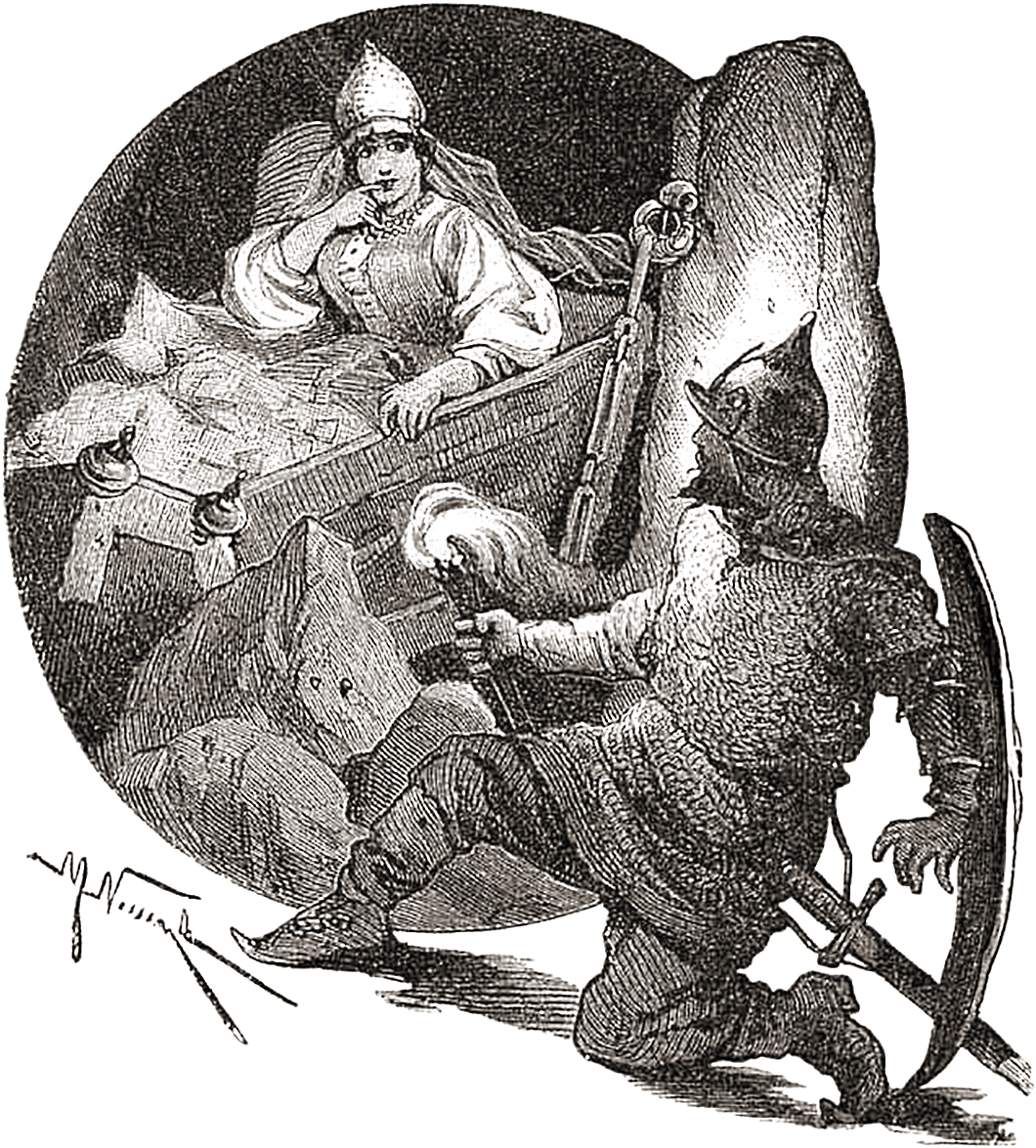
Mikhail Nesterov (1862–1942), illustration for Aleksandr Pushkin’s The Tale of the Dead Princess and the Seven Bogatyrs, published in 1889. The princess awakens before Prince Yelisey, who has found her in a coffin suspended inside a cave. Public domain.
Snow White as a Tale of Warning and Hope
Snow White can be read along three broad lines, with substantial differences between versions. The first is its cautionary dimension, depicting the violence a young woman may suffer and the people responsible, often within her immediate circle. The second is to offer encouragement and hope to those listening, suggesting that even a life of great hardship can end in triumph. The third is moral education, achieved here through narrative contrasts. I discuss the first two below. The third requires a fuller treatment and will be addressed later.
As regards the first, folktale protagonists are frequently subjected to abuse and exploitation. The relationship between social inequality, marginalisation and personal difficulties, reworked through the narrative imagination, is a recurrent concern of traditional tales (Zipes 2002, Zipes 2012, ch. 5). As we have seen in The Magic Mirror, such distressing circumstances can enter stories that echo everyday experience. For example, as I discussed in Rondalles de Sang, young Pere Xic must work far from his family, alone and unprotected, under a wealthy master’s tyrannical rule. The tale warned young men of the dangers of working on farmsteads far from their families. In Pere Xic’s case, his family’s poverty leaves him no choice. The story readily invites comparison with the experiences of workers past and present. Exploitation, poverty, hunger, loneliness and abandonment are universal experiences that can bring us closer to narratives from other periods. In Snow White, at least in the version presented here, these painful experiences primarily involve abuse within the family.
In wonder tales, the aggressor is sometimes represented metaphorically, in an expressionistic form, as an ogre, a witch or another monster. This gives outward form to an inner reality. At other times, as in The Magic Mirror, the aggressors are ordinary people of flesh and blood. Here we encounter the uncle’s sexual harassment, the father’s hasty judgement and violence, and the stepmother’s obsessive persecution. All these acts take place within the family, another recurrent theme in folktales. Examples include the abandonment of the children in Little Thumb and Hansel and Gretel, or the mistreatment of Cinderella by her stepmother and stepsisters. Such experiences recur because, like abuse in the workplace, they are familiar features of everyday life, especially in periods when protection for children and workers was limited or virtually nonexistent. Vast class inequalities, scarce resources, social marginalisation and isolation could, and still can, increase children’s vulnerability. Expulsion from home or the loss of parents also frequently leaves protagonists exposed to people who wish to exploit them (Tatar 2019, ch. 1).
The second line of interpretation concerns the hope offered by tales such as The Magic Mirror, even as they condemn abuse and wrongdoing. Many wonder tales, however dark and painful, offer eventual redress or restore the order disrupted by the villains’ actions. This does not mean that they encourage resignation on the grounds that everything will turn out well. On the contrary, protagonists such as Snow White tend to take the initiative, make decisions and confront difficulties, either alone or with help from others. They are not passive figures who simply wait for a happy outcome. Nor does this mean that every folktale ends well or shares the same moral outlook. Nevertheless, the restoration of balance is relatively common (Röhrich 1991, chs. II and VI, Tolkien 1964, “On Fairy-stories”). One function tales can serve is to warn of danger and help listeners recognise violence within a controlled, safe setting. They portray harmful experiences and wicked people so that young listeners can learn to recognise them, escape them or confront them should the need arise. One example is the heroine throwing boiling water over her uncle. Folktales encourage listeners to imagine ways of resisting or overcoming life’s difficulties.
Wonder tales are not simply violent horror stories, as they are often marketed today or portrayed on social media. Quite the reverse. They acknowledge suffering while imagining a way out of it. This does not require us to overlook their disturbing aspects or harsh punishments, since hope and cruelty can coexist within a single narrative, just as they do in life (Tatar 2019, ch. 1). Significantly, Snow White triumphs while retaining her faith in people and in goodness. Her victory is therefore not merely external, expressed through social advancement, the punishment of the villains and the overcoming of obstacles and abuse. It can also be read as an allegory of a more important victory. The villains cannot corrupt the heroine from within or rob her of what makes her good and innocent. They cannot make her like themselves. Perhaps this is the tale’s most important lesson.
Comparison and Allegory as Narrative Techniques
Not all folktales were conceived to educate children and adolescents, although at certain points in their transmission they came to serve that purpose. Traditional storytelling also addressed adult audiences and provided entertainment, opportunities for social interaction and criticism. Its adaptation for children has a history of its own (Warner 2018, ch. 5). An educational reading remains possible, however (Tatar 2019, chs. 1–2, Zipes 2002). When tales fulfil this didactic function, we should remember that they were generally told to the young by grandparents who had probably experienced such situations themselves and cared deeply for their listeners. They wanted to teach them what might happen and what they could do.
This brings us to the third narrative dimension of the Russian version of Snow White. It criticises harmful traits while praising positive qualities such as courage, resilience, intelligence and kindness. Comparison is a common technique in folktales throughout the world and has been used since antiquity. We find it, for example, in many of Aesop’s fables, dating as far back as the seventh and sixth centuries BCE. The technique may well reach back to prehistoric oral storytelling. It is an economical way of telling a story, conveying meaning through action rather than explanation, and is highly effective in the hands of a skilled storyteller. It also reflects life itself. Anyone can identify with these traits or recognise them in others, perhaps finding both good and bad qualities in the same person.
Comparison invites self-examination. Contrasting good and bad moral qualities does more than point to other people, as discussed above. Its function is not solely cautionary, since it also directs listeners’ attention inwards. They are invited to reject the traits their community regards as harmful to its functioning, and to embrace or strengthen those it considers beneficial. Thus selfishness, obsession and deceit are set against generosity, intelligence and truth. Societies around the world have relied on these virtues, or tried with varying success to promote them, in order to function without collapsing. Here they appear in an idealised form, sharply defined and without nuance, because they serve an educational purpose (Lüthi 1986, ch. 3).
The most prominent contrasts in the Russian version of Snow White are the following.
- The father’s impulsive, violent and hot-headed behaviour, condemning his daughter without hearing her, contrasts with the brother’s thoughtful approach, asking both the neighbours and the young woman herself.
- The uncle’s and the general’s repugnant desire to force themselves sexually upon the heroine contrasts with the conduct of the two bogatyrs and the young sailor, who protect and respect her without expecting anything in return.
- The murderous old woman’s hatred and cruelty contrast with the heroine’s kindness, generosity and capacity for forgiveness.
- The stepmother’s envy and manipulation, her obsessive resentment of Snow White’s very existence, which constantly reminds her of what she herself is, contrast with the young woman’s trust and goodness.
Another interesting idea in the Russian version is that goodness or evil can come from anyone, regardless of social class or personal circumstances. Good characters come from humble backgrounds, like the young sailor who must live aboard a ship, and from higher social ranks, like the two bogatyrs who inhabit a magnificent palace. Some villains hold prestigious positions or belong to the upper classes, like the general. Others are unremarkable figures from everyday life, like the uncle or the old woman. The tale teaches that neither rank nor class determines a person’s character. Goodness and wickedness can be found in people of every kind. The warning that appearances cannot be trusted is a familiar lesson in folktales. One of its clearest and most literal expressions is the wolf dressed as the grandmother in Little Red Riding Hood.
The Magic Mirror repeatedly emphasises the villains’ use of manipulation and social disguise. The murderous old woman presents herself as an endearing, kindly figure. The stepmother uses lies and manipulation to achieve her aims. The general may appear respectable, and the uncle lies in his letter, yet both give way to their ugliest impulses. Conversely, one might expect a young sailor to desire the heroine, or the two bogatyrs, fierce warriors accustomed to violence, to mistreat her. Instead, they do precisely the opposite. Those who might be most violent, the soldiers and warriors, show her the greatest kindness. The lesson is that people should be judged by their actions alone, rather than their appearance, what others say about them or the image they wish to project.
All this gives The Magic Mirror a moral complexity beneath its apparently simple structure. The heroine is initially trusting and vulnerable, but she also acts, resists, tells her own story and helps bring the truth to light. She matures along the way and ends in a very different personal position from where she began, without losing her defining qualities. Like the tale’s listeners, she has learned its lessons.
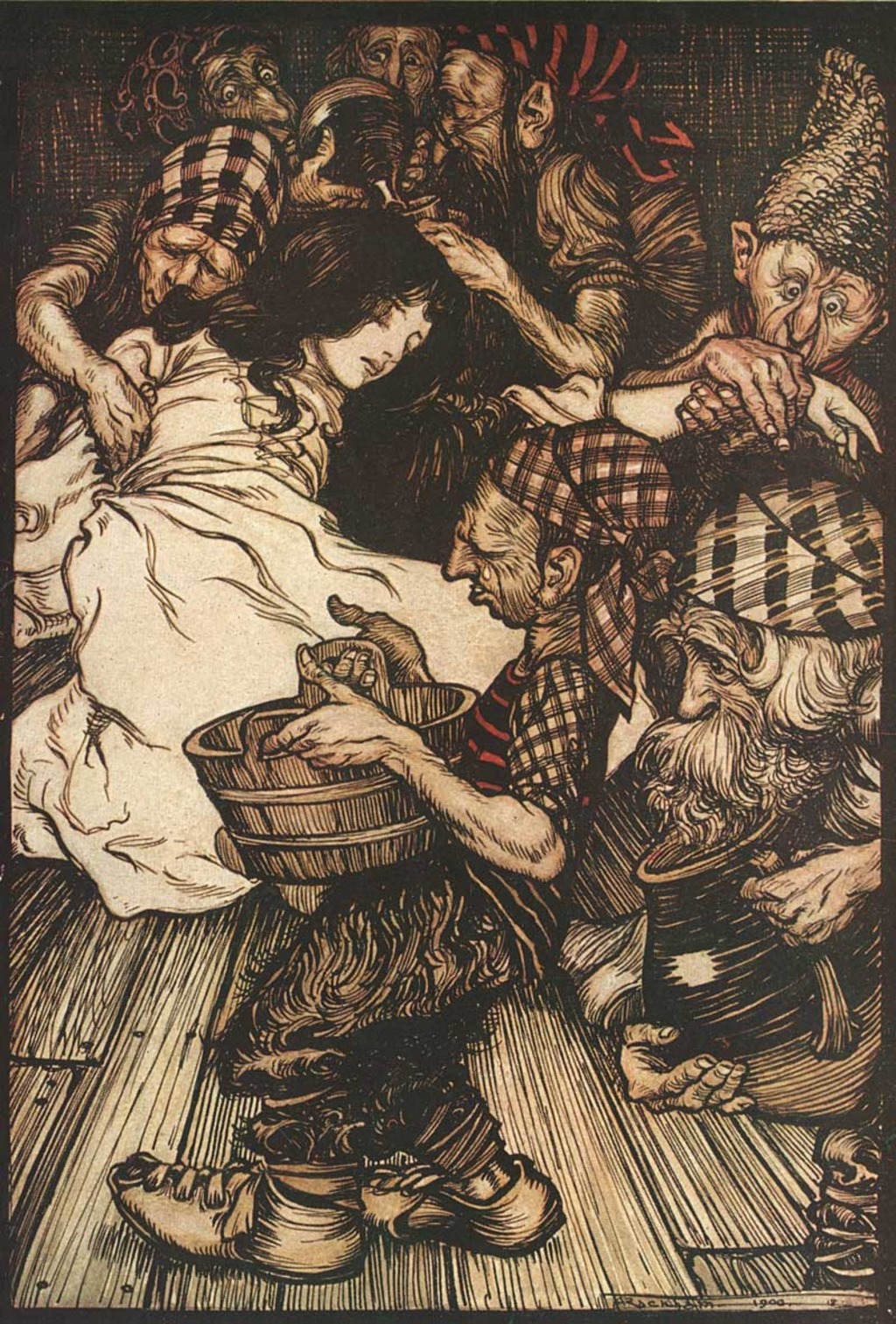
Arthur Rackham (1867–1939), illustration for the Brothers Grimm’s Snow White, dated 1900 and reproduced in the 1909 edition. After Snow White has been poisoned by the apple, the dwarfs try unsuccessfully to revive her. Public domain.
From Threats to Protectors. Magical Helpers
The Magic Mirror may preserve traces of other themes, rather like cultural fossils carried through generations of oral transmission, now detached from their original contexts and no longer bearing the meanings they might have held in a hypothetical distant past. For this reason, we cannot speak of coherent themes, but rather of possible readings of fragmentary motifs altered through transmission. Archaic elements in tales are continually reinterpreted, and some retain wondrous qualities attributed to objects and phenomena whose original contexts are no longer understood (Bardakhanova and Gympilova 2008, pp. 5–7). Here I shall briefly discuss just two such elements, the mysterious magical figures who shelter Snow White, and the strange sleep or apparent death brought about by the spell. Other important motifs, such as the magic mirror, will be considered through other versions.
The figures who protect the heroine (F451.5.1, helpful dwarfs, N765, band of robbers, F451.5.1.2, dwarfs adopt a girl as their sister) vary from version to version. They may be hunters, bandits or robbers, practitioners of magic such as witches or sorcerers, or benevolent spirits such as elves, gnomes, magical animals and other supernatural beings. Whatever their identity, they tend to share certain characteristics.
One is that they may initially appear dangerous or hostile to the heroine. Robbers, bandits and hunters have associations with violence, as do the bogatyrs. In Germanic folklore, dwarfs are earth spirits who can also be dangerous or deceitful. Witches and sorcerers may be monstrous, but they can also be ambivalent figures, dispensing gifts or misfortune, as Baba Yaga or Mother Holle may do. Depending on the version, their dwellings may be guarded by fierce dogs, deadly fantastic beasts or other fearsome guardians. However splendid and alluring these homes may be, a sense of mysterious danger always hangs over them. Sometimes they are explicitly supernatural places, beyond the bounds of the ordinary and the possible. We find a similar atmosphere in the Beast’s dwelling in Beauty and the Beast, ATU 425C, and in many other tales belonging to the broader group ATU 425, The Search for the Lost Husband.
The second characteristic is that the protectors are always liminal figures. They inhabit the border between humanity and wilderness, the human and the inhuman, civilisation and the world of beasts, everyday reality and the realm of magic and dreams. Moreover, even when they appear ordinary and realistic, as robbers might, they tend to perform supernatural deeds or be surrounded by magical elements, including their own homes. Robbers and bandits live outside the law, on society’s margins. Hunters, whether poachers or not, also inhabit the forest, where civilisation ends. Dwarfs live underground, in caves and tunnels. Their nature is chthonic, belonging to the subterranean world (Girardot 1977, pp. 290–291). Bogatyrs may be human heroes, but they are also magical or legendary figures. In a note to the tale, Afanasyev observes that some variants have twelve bogatyrs rather than two, just as there are twelve protectors in the version he collected in Belarus.
The protectors therefore have a dual nature. On the one hand, they inhabit and belong to a marginal, liminal, chthonic or underworld space, understood as somewhere beyond, beneath the earth or outside the boundaries of the everyday world. On the other, they may be dangerous, even demonic figures and guardians, yet ultimately become benevolent protectors. To bring about this change, the heroine performs a series of services or tasks, usually involving housework, associated with motif N831.1, mysterious person performs household tasks. This sequence is not developed in the version with the two warriors. Snow White enters the empty palace, and they arrive just as she is about to leave. They meet her, welcome her as their sister and give her the keys so that she can manage the household. In most versions, however, the process is less immediate, and motif N831.1 is developed. The inhabitants of the wondrous place Snow White reaches may be dangerous, even deadly, but her work wins their favour.
In the great majority of versions, she notably performs this work in secret, without the inhabitants knowing who is responsible. Only when she has completed the tasks can she emerge and reveal herself safely. The protectors’ association with a house is highly significant. In Rondalles de difunts, I devoted an entire chapter to the close relationship between household tasks and dealings with spirits, particularly the lares, ancestral or domestic guardian spirits. The home creates a relationship between the living and the dead, the ancestors, because all have passed through it and contributed something of their lives to it. Other heroines of wonder tales call on their ancestors when they are most endangered and alone, as Cinderella calls on her dead mother. In Snow White’s case, one hypothesis or alternative reading is that the protectors more closely resemble spirits of place, associated with the earth or with thresholds. In another sense, they may represent a hidden, subterranean part of the heroine herself.
Some versions of ATU 709 accentuate this idea through the intriguing motif N812, ogre or giant as helper. Snow White’s protectors are beings who are unequivocally hostile in other tales, such as man-eating ogres, terrifying giants or ferocious beasts. Yet the heroine wins their favour through her actions, magic, intelligence or good deeds, for example by showing no fear or treating them with compassion. They then become benevolent protectors or faithful servants. It is as though, by integrating them into herself and recognising their monstrosity as something that also belongs to her, she brings them under her control. This motif also connects with tale types in the ATU 425 group, including 425A, The Animal as Bridegroom, represented by East of the Sun and West of the Moon, and, once again, 425C, Beauty and the Beast. It is also very common in tales of types such as ATU 480, The Kind and the Unkind Girls, among others.
In the Russian version presented here, the protectors are bogatyrs, the strong, courageous and heroic warriors of medieval Russian epic. They are legendary warriors of the national folklore and therefore have a supernatural dimension associated with the land itself, honour and protection. They call the heroine their sister and are bound to her by an oath stronger than friendship or fascination with her extraordinary beauty. In older folktales, such beauty may sometimes stand for a supernatural quality. Here the bogatyrs kill themselves in despair when the heroine “dies”, perhaps suggesting a bond that exceeds simple affection or friendship. This also occurs in other versions of ATU 709. The magical protectors leave or die when Snow White falls into her enchanted sleep. In another substantial group of versions, including the Brothers Grimm’s classic telling, the dwarfs continue to watch over and protect her as she sleeps.
Whatever the interpretation, Snow White and her protectors, whose favour she wins and whom she in turn helps, appear bound by shared roots. Their relationship is reciprocal, as though they were part of her, brought together in a dwelling on the border between civilisation and wilderness.
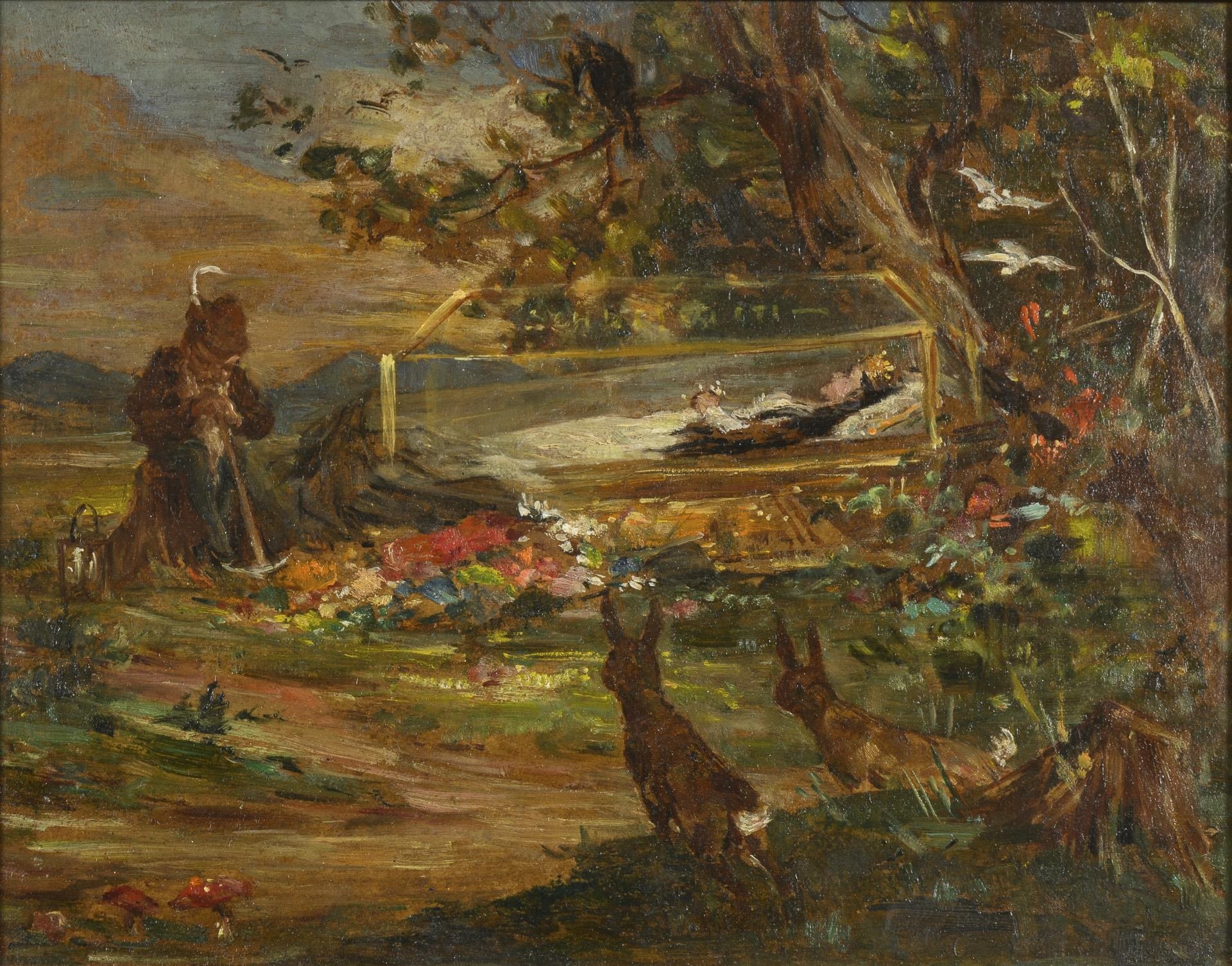
Heinrich Schlitt (1849–1923), Snow White in the Glass Coffin, an undated painting. A dwarf and two hares watch over the heroine’s body in a woodland setting surrounded by flowers and birds. Public domain.
Snow White’s Enchanted Sleep
Snow White’s strange “death” calls for a more extensive study. Here I shall only briefly suggest a few possible interpretations.
Snow White’s death is not an ordinary death. Indeed, she does not die, but remains suspended between one world and another. Her body retains the appearance of life, and she can revive when the magical object causing the enchantment is removed. In this version, the objects are the ring, the ribbon and the strand of hair. This recalls, in reverse, tales in which the heroine’s soul is housed in an object. In the Russian tale The Boar Master, for instance, the heroine falls ill when she loses the ring containing her soul and recovers when it is returned (Bardakhanova and Gympilova 2008, pp. 51–52, note 179). Other tales share this motif, the broad category E710, external soul, and the more specific E711, soul in an object, and E711.3, soul in a jewel. In Afanasyev’s Belarusian version, the twelve brothers live in a characteristically enchanted palace. When the heroine “dies”, they suspend her silver coffin from the trees, an image both beautiful and distinctly liminal or initiatory.
The ever-fascinating glass coffin, motif F852.1, also deserves attention. It makes the body visible while separating it from the living. This quality invites a symbolic reading of the boundary between presence and absence, life and death. The body does not decay and is not immediately buried. Glass is an extraordinary material, present yet almost absent, there and not there, allowing us to see through it but not pass through it. Snow White is dead, yet she is not. She is not buried, and her body does not decompose. She seems to be asleep, in transition. Between one world and another, she lies within a translucent enclosure, cloudy like old glass, which was not entirely transparent. It recalls a new amniotic sac in which she is being carried towards (re)birth (Girardot 1977, pp. 293–294).
From this perspective, the descent into the space of death and rebirth can be read as Snow White’s personal transformation. Her return to life is the logical, triumphant culmination of her journey to the otherworld, to the palace, house or cave that is at once wondrous and dangerous. Such a place might function as a sanctuary between worlds, where a person dies only to be reborn and never die again. Having overcome death, Snow White, like the magical maiden or guardian fairy of ATU 313, is reborn more powerful than ever. She is now an adult, complete, and can no longer be harmed by the old witch’s hostile magic. Some versions of ATU 709 end with her awakening. Others add further episodes, as often happens after the return in ATU 313. In this version, after reviving and marrying, she still faces the general’s aggression and must defend herself again, but she can prevail. Perhaps, symbolically, because she has already passed through death. Her final victory lies in the recognition of the truth and the defeat of her attackers.
Many wonder tales follow the archaic narrative pattern of travelling to an unknown “otherworld”, at the meeting point of the physical and the metaphysical. It is usually represented by places such as forests, caves or realms beneath the sea or other waters. Heroes and heroines cross these dangerous spaces, receive help and return after overcoming trials. This pattern can be compared with the separation, transition and incorporation described in Arnold van Gennep’s classic study of rites of passage, a process equivalent to dying and being born again (Van Gennep 1960, chs. 1–2 and 6, Girardot 1977, pp. 274–300). Naturally, none of this demonstrates that a folktale is a record of a ritual. A forest, cave or remote palace can fulfil different narrative functions depending on its context. Comparing motifs nevertheless allows an initiatory reading. Whether a tale had such a meaning at some hypothetical remote stage of its transmission cannot be established.
When The Magic Mirror was collected in the nineteenth century, the motifs interpreted above need not have been understood in these terms. Rather than serving these functions, they fulfilled others that were more straightforward but no less important. One example is the lesson that if you do good for others, by cleaning and tidying their home, they will treat you well in return. In the Russian tale, the heroine remembers the young sailor and rewards him. This reciprocity is explicit. The same sequence can therefore invite social, moral or symbolic readings. Giving and receiving help, losing one home and finding another, dying and returning to life are narrative experiences that each version shapes in its own way, according to the culture and period in which it is received and interpreted (Zipes 2012, ch. 1). Today, we can read these tales through more than a single interpretation and appreciate the full richness they preserve.
© Arnau Folch / Llegendàrium. This article may be shared by linking to the original publication. Reproduction, translation, adaptation or distribution in full is not permitted without prior authorisation.
