


Peter the Fearless and Death: Two Catalan Folktales for All Saints’ Day
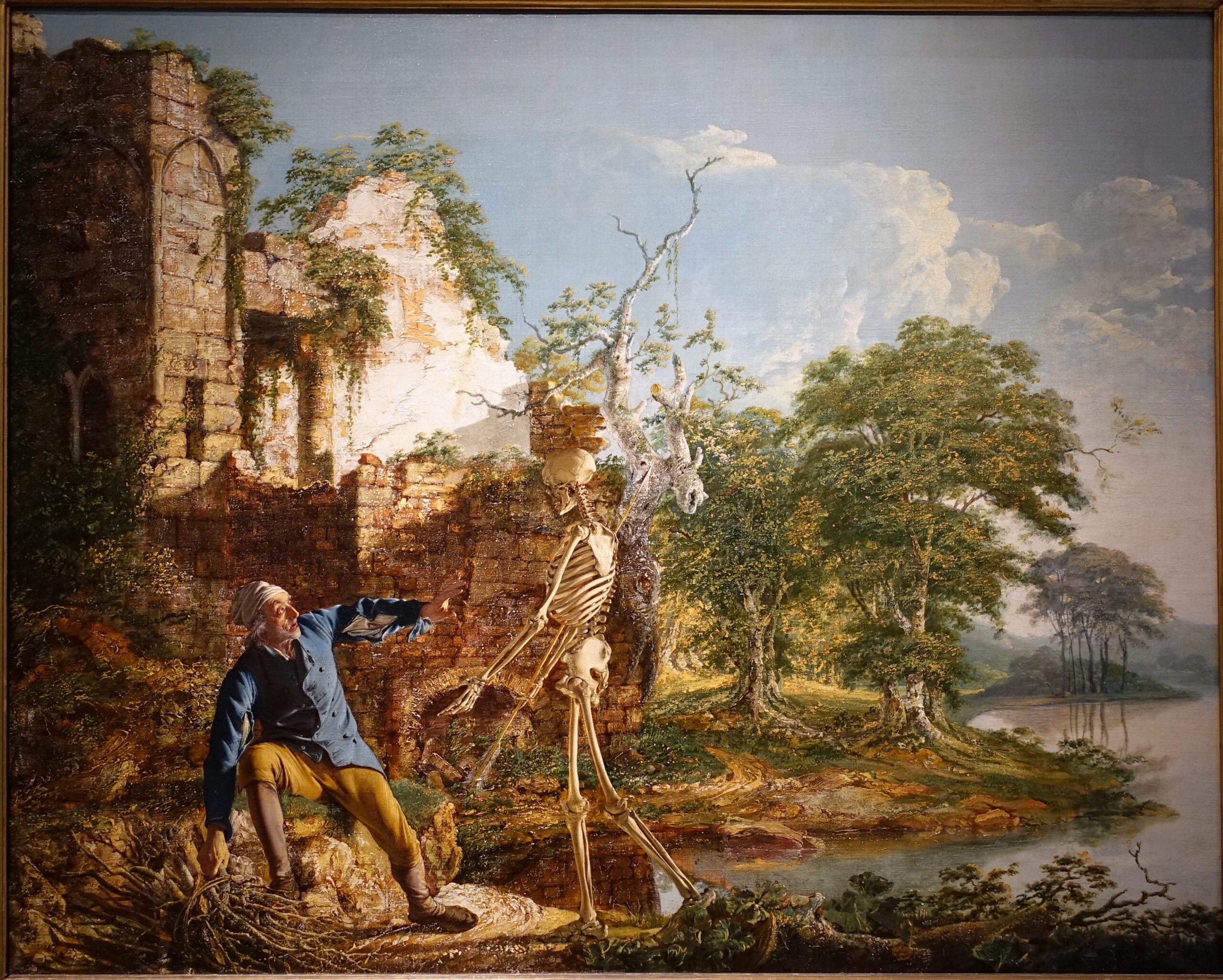
The Old Man and Death, by Joseph Wright of Derby (1734–1797), 1773. An old man recoils before Death, depicted as a skeleton, in a landscape with ruins. Inspired by traditional folklore, the painting evokes the encounter between human beings and death. Wadsworth Atheneum Museum of Art, Hartford, Connecticut. Public domain.
People have always told frightening stories for all sorts of reasons: to teach lessons, pass on values, explore the anxieties and uncertainties that arise from hardship, trauma and loss, ease the pain of losing someone we love, or simply enjoy a good story. For that last reason, tales of terror have often mingled with comedy. The two genres go hand in hand far more often than we might think, in traditional folktales too, and even draw on some of the same ways of stirring our emotions.
Sometimes the very stories that make us glance nervously into the dark also make us laugh. What frightened us yesterday can seem ridiculous once we have come to understand it, grown used to it or overcome it. We see this everywhere: in old monster films that once terrified audiences and now provoke laughter, and in our own fears, our inner monsters and the enemies we face in the world. Laughter and the shudder stand back to back: facing opposite ways, yet inseparable. Traditional folktales know this kinship between fear and comedy well: the dead return, wild beasts tumble down the chimney, and the Devil ends up taking a beating. The two tales I bring you today play with this mixture, drawing us closer to death and the dead through laughter and shivers alike.
Peter the Fearless: Wit, Courage and Fortune
Peter the Fearless is one of three versions of the same tale preserved in the papers of the Majorcan poet and writer Marià Aguiló (1825–1897), whose first name was also written Marian in his lifetime. This particular version comes from Vallcebre, a village set between the Cadí range, Pedraforca and the Rasos de Peguera. The edition identifies Josep Tomàs as the person who wrote down the text and credits Aguiló with recording its place of origin, but gives neither the storyteller’s name nor the exact date it was collected. Aguiló began gathering folktales in 1841 and continued intermittently for almost thirty years, working particularly intensively between 1854 and 1864. Jaume Guiscafrè’s edition, published in 2008, brings together 169 versions, alongside the fragments included in an appendix. The material ranges from fully written accounts to summaries and fragments. Sadly, the poet never managed to complete the project or publish it during his lifetime. His was a pioneering effort to collect oral narratives from across the Catalan-speaking lands. Other notable undertakings include those of Maspons, Bertran and Verdaguer; Verdaguer’s collection, too, remained unfinished.
The tale from Aguiló’s collection presented here belongs to ATU 326, The Youth Who Wanted to Learn What Fear Is. In Catalonia, these stories are best known by the familiar names of their fearless protagonists, such as Peter, Joan or Maria, whose lack of fear leads them into situations both comic and terrifying. This tale type often turns accepted values on their head. The hero’s daring and courage lead him to confront apparitions, devils, executioners and even Saint Peter. Through grotesque scenes and bursts of comic violence, he defies the hierarchies of this world and the next, much like other characters with a rebellious, almost Luciferian streak, such as the blacksmith in The Smith and the Devil. Fear, which ought to keep him in his place, has no hold over him.
In many versions of this tale type, the hero overcomes the most horrifying trials and wins riches, a fortunate marriage or some other reward, sometimes a supernatural one. This happens, for example, in the Grimms’ Good Bowling and Card Playing. One lesson we might draw from such stories is that we should not let ourselves be defeated by fears that often loom far larger in our minds than they turn out to be. How many devils prove to be paper tigers after all? And how many seemingly terrible enemies turn out, once we face them, to be mere illusions or sorry little figures like the Wizard of Oz? In Aguiló’s version, Peter’s sheer audacity and quick wits carry him as far as defying the authorities of the next world.
As with Fortunatus and other wandering adventurers—the fools of the road, the wandering scholars, minstrels, street performers, gamblers and, more broadly, all the favourites of the goddess Fortune—we do not know whether his victory will last, or whether Fortune’s wheel is turning upwards or downwards. For that moment, though, his triumph is complete and satisfying. The tale in Aguiló’s papers, like other versions of ATU 326, also incorporates motifs familiar from other tale types concerned with fortune’s favourites, such as ATU 592, The Dance Among Thorns, and ATU 566, The Three Magic Objects and the Wonderful Fruits.
Other versions of ATU 326 end with a comic twist: the hero finally discovers fear, often through an everyday incident that makes a satirical contrast with his supernatural adventures. In the expanded 1819 version of the Grimms’ The Story of the Youth Who Went Forth to Learn What Fear Was, for example, the hero triumphs over all manner of extraordinary and terrifying adventures, each more extravagant than the last, in the spirit of Baron Münchhausen. Yet he only discovers fear when his wife tips water and fish over him as he sleeps. This final twist suggests that, for all the earlier lesson about overcoming fear, we should not become overconfident: caution still has its place. Fear serves a purpose in the order of things, encouraging us to take care and think before we act or speak. It also reminds us that, however much we have achieved, we should not grow conceited. Think of the victorious Roman generals whose triumphal processions included a slave whispering in their ear that they, too, were human and would die: memento mori.
With their blend of lessons, laughter, wonder and terror, tales such as Peter the Fearless and Fearless Marieta were already being told chiefly to the youngest children in the household in Aguiló’s day.
Young Peter the Fearless
Once upon a time, a man owned a house where wild beasts kept appearing, and he was terribly afraid of it.
Knowing that Young Peter the Fearless never took fright at anything, he asked whether he would spend the night there. There was just one condition: he had to light the fire at eleven and eat his supper at midnight.
“Of course I will!” said Young Peter the Fearless.
“Then go whenever you like,” said the owner.
Off Peter went, and at eleven he lit the fire. He put some water on to heat and began making himself some soup. As he worked, things started coming down the chimney: an arm, a leg, a head, a body… Once they reached the floor, the pieces joined themselves together until they had formed three men.
Peter asked whether they wanted supper. They said they did, but when they sat down at the table, they would not eat. Peter had his supper alone. Afterwards, they all went into another room and began playing skittles. Peter won all their money, and they tried to take it back by setting on him with their fists. He fought back, but when he saw he was getting nowhere, he fetched the frying pan and—whack, whack!—laid into one, then another, until he had killed the lot.
The next morning, the owner came round.
“Well, Peter? How did you get on?”
“Very well,” he replied. “I’ve never had such an entertaining evening.”
“Very good,” said the owner, and off he went.
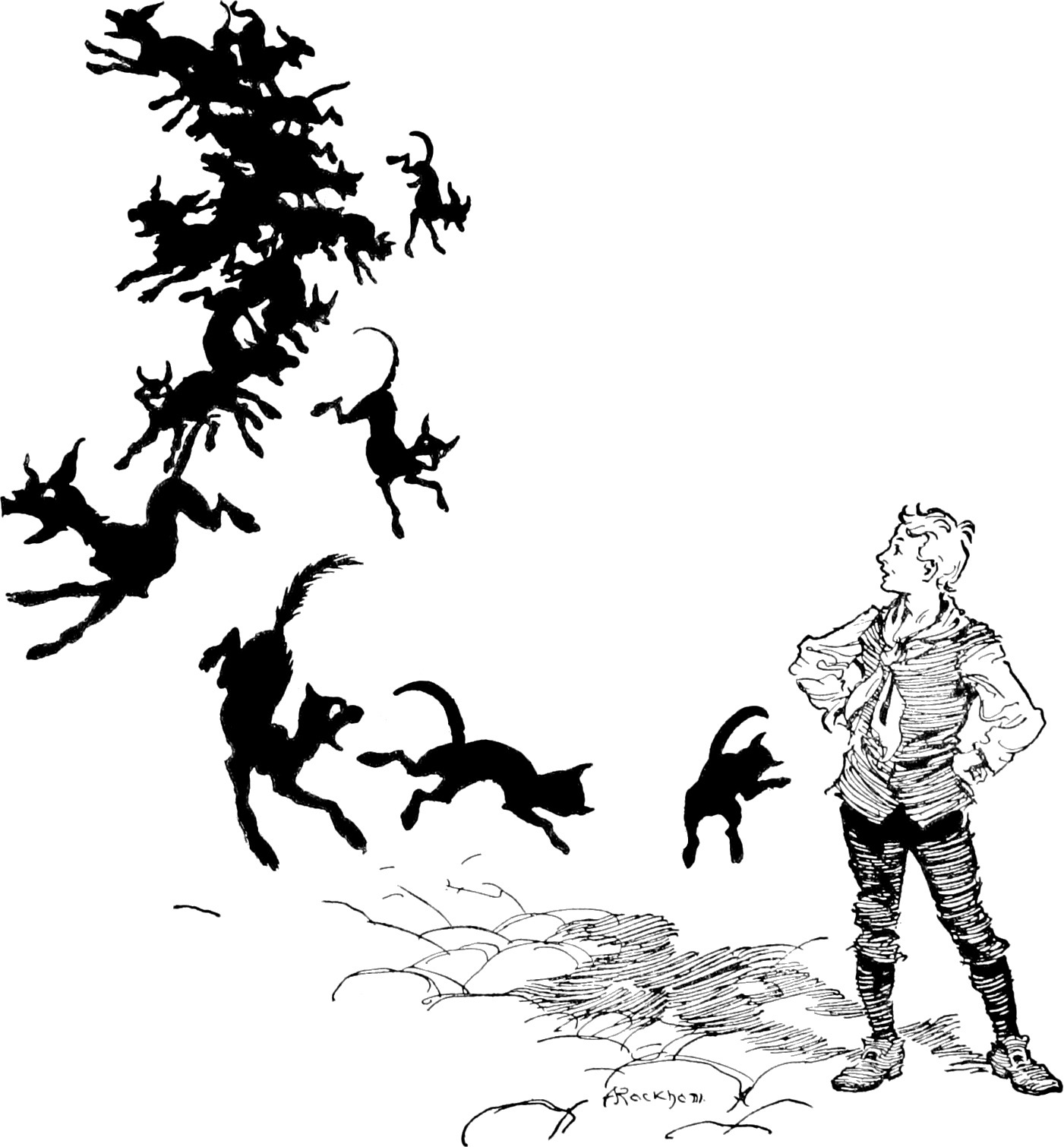
That evening, at the same hour, Peter lit the fire, put some water on to heat and began making his soup. As he worked, cats started leaping down the chimney, one after another. They settled in a circle round the fire until there were twelve of them. Every so often, one would creep towards the pan, but if Peter caught it doing so, that was the end of that cat.
When he put supper on the table, he asked:
“Would you like some supper?”
“Yes,” they replied.
But once they were at the table, not one of them would eat. Peter had his supper, and afterwards they went back into the same room and began leaping about. He struck out at them with a log, first one, then another, but when he saw he was getting nowhere, he fetched the frying pan. Whack, whack! He kept at it until not one of them stirred.
The next morning, the owner came round.
“Well, Peter? How did you get on?”
“Very well,” he replied, and told him everything that had happened.
“Very good,” said the owner, and off he went.
That evening, at the same hour, Peter once again lit the fire, put on some water and began making his soup. As he worked, animals started appearing: a dog, an ox, a lion, a tiger, a snake, a crocodile… Every kind of beast you could imagine.
When he put supper on the table, he asked:
“Would you like some supper?”
“Yes,” they replied.
But once they were at the table, none of them wanted any. Peter ate his supper, and afterwards they all went into the same room to play. The ox gored him, the dog bit him, the snake lashed at him: each beast did what came naturally.
Peter grabbed one, then another, but more kept appearing. At last he fetched the frying pan and—whack, whack!—kept going until he had slaughtered the lot. Then he went to bed.
The next morning, the owner came round.
“Well, Peter?”
“Very well,” he replied.
“Come along, then. Since you’re not afraid, you must go and put out that light down there in the big cellar.”
“All right,” said Peter.
Down he went to put it out. As he and the owner were making their way back to the door, a horde of wild beasts appeared and tossed him about as though he were a ball. The owner said:
“I can see you’re not afraid. Here, take these three pesetas for your trouble.”
Peter took them, but he was furious at being paid so little and went off grumbling. On the road he met two travellers, who were Our Lord and Saint Peter, and told them what had happened. They asked what he would like as a reward, and Peter replied:
“A fiddle that makes everyone dance whenever I play it, a gun that kills whatever I aim at without my having to fire, and a bag that draws in anything I want whenever I say, ‘Into my bag!’”
With these gifts, he went out hunting one day. He met a man who was going hunting too and asked Peter to join him.
“Of course,” said Peter, “provided you fetch whatever I kill.”
“Agreed,” said the other man.
When they reached a wood, Peter aimed at a bird and it fell down dead.
“Go on, fetch it,” he told the man.
The man went to pick it up. Peter took out his fiddle and struck up a tune, and the man began to dance. The man begged him to stop and promised him a great deal of money if he would.
“All right,” said Peter, “but you’ll have to fetch it while you’re dancing.”
“Agreed!”
Off the man went to fetch a large sum of money, which he handed over to Peter.
After that, Peter went on his way, and the Devil appeared before him. The moment he saw him, Peter said:
“Into my bag!”
And in the Devil went at once. With the Devil safely inside, Peter made his way to the blacksmith’s and said:
“Hammer away at this. The Devil’s inside.”
“Gladly!” said the blacksmith. Then he called to his men, “Come on, lads, let’s get to work!”
They laid the bag on the anvil and—clang, clang! The Devil cried out:
“Ow! Ow!”
They did not stop until they had battered him black and blue.
Then Peter let him go. The Devil ran back to hell to tell the other devils what had happened. When he had finished, the biggest of them said:
“You coward! What a coward!”
At that, the first devil replied:
“Very well, you go and see him. Then tell me how you get on.”
Off went the biggest devil, pleased as could be. He was quite sure he would make a fool of Peter. Poor fellow…
When Peter saw him, he said:
“Into my bag!”
And in the Devil went at once. Peter did exactly as before: off to the blacksmith’s!
“Come on, lads, give it all you’ve got, all together! The biggest devil in hell is in this bag!”
That put heart into them! They all began hammering together: one, two, three—clang, clang, bang! What a racket! And how the devil screamed! You would have thought the world was splitting apart. The louder he screamed, the harder they hammered. How they sweated! When the devil was half dead, Peter let him go, and off he fled as fast as his legs would carry him, back to hell to admit that the other devil had been right.
After all this, Peter was sentenced to hang, though I couldn’t tell you what crime he had committed. When they had him at the gallows, ready to hang him, he begged the executioners, for the love of God, to let him play his fiddle for a little while. They agreed. How pleased Peter was! He took up the fiddle and struck up a tune, and everyone began to dance. Away he went, leaping and bounding, for he could run faster without dancing than the others could while they danced.
Once he had escaped, he went to hell to see whether they would have him. Knock, knock!
“Who’s there?” asked the damned.
“Young Peter the Fearless,” he replied.
What a commotion! The devils went leaping and bounding away.
“We don’t want you here!” they told him.
Peter went on to purgatory. Knock, knock!
“Who’s there?” asked the souls.
“Young Peter the Fearless,” he replied.
As soon as they heard his name, they slammed the door in his face.
Then he went to heaven. Knock, knock!
“Who’s there?” asked Saint Peter.
“Young Peter the Fearless,” he replied.
“You’re not coming in,” said Saint Peter. “When I told you to ask for the glory of heaven, you made fun of me. Now it’s my turn to laugh at you.”
But poor Saint Peter’s plan backfired. Peter settled down beside the gates of heaven, and whenever he saw a soul coming up after completing its penance in purgatory, he said:
“Into my bag!”
In went the souls, one after another, until there was scarcely room for any more.
Meanwhile, Our Lord and Saint Peter were saying to each other:
“How strange that no souls are arriving!”
Then Peter went up to the gates of heaven. Knock, knock!
“Who’s there?” asked Saint Peter.
“Young Peter the Fearless, with a whole bagful of souls. Let him into heaven and he’ll give them to you. Otherwise, he’ll keep them for himself.”
If you know more of the tale, tell us the rest.
Marià Aguiló, “Lo Peret sense por”, in Jaume Guiscafrè, El rondallari Aguiló. Transcripció, catalogació i estudi introductori (Barcelona: Publicacions de l’Abadia de Montserrat, 2008), pp. 188–191. Version from Vallcebre, in the upper Llobregat valley. Text written down by Josep Tomàs; place of origin recorded by Marià Aguiló. Translated from the modern Catalan adaptation.
Death: Justice and Balance
The second tale was collected by the Catalan folklorist Sara Llorens (1881–1954). Llorens studied with leading folklorists such as Rossend Serra i Pagès, the foremost specialist in the Count Arnau cycle. Moving beyond the romantic, idealist folklore scholarship of the nineteenth century, she emerged as one of the most forward-looking Catalan folklorists of the twentieth. The war, however, cut her career short. She went into exile in Argentina in 1938 and died in exile in Perpignan in 1954. Although she published works such as El cançoner de Pineda (1931), her collection of folktales, like Aguiló’s, remained unpublished during her lifetime. The Rondallari de Pineda finally appeared in 2006.
Recorded on 29 July 1902 from Josep Clarabuch i Aragonès, of the household known as Can Jordà in Pineda de Mar, Death is another tale particularly suited to All Saints’ Day and All Souls’ Day. Like the first, it blends comedy with serious concerns. It combines ATU 332, Godfather Death, with a second part linked to ATU 331, The Spirit in the Bottle. A poor but cunning charcoal burner refuses to share a chicken with powerful figures such as God and the Devil, yet welcomes Death because he considers her just: she treats everyone alike. In gratitude, she gives him the ability to tell whether a sick person will die or recover, depending on whether he sees her at the head or the foot of the bed. This sets in motion a series of adventures that will upset the balance between life and death and disrupt the natural cycle. As in Afanasyev’s wonderful tale Death and the Soldier, the version collected by Llorens pushes this disruption still further: the charcoal burner captures Death, and the whole order of things falls apart.
I explored this family of tales in detail in my book Rondalles de difunts. For now, it is enough to say that the story has very old precedents, reaching back to antiquity. One of its underlying ideas, perhaps the most important, is the acceptance of death as an essential part of life. Paradoxical as it may seem, death is what keeps the world in balance. As the charcoal burner says, she is the only one who seems truly just, because she takes everything and everyone. As in the first tale, a simple, comic surface conceals profound questions: questions that generations before us have pondered, lived with and suffered through.
Death
Once upon a time, a charcoal burner lived in a wood. One day he had to go down to the village for supplies. On his way, he spotted a chicken near a farmhouse and said to himself, “You know what? You could take that chicken. Of course you could! You’d be a fool to go all the way down to the village for food when you’ve found some already!”
And so he did. He took the chicken, carried it back up to his hut, barred the door and said:
“Even if God himself asks, I won’t give him any!”
After a while, he heard a knock at the door. Knock, knock.
“I bet that’s God,” he thought.
At once he called out, “Who’s there?”
“It’s God. I’ve come to ask whether you’ll take me in.”
“Didn’t I say so? No, I’m not giving you any chicken!” said the charcoal burner.
“But I’m only asking for shelter…”
“Say what you like. You’re not getting any!”
God had to turn back. On his way down the mountain, he met the Virgin Mary, who asked, “What did the charcoal burner say?”
“He wouldn’t even open the door!” said God.
“Then I’ll go and see whether he’ll give me some chicken,” said the Virgin Mary, and up she went.
Knock, knock, she went at the hut door.
“Who’s there?” asked the charcoal burner irritably.
“The Virgin Mary.”
“I’ll bet you’ve come for the chicken. Well, you can go straight back where you came from! You’re not getting any!”
“But I’m not asking for chicken, just a corner to lie down in!”
She kept trying to persuade him for quite a while, but it was no use. The stubborn charcoal burner refused to open the door, and the Virgin Mary had to turn back.
When she rejoined God, the Devil appeared and asked, “Didn’t the charcoal burner give you any chicken?”
“No!” they both said.
“Then I’ll go up and see if I have better luck.” And off he went.
Knock, knock, he went at the door.
“Who the devil is it?” the charcoal burner asked crossly.
“The Devil.”
“You must have come for the chicken! That wretched chicken! What a lot of trouble it’s causing me! Don’t bother trying. You’re not getting any!”
The Devil went back down, joined God and the Virgin Mary, and they walked on together. Then they met Death.
“Where have you come from?” she asked.
“The charcoal burner’s hut. He wouldn’t give us any chicken, no matter what we said.”
“Wouldn’t he?” said Death.
“Then I’ll see whether he’ll give me some.” And up she went.
Knock, knock.
“Who the blazes is it now? Can’t you leave me in peace?” the charcoal burner shouted in a fury.
“It’s Death!”
“Ah, well! If you’re Death, I’ll let you in and give you some chicken!”
As he opened the door, he said, “You wrong no one. You take everyone just the same!”
And he let her eat as much chicken as she pleased.
Death was so grateful that she said, “I’ll give you a gift. Leave this trade of yours. Go down to the village and set yourself up as a doctor.”
“How am I supposed to do that?” asked the charcoal burner. “Poor me! I can’t even read!”
“You don’t need to! Look, go down the mountain and let everyone know you’re a doctor. If someone in a household is ill, they’ll send for you. Go to them, and if you see me at the head of the bed, you can say, ‘There’s no hope for this one.’ But if you see me at the foot, say, ‘Oh, they’ll soon be well.’ Then go and gather a handful of herbs, the first ones you find, boil them in a pot and give the patient the water to drink. They’ll be up and about in no time.”
The charcoal burner did just that and cured a great many sick people. Then one day the king sent for him to cure the princess. He arrived and saw Death standing at the head of her bed. But he paid no attention and insisted on trying to cure her.
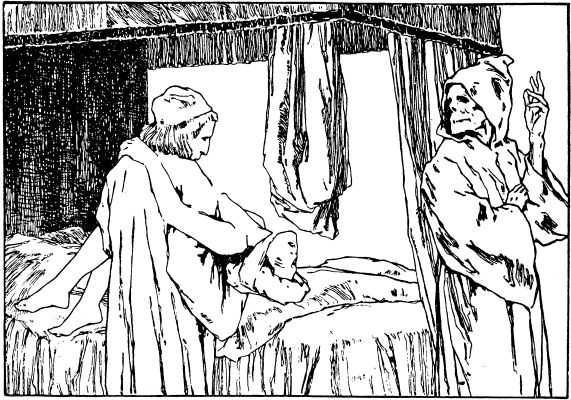
As he left the house, he met Death, who said angrily, “Come to my castle. I’m going to kill you for disobeying me.”
“Not yet, not yet! Let me stay in this world for three more months! I promise I’ll come then!” said the charcoal burner.
Death took pity on him and gave him another three months to live.
But the charcoal burner only wanted a chance to trick her. He went to a regiment and ordered an iron cannon barrel. He took it to a spot near Death’s castle, and when she came for him three months later, he was ready.
He climbed into Death’s carriage. Once they had set off, he said, “What I can’t believe is that you can pass through such tiny holes, as everyone says.”
“But it’s perfectly true!”
“Nonsense! I’d wager my head you couldn’t get through this hole, and it’s not even all that small!” He pointed to the mouth of the iron cannon barrel, which was now in sight.
“You think I can’t?” said Death, laughing. “Here, I’ll show you!”
In she went. No sooner was she inside than the charcoal burner sealed the opening tight. The other end was already closed, so Death could not get out.
Then he took the barrel and hid it inside the trunk of an oak tree.
Seven hundred years later, some sawyers came by. Seeing such an old oak, one of them said, “There’s a fine tree for sawing!” So they set to work.
As they sawed, they opened up the barrel. Death, who had been shut inside for seven hundred years, came rushing out and went to see the charcoal burner. He was now so old that he could only drag himself about his house, and his children and grandchildren were no better off. Everyone was ancient, for of course no one had died in seven hundred years. The moment the charcoal burner saw Death, he called out, “Come, come! I’m tired of living!”
Death had to hurry here, there and everywhere, for the world was full of old people whose time had come.
Sara Llorens, “La mort”, Rondallari de Pineda, introduction and study by Josefina Roma; illustrations by Waldesca Santana (Pineda de Mar: Ajuntament de Pineda de Mar, 2006), pp. 499–501. Told by Josep Clarabuch i Aragonès, of Can Jordà, on 29 July 1902. Translated from the Catalan text with revised spelling and grammar and some expressions modernised.
© Arnau Folch / Llegendàrium. This article may be shared by linking to the original publication. Reproduction, translation, adaptation or distribution in full is not permitted without prior authorisation.
