

Tales of the Dead: Two Norwegian Folktales from Asbjørnsen and Moe
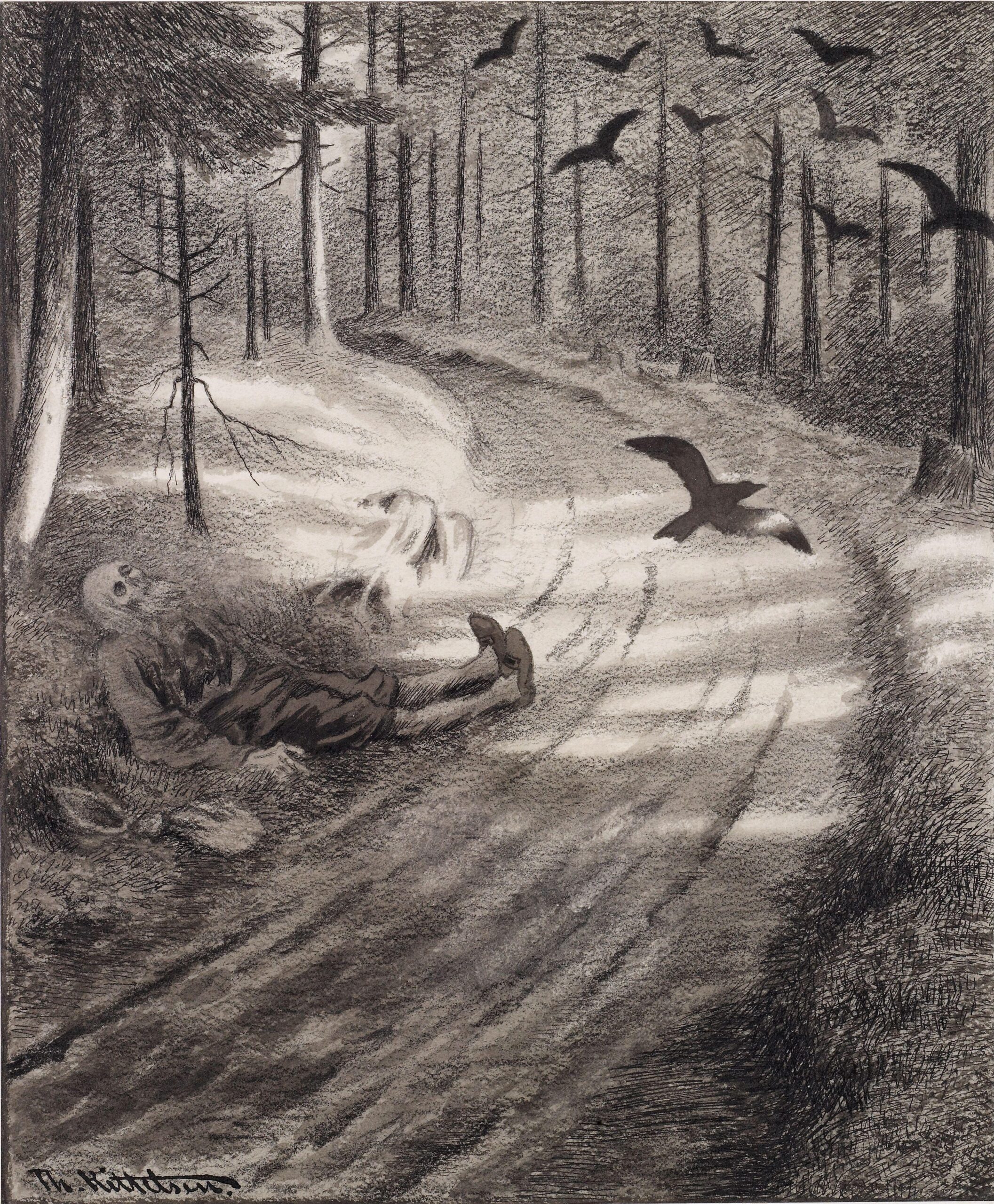
Fattigmannen (“The Poor Man”) is an illustration by the Norwegian artist Theodor Kittelsen (1857–1914), created between 1894 and 1896 for Svartedauen (“The Black Death”), a work published in 1900 and inspired by Norwegian folk traditions about the plague. It depicts a dead man beside a lonely road, surrounded by ravens in a wooded landscape. The scene evokes the death, poverty and devastation brought by epidemics, while also conveying a more intimate, personal sense of desolation. Nasjonalmuseet, Oslo, Norway. Drawing on paper in pencil, ink, black crayon and wash. Public domain.
In this post, I bring you two Norwegian folktales well suited to the days around All Souls’ Day. They were collected in Norway by the country’s foremost folklorists, Peter Christen Asbjørnsen (1812–1885) and Jørgen Engebretsen Moe (1813–1882), who often worked together.
The first, Venner i Liv og Død (“Friends in Life and Death”), belongs to the tale type of the same name, ATU 470, found throughout Europe: two close friends swear that, if one dies before the other, he will send his surviving friend a sign or return to visit him. In this particular version, they promise never to part, either in life or in death. Asbjørnsen records that he collected it in 1870 from Lars Larsen Ronestrand, a tailor and watchmaker from Graven, now Granvin, in Hardanger. It appeared in 1871 as tale no. 62 in Norske Folke-Eventyr. Ny Samling (“Norwegian Folktales: A New Collection”). The story allows us to explore the different passage of time in the worlds of the living and the dead, accompany its characters on a journey to the otherworld, and discover how much thinner the boundary between those two worlds may be than we imagine.
The second, much longer tale is Følgesvenden (“The Travelling Companion”), a fascinating example of the grateful dead cycle. A young man finds a corpse encased in a block of ice outside a church. The townspeople spit on it as they pass. The dead man was a wine seller, executed for watering down his wine. Believing it wrong to go on punishing him after death, the young man pays for his burial, an act of kindness that brings rewards far beyond anything he could have imagined. The grateful dead is an ancient motif, E341, associated with the group of tale types traditionally numbered 505–508. These stories are found across Europe and around the world; I explored them in detail in my book Rondalles de difunts.
Følgesvenden is classified as ATU 507, formerly AaTh 507A, The Monster’s Bride. Like many of the Norwegian folktales collected by Asbjørnsen and Moe, it is full of wild and striking details: a princess with a troll for a lover, for instance, who rides a billy goat smeared with a magical ointment. As you will see, the story has strong connections with the imagery of witchcraft. It appears as tale no. 100 in the 1871 edition of Norske Folke-Eventyr, and Asbjørnsen notes that it had previously been published in 1855 and 1866. Its principal version comes from the valley of Ådalen, now in the municipality of Ringerike. This is combined with a version from the Valdres region, also collected by Asbjørnsen, and another from Åmot in Østerdalen, supplied by the storyteller Tolleif Lindberget. It also incorporates material from variants recorded by his friend Jørgen Moe.
Friends in Life and Death
Once upon a time there were two men who were such close friends that they swore never to part, either in life or in death. One died young. Some time later, the other courted a farmer’s daughter, became engaged to her, and was to be married. When the wedding guests were being invited, the bridegroom went himself to the churchyard where his friend lay buried. He knocked on the grave and called to him, but his friend did not come. He knocked and called again, but still no one appeared. The third time, he knocked harder and called louder, telling his friend to come out, for he wanted a word with him. At last he heard a rustling, and the dead man came up out of the grave.
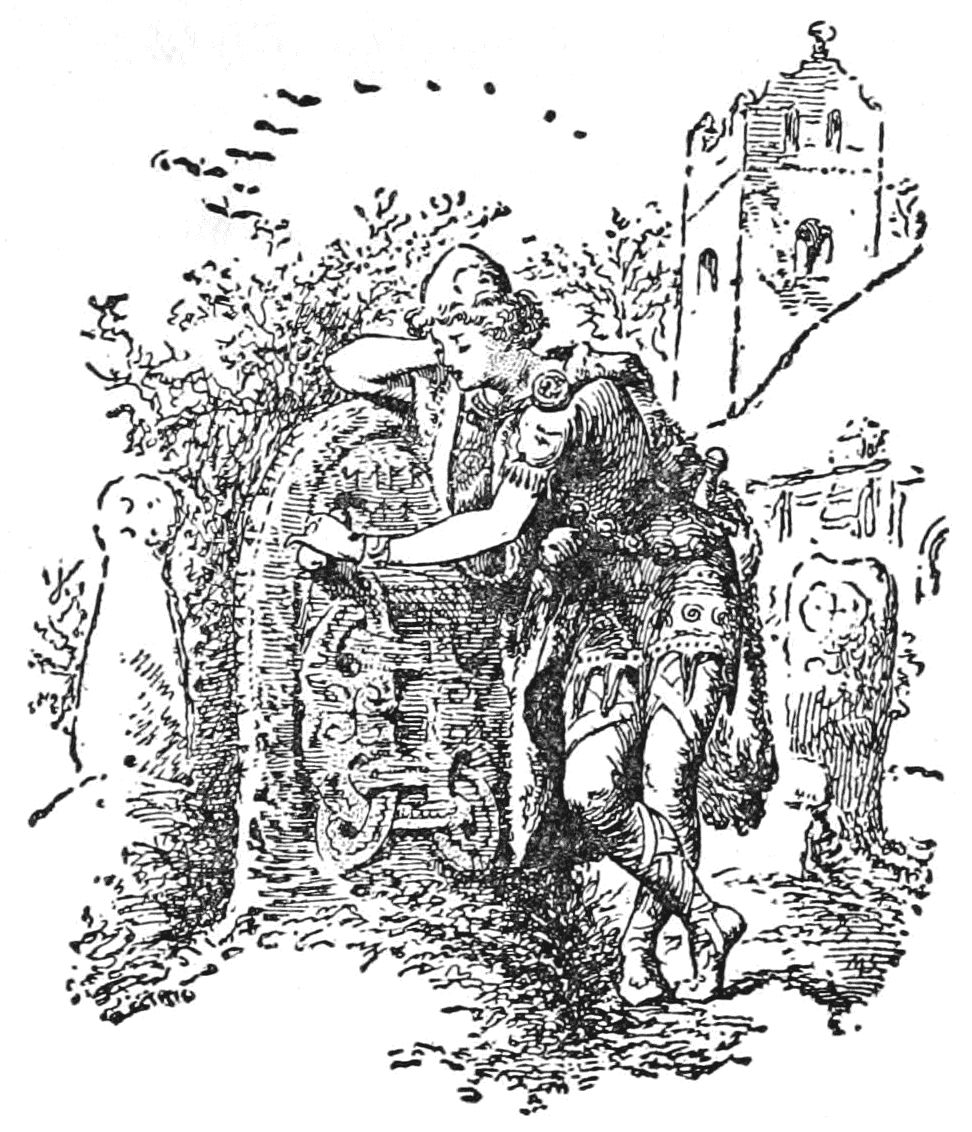
“About time you came!” said the bridegroom. “I’ve been standing here knocking and calling for ages.”
“I was a long way away,” said the dead man, “and I couldn’t hear you properly until that last time.”
“Well, I’m getting married today,” said the young man, “and I expect you remember what we agreed: that we would keep each other company and come to each other’s wedding.”
“I remember,” said the dead man. “But you’ll have to wait a little while I tidy myself up. I’m not dressed to join a wedding procession.”
The young man was in a hurry. He had to get back to the guests, and they would soon be leaving for church. But they had to be patient and give the dead man a room to himself, as he had asked, so that he could make himself presentable and put on his Sunday best like everyone else. He was going to church with them too.
And so the dead man went with them to church and came back with them afterwards. But later in the celebrations, when the bride’s crown had been taken off, he said it was time for him to leave. For the sake of their old friendship, the bridegroom offered to walk him back to his grave. On the way to the churchyard, he asked whether his friend had seen many strange things, or anything worth hearing about.
“Indeed I have,” said the dead man. “A great many things.”
“They must be wonderful to see,” said the bridegroom. “I should like to come with you and see them for myself.”
“You may,” said the dead man, “but you might be away for quite some time.”
The bridegroom thought that hardly mattered, and followed him through the grave. Before they went down, however, the dead man cut a piece of turf from the churchyard and placed it on the young man’s head. They travelled a long way through pitch darkness, scrub and marshland, until they came to an enormous gate, which opened at the dead man’s touch. Beyond it, things began to grow lighter. At first the light was like moonlight, but the further they went, the brighter it became.
At last they reached a stretch of green hills covered in rich, luxuriant grass. A large herd was grazing there, eating all the while. Yet for all they ate, the cows looked ugly, thin and wretched.
“What does this mean?” asked the young bridegroom. “Why are they so thin and sickly when they eat as though they were being paid for it?”
“They represent those who never have enough, however much they acquire and hoard,” said the dead man.
They travelled on and on until they reached some mountain pastures where there was nothing but bare crags and rocky ground, with a little patch of grass here and there. Another great herd was grazing there, and the animals were so handsome, so fat and sleek, that their coats shone.
“And these?” asked the bridegroom. “How can they look so well when they have so little to eat? What does it mean?”
“They represent those who are content with the little they have,” said the dead man.
On and on they went again, until they came to a great lake. Everything there was so bright and dazzling that the bridegroom could not bear to look at it.
“Sit here until I come back,” said the dead man. “I must leave you for a while.”
And off he went. The bridegroom sat down, and as he sat there, sleep came over him. Everything seemed to fade away as he sank into a deep and peaceful slumber.
After a while, the dead man returned.
“It’s a good thing you stayed where you were,” he said. “That way I could find you again.”
But when the bridegroom tried to get up, he was so overgrown with moss and bushes that he seemed to be sitting in a tangle of branches. Once he had freed himself, they set off back, and the dead man led him by the same route as far as the grave. There they parted and said goodbye. When the bridegroom came up out of the grave, he went straight to the house where the wedding was being celebrated.
But when he reached what he thought was the place, he could recognise nothing. He looked all around and questioned everyone he met, but no one could tell him anything about his bride, the wedding, his relatives or his parents. He could not find a single person he knew. Everyone wondered at this strange figure wandering about looking like a scarecrow.
Since he could find no one he knew, he went to the parson and told him about his family, what had happened on his wedding day, and how he had left in the middle of the celebrations. The parson knew nothing of it. But after searching through the old parish registers, he discovered that the wedding had taken place long, long ago, and that the people the man spoke of had lived four hundred years before.
In that time, an enormous oak had grown up at the parsonage. When the old man saw it, he climbed up to look around. But the man who had sat asleep in heaven for four hundred years and now come home again did not get down as well as he had got up. He was stiff and sore, as well he might be, and as he tried to climb down, he lost his footing, fell, broke his neck and died.
P. Chr. Asbjørnsen, Norske Folke-Eventyr. Ny Samling (Christiania: I Kommission hos Jak. Dybwad, 1871), no. 62, “Venner i Liv og Død”, pp. 5–7.
The Travelling Companion
Once upon a time there was a farmer’s son who dreamed that he would marry a princess in a faraway country. Her complexion was as white and red as milk and blood, and so rich that there was no end to her wealth. When he woke, he could still see her before him, as though she were standing there in the flesh. He thought her so lovely and enchanting that he could not live unless he married her. So he sold everything he owned and set out into the world to find her.
He travelled on and on, and in winter he came to a country where all the roads ran straight ahead without a single bend. After walking straight on for about three months, he reached a town. Outside the church door stood a great block of ice with a corpse inside it, and all the churchgoers spat on it as they passed.
The young man was puzzled, and when the parson came out of the church, he asked him what it meant.
“He was a great wrongdoer,” said the parson. “He was executed for his wickedness and put on display here for everyone to mock and scorn.”
“What did he do?” asked the young man.
“In life he sold wine,” said the parson, “and he mixed water into it.”
The young man did not think that such a terrible crime.
“If he has already paid for it with his life,” he said, “surely you could let him lie in Christian ground and be at peace after death.”
But the parson said that was out of the question. Men would have to be paid to break him out of the ice. A plot of Christian ground would have to be bought from the church. The gravedigger would need paying for the grave, the church’s owner for the bells, the parish clerk for the singing, and the parson for casting earth over the body.
“Do you think anyone would pay all that for an executed sinner?” he asked.
The young man said he would. If they would only bury him, he would pay for the funeral feast out of what little he had.
Still the parson refused. But the young man came back with two men and asked, in their hearing, whether he could refuse to cast earth over the dead man. The parson had to admit that he dared not.
So they broke the wine seller out of the block of ice and buried him in Christian ground. The bells rang and they sang over him; the parson cast earth over the body, and they drank at the funeral feast until they were laughing and crying by turns. But once the young man had paid for it all, there were very few coins left in his pocket.
He set off again, and had not gone far when a man caught up with him and asked whether he did not find it lonely to walk by himself.
The young man said he did not: he always had something to think about.
The man asked whether he would like a servant.
“No,” said the young man. “I’m used to looking after myself, so I don’t need one. And even if I wanted a servant, I couldn’t afford one. I have no money for his food and wages.”
“You do need a servant. I know that better than you do,” said the man. “And you need one you can trust in life and death. If you won’t have me as your servant, take me as your travelling companion. I promise I’ll be useful, and I won’t cost you a penny. I’ll pay my own way, and you needn’t worry about my food or clothes.”
On those terms, the young man was happy to have him along. From then on they travelled together, with the man usually going ahead to show the way.
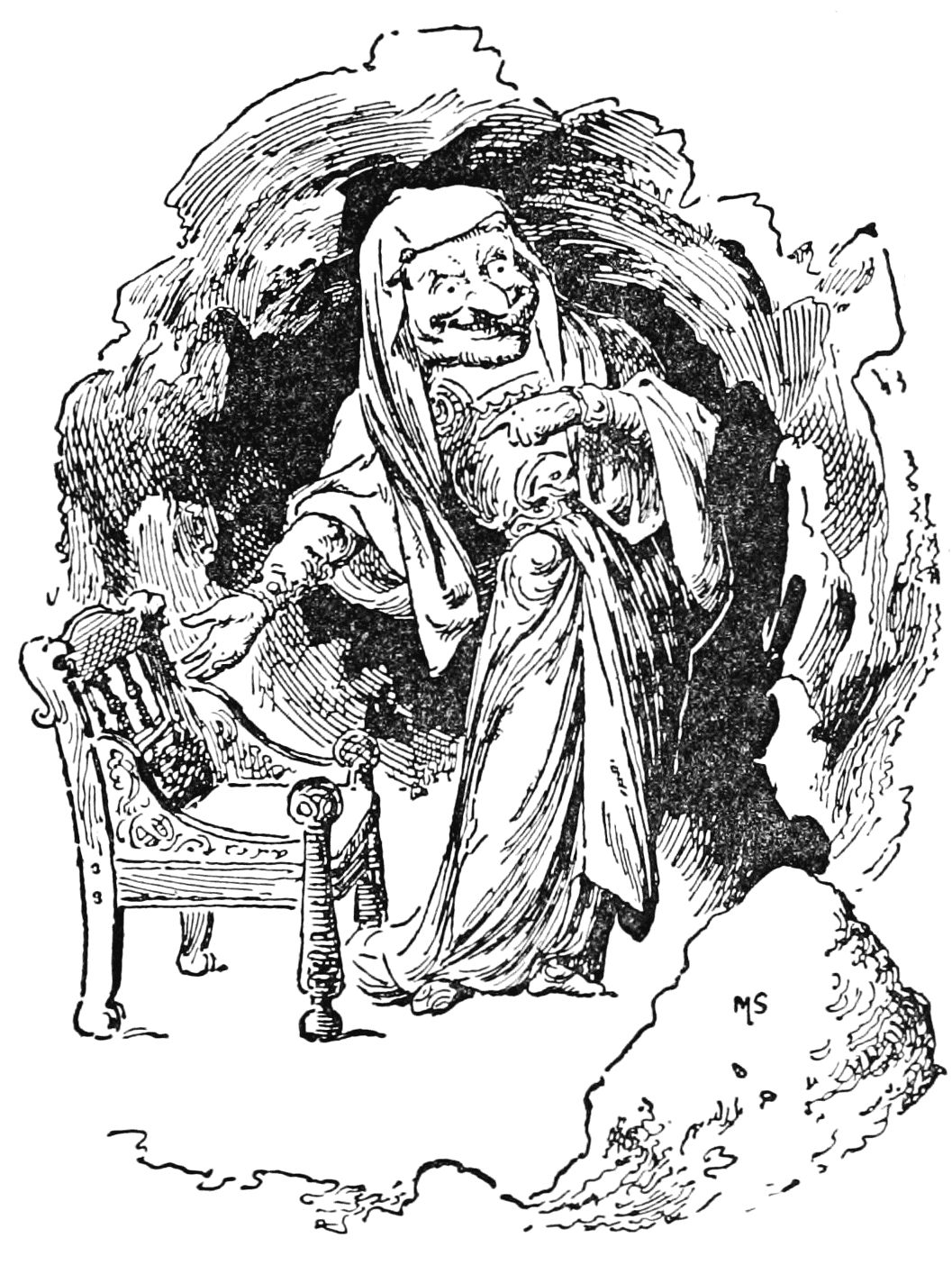
After journeying through many lands, over hills and moors, they came to a sheer rock face that barred their way. The companion knocked and asked to be let in. The rock opened, and once they were deep inside the mountain, an old troll woman appeared with a chair.
“Please sit down. You must be tired,” she said.
“Sit down yourself!” said the man.
The old woman had to sit, and once she had done so, she was stuck fast: that chair would not let go of anyone who came near it.
Meanwhile, the two of them explored the mountain, and the companion looked about until he saw a sword hanging over a door. He was determined to have it, and promised the old troll woman that, if she gave it to him, he would free her from the chair.
“No!” she shrieked. “Ask me for anything else! You can have it all, but not that. It’s my Three Sisters’ sword!”
There were three sisters, and they owned it together.
“Then you can sit there until the end of the world,” said the man.
When she heard that, the old woman said he could take it, as long as he set her free. He took the sword and went away, but left her sitting where she was.
After walking a long way over bare mountains and wide moors, they came to another rock face. The companion knocked and ordered it to open. Everything happened as before: the rock opened, and once they were deep inside the mountain, another old troll woman appeared with a chair and invited them to sit down, for they must be tired.
“Sit down yourself!” said the companion.
The same thing happened to her as to her sister. She dared not disobey, and once she sat in the chair, she was stuck fast.
Meanwhile, the young man and his companion explored the mountain. The companion opened every cupboard and drawer until he found what he was looking for: a ball of golden thread. He was determined to have it, and promised the old troll woman that, if she gave it to him, he would free her from the chair. She said he could take everything she owned, but she would not part with that, for it was her Three Sisters’ ball of thread. But when she heard that she would sit there until Judgement Day unless she gave it to him, she said he could take it, provided he set her free. The companion took it, but left her sitting where she was.
They walked for many days over moors and through forests until they came to yet another rock face. Everything happened just as it had the first two times: the companion knocked, the rock opened, and inside the mountain an old troll woman appeared with a chair and invited them to sit down, for they must be tired.
“Sit down yourself!” said the companion.
And there she sat. They had only passed through a few rooms when he noticed an old hat hanging on a peg behind a door. The companion wanted it, but the old woman would not part with it. It was her Three Sisters’ hat, and she would be utterly wretched if she gave it away. But when she heard that she would sit there until the end of the world unless he had it, she said he could take it, if only he would let her go. Once the companion had the hat safely in his hands, he told her to stay where she was, just like her sisters.
At last they came to a stretch of water. The companion took the ball of golden thread and threw it so hard against the rock on the far bank that it bounced back to them. After he had thrown it a few times, a bridge had formed. They crossed it, and once they were on the other side, the man told the young fellow to wind up the thread as quickly as he could.
“If we don’t get it in at once, the three old troll women will come and tear us to pieces,” he said.
The young man wound as fast as he could. When only the last length of thread remained, the troll women came flying towards them. They swooped down to the water, driving a mist before them, and reached for the end. But they could not catch it, and drowned in the channel.
After a few more days’ walking, the companion said:
“We’ll soon reach the castle where the princess you dreamed of lives. When we get there, go in and tell the king about your dream and what you have come to seek.”
When they arrived, the young man did as he was told and was warmly welcomed. He was given a room for himself and another for his servant. When it was time to eat, he was invited to dine at the king’s own table.
As soon as he saw the princess, he recognised her as the girl he had dreamed he would marry. He told her why he had come, and she answered that she liked him and would gladly marry him, but first he must pass three tests.
When they had finished eating, she gave him a pair of golden scissors and said:
“Your first test is to keep these safe and give them back to me tomorrow at noon. I hardly think that can be very difficult,” she added, pulling a face. “But if you fail, you will lose your life. That is the law. You will be executed, your body displayed on a wheel and your head set on a stake, just like the suitors whose skulls and skeletons you can see outside the palace.”
“There’s nothing difficult about that,” thought the young man.
But the princess was so merry and high-spirited, and teased and flirted with him so much, that he forgot both the scissors and himself. While they were playing and laughing together, she slipped the scissors away without his noticing.
When he went up to his room that evening and told the companion everything that had happened, what the princess had said, and how she had given him the scissors to keep, the companion asked:
“You do have the scissors she gave you, don’t you?”
The young man searched all his pockets, but the scissors were not there. When he realised they were gone, he was beside himself.
“There, there, keep calm. I’ll see if I can get them back,” said the companion.
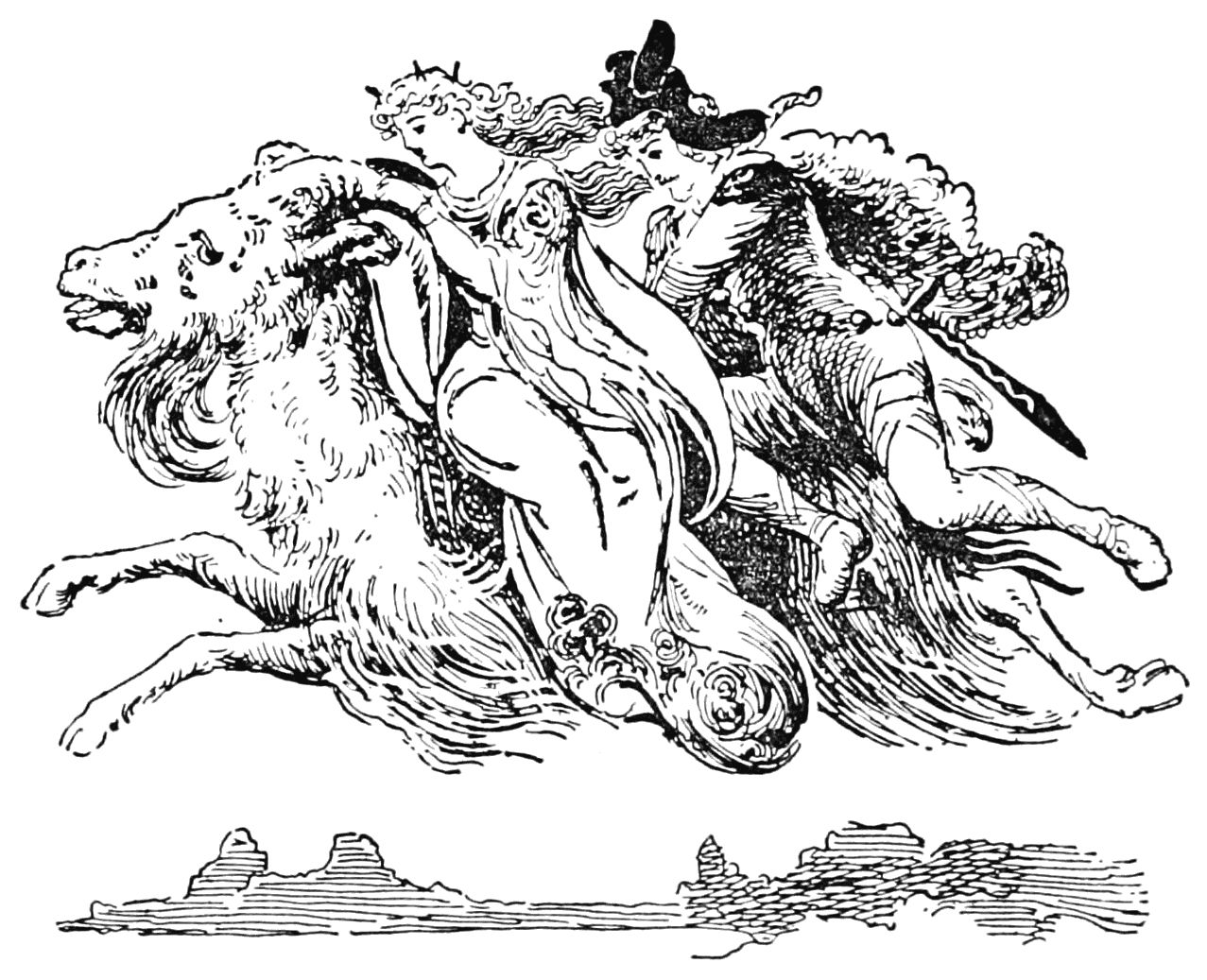
He went down to the stable, where an enormous billy goat belonging to the princess was kept. It could fly through the air many times faster than it could walk on the ground. The companion took the Three Sisters’ sword, struck it between the horns, and asked:
“What time is the princess riding to see her lover tonight?”
The goat bleated that it dared not tell him. But after another blow, it admitted that the princess would come at eleven o’clock.
The companion put on the Three Sisters’ hat, became invisible, and waited for her. When the princess arrived, she smeared the goat with an ointment she carried in a large horn, and said:
“Up into the air, up into the air, over rooftops and steeples, over land and water, over mountain and valley, to my lover, who waits for me in the mountain tonight!”
The moment the goat set off, the companion sprang up behind her, and away they sped through the air like the wind. Before long they reached a rock face. The princess knocked, and they went into the mountain, where her lover, the troll, lived.
“Another suitor has come to marry me, my love,” said the princess. “He is young and handsome, but I want no one but you.”
And she began to coax and caress the mountain troll.
“I set him a test, and here are the scissors he was supposed to keep safe. Now you look after them!” she added.
They both laughed heartily, as though the young man were already dead and laid out on the wheel.
“Yes, I’ll keep them safe, and I’ll sleep in the arms of my bride, while the raven pecks at the young man’s insides,” said the troll.
He put the scissors into an iron chest with three locks. But just as he dropped them in, the companion caught them. Neither the troll nor the princess could see him, for he was wearing the Three Sisters’ hat. So the troll locked the empty chest and hid the keys in the hollow of an aching tooth. The young man would have a hard time finding them there, he thought.
After midnight, the princess set off home. The companion climbed onto the goat behind her again, and they were back in no time.
The next day at noon, the young man was invited to the king’s table. The princess was so disagreeable, so haughty and disdainful, that she would scarcely look in his direction. After the meal, however, she put on a solemn face, became all sweetness, and said:
“Perhaps you have the scissors I asked you to keep yesterday?”
“Indeed I do. Here they are!” said the young man.
He took them out and drove them into the table so hard that it jumped. The princess could not have been more taken aback if he had driven them into her face. Even so, she made herself pleasant again and said:
“Since you have looked after the scissors so well, you should have no trouble keeping my ball of golden thread safe and giving it back to me tomorrow at noon. But if you haven’t got it, you will lose your life and be executed. That is the law.”
The young man thought that would be easy enough and put the ball of golden thread in his pocket. But the princess began joking and flirting with him again until he forgot both himself and the thread. At the height of their fun, she stole it from him and let him go.
When he went up to his room and told the companion what they had said and done, the companion asked:
“You do have the ball of golden thread she gave you, don’t you?”
“Of course I have,” said the young man, reaching into the pocket where he had put it.
But no, it was not there. He was so distraught that he did not know what to do.
“There, there, keep calm,” said the companion. “I’ll see if I can get hold of it.”
He took the sword and the hat and went straight to a blacksmith, where he had twelve våger of iron added to his sword. Then he went to the stable and struck the goat between the horns so hard that it staggered, and asked:
“What time is the princess riding to see her lover tonight?”
“At twelve,” bleated the goat.
The companion put on the Three Sisters’ hat again and waited until the princess arrived with her horn of ointment and smeared it over the goat. She said the same words as before:
“Up into the air, up into the air, over rooftops and steeples, over land and water, over mountain and valley, to my lover, who waits for me in the mountain tonight!”
The moment they set off, the companion sprang onto the goat behind her, and away they sped through the air like the wind. Soon they reached the troll’s mountain. The princess knocked three times, and they passed through the rock to her lover.
“How did you look after the golden scissors I gave you yesterday, my love?” asked the princess. “The suitor had them and gave them back to me!”
The troll said that was quite impossible. He had locked them in a chest with three locks and hidden the key in the hollow of his tooth. But when they opened the chest and looked inside, there were no scissors.
The princess told him she had given the suitor her ball of golden thread.
“Here it is,” she said. “I took it back without his noticing. But what are we to do, if he knows tricks like that?”
The troll did not quite know. After thinking for a while, they decided to build a great fire and burn the ball of golden thread, so they could be sure he would never get it. But just as she threw it into the flames, the companion, who was standing ready, caught it. Neither of them saw him, for he was wearing the Three Sisters’ hat.
When the princess had spent some time with the troll and morning was drawing near, she set off home. The companion sat behind her on the goat, and they were back quickly and safely.
When the young man was invited to dinner, the companion gave him the ball of thread. The princess was even haughtier and more disdainful than the day before. When they had finished eating, she pursed her lips and said:
“I don’t suppose I could be so fortunate as to have back the ball of golden thread I gave you to keep yesterday?”
“Yes,” said the young man. “You certainly can. Here it is!”
He slammed it onto the table so hard that the table jumped and the king leapt in fright.
The princess turned as pale as a corpse, but soon she was making herself pleasant again. She said he had done very well, and there was only one little test left.
“If you are clever enough to bring me, by noon tomorrow, whatever I am thinking of at this very moment, you may have me for your wife,” she said.
The young man felt as though he had been sentenced to death. He thought it impossible to know what she was thinking of, and more impossible still to get it. When he went up to his room, he could hardly be calmed. The companion told him not to worry: he would find a way, just as he had the other two times. At last the young man grew calm and lay down to sleep.
Meanwhile, the companion went to the blacksmith and had twenty-four våger of iron added to the sword. Then he went down to the stable and struck the goat between the horns so hard that it reeled from wall to wall.
“What time is the princess riding to see her lover tonight?” he asked.
“At one,” bleated the goat.
As the hour approached, the companion waited in the stable wearing the Three Sisters’ hat. Once the princess had anointed the goat and spoken the usual words about flying to her lover, who waited for her in the mountain, off they went through the air again, with the companion sitting behind her. But this time he was not gentle. Every so often he struck the princess, now here, now there, until he had nearly beaten her half to death.
When they reached the rock face, she knocked at the gate, which opened, and they went into the mountain to her lover. The princess began to moan and complain. She had never known such rough weather, she said, but it had felt as though someone were riding with her, striking both her and the goat. She must be bruised all over: she had had such a dreadful journey.
Then she told him that the suitor had got hold of the ball of golden thread too. Neither she nor the troll could understand how he had done it.
“But do you know what I’ve thought of now?” she asked.
No, the troll could not guess.
“I told him he must bring me by noon tomorrow whatever I was thinking of. And I was thinking of your head. My love, do you think he can get it?” said the princess, caressing him.
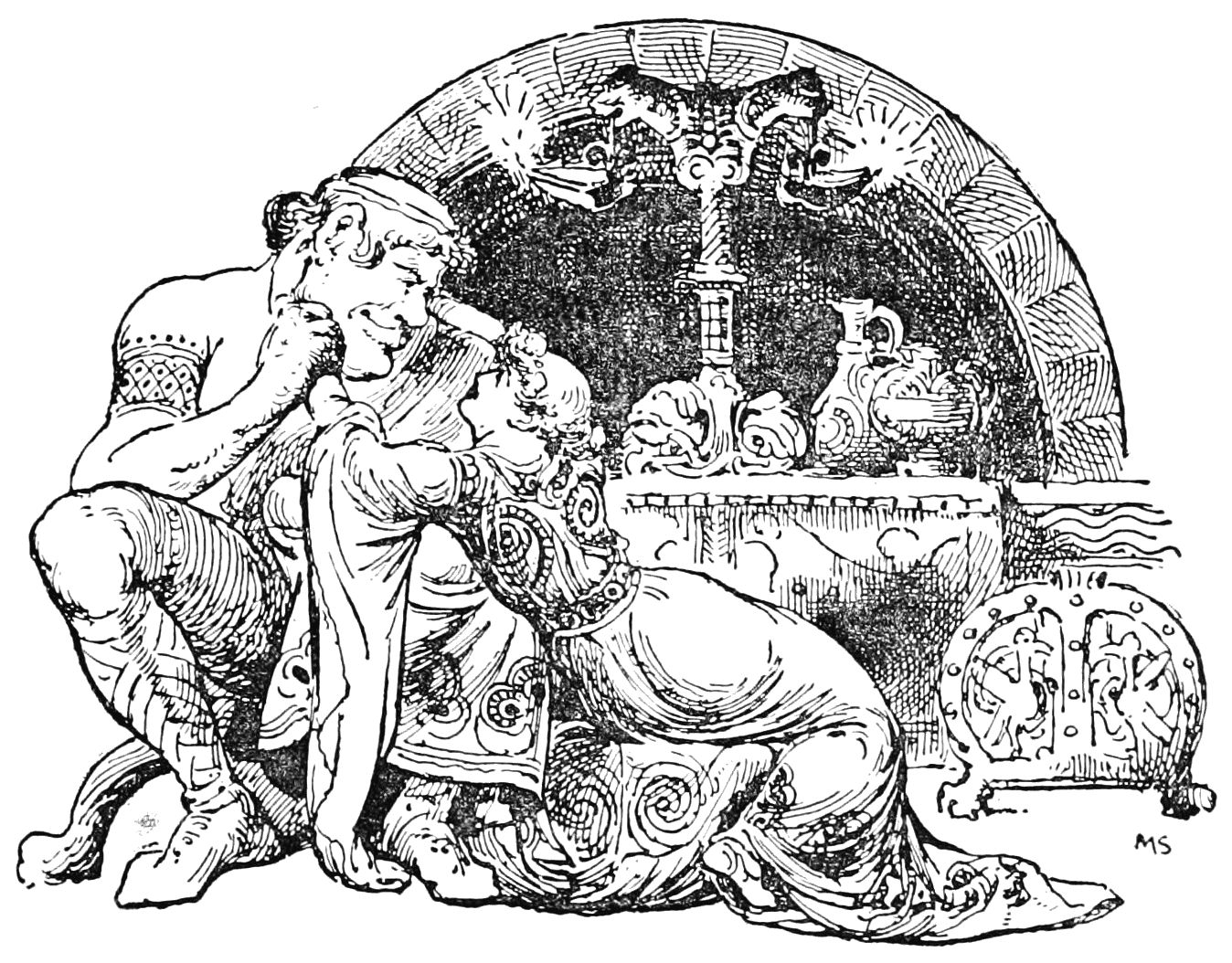
“I think not!” said the troll.
He swore to it, then burst into laughter, roaring more horribly than a ghost. Both he and the princess thought the young man would be laid out on the wheel, with the raven pecking out his eyes, before he ever got hold of the troll’s head.
As morning drew near, she had to go home. But she said she was frightened. She felt that someone was following her, and she dared not make the journey alone. The troll must come with her.
He agreed and brought out his own goat, which was just like the princess’s. He smeared it with ointment too, taking care to anoint it between the horns. When the troll mounted, the companion climbed up behind him, and off they flew through the air towards the palace.
But all the way there, the companion struck the troll and the goat with his sword, blow after blow, until they sank lower and lower and almost plunged into the sea beneath them. Finding himself in such danger, the troll escorted the princess right to the palace and waited outside to see her safely in. But the moment she shut the door behind her, the companion cut off the troll’s head and hurried up to the young man’s room.
“Here is what the princess was thinking of,” he said.
That was good news indeed, as you can imagine. When the young man was invited to the table and they had finished eating, the princess was as cheerful as a lark.
“Perhaps you have what I was thinking of?” she asked.
“Of course I have!” said the young man.
He pulled the head from beneath his coat-tails and slammed it onto the table so hard that the table and everything on it went crashing over. The princess looked as though she had just risen from the grave. But she could not deny that this was what she had been thinking of, and now she had to marry him, as she had promised. So the wedding was celebrated, and there was great rejoicing throughout the kingdom.
But the companion took the young man aside and told him that, on his wedding night, he might shut his eyes and pretend to sleep, but if he valued his life and would listen to his advice, he must not sleep a wink until he had stripped the princess of the troll-skin she wore. He must whip it off her with the twigs from nine newly made birch brooms, then scrub it away in three tubs of milk. First he must scrub her in a tub of last year’s whey, then scour her with sour milk, and finally rinse her in a tub of fresh milk. The brooms were under the bed, and the companion had put the tubs in the corner himself. Everything was ready.
The young man promised to listen and do everything he had been told.
When they got into their bridal bed that evening, he pretended to fall asleep. The princess raised herself on one elbow and looked at him to see whether he was sleeping. She tickled him under the nose, but he slept on. Then she pulled his hair and beard. Still he slept like a log, or so she thought. At last she drew a great butcher’s knife from beneath her pillow and made to cut off his head.
But the young man sprang up, knocked the knife from her hand, and seized her by the hair. He whipped her with the birch twigs until he had worn them all out, with not a stick left. When that was done, he threw her into the tub of whey, and then he saw what sort of creature she was: her whole body was as black as a raven. But once he had scrubbed her with whey, scoured her with sour milk, and rinsed her in fresh milk, the troll-skin came off, and she was sweeter and more beautiful than ever before.
The next day, the companion said they must leave. The young man was ready, and so was the princess, for her dowry had long been prepared. During the night, the companion brought to the palace all the gold, silver and precious things the troll had left in the mountain. By morning, when they were ready to set off, the palace was so full of treasure that they could scarcely move about. That dowry was worth more than all the king’s lands and kingdom, and they did not know how they would carry it away.
But the companion always found a way out of every difficulty. The troll had left six of those flying goats. They loaded them with so much gold and silver that the animals had to walk along the ground, for they could not take to the air beneath such a weight. Whatever the goats could not carry had to be left at the palace.
They travelled on and on, but at last the goats were so worn out that they could not take another step. The young man and the princess did not know what to do. But when the companion saw that they could go no further, he hoisted the whole dowry onto his back, piled the goats on top, and carried the lot until they were only half a mile from the young man’s home.
Then he said:
“Now we must part. I can go no further with you.”
But the young man would not part with him. He would not lose him for anything in the world. So the companion went another half-mile with them, but beyond that he could not go. The young man begged and urged him to come home and stay, or at least to join the welcome-home feast at his father’s house. But the companion said no: it could not be.
Then the young man asked what payment he wanted for having travelled with him and helped him.
“If I am to have anything,” said the companion, “it must be half of everything you produce over the next five years.”
The young man said he should have it.
When the companion had gone, the young man left all his riches where they were and went home empty-handed. They celebrated his homecoming with such a feast that news of it spread through seven kingdoms. Afterwards, it took them the whole winter, making journeys with the goats and his father’s twelve horses, to bring all the gold and silver home.
Five years later, the companion returned to claim his share. By then the man had divided everything into two equal parts.
“But there is one thing you haven’t divided,” said the companion.
“What is it?” asked the man. “I thought I had divided everything.”
“You have fathered a child,” said the companion. “You must divide that in two as well.”
Yes, that was what he must do. The man took the sword, but just as he raised it to cut the child in two, the companion caught the blade near its tip and stopped the blow.
“Aren’t you glad I didn’t let you strike?” he asked.
“Yes, I have never been so glad,” said the man.
“That is how glad I was when you freed me from the block of ice,” said the companion. “Keep everything you have. I need nothing, for I am a spirit that floats through the air.”
He was the wine seller who had stood in the block of ice outside the church door, the one everyone spat on. He had travelled with the young man and helped him because the young man had given everything he had to secure him peace and burial in Christian ground. He had been allowed to accompany him for a year, and that year had ended when they last parted. Then he had been allowed to visit him once more. But now they must part for ever, for the bells of heaven were ringing to call him home.
P. Chr. Asbjørnsen, Norske Folke-Eventyr. Ny Samling (Christiania: I Kommission hos Jak. Dybwad, 1871), no. 100, “Følgesvenden”, pp. 201–214.
Translation notes: the våg (plural våger) is an old unit of weight. The distances given as “miles” represent the Norwegian mil in the original, rather than the English statute mile. I have translated Troldhammen as “troll-skin”, preserving that concrete image, along with the three old troll women, the words spoken before taking flight, and the complete ending. As I mentioned in the introduction, the trolls in this tale have different characteristics: the three old women possess magical objects, while the princess’s supernatural lover combines the traits of an ogre and a sorcerer. These particular features matter if we are to understand their role, rather than relying solely on the familiar image of a monstrous troll that lives in caves or threatens travellers.
The princess’s relationship with this supernatural lover, her nocturnal flight on a billy goat, the use of ointments, and the words spoken before the journey all connect the tale with the imagery of witchcraft. The episode of the old troll woman and her enchanted chair adds to those associations. Read in this light, the antagonist takes on a demonic character, reinforced by his hold over the princess and the deaths of her suitors. This does not mean that all trolls should be equated with demons. It is the particular combination of motifs and roles in this tale that allows us to draw parallels with the sorcerer, the ogre and the demonic lover.
© Arnau Folch / Llegendàrium. This article may be shared by linking to the original publication. Reproduction, translation, adaptation or distribution in full is not permitted without prior authorisation.
