

Tales of the Beast’s Skin (I)
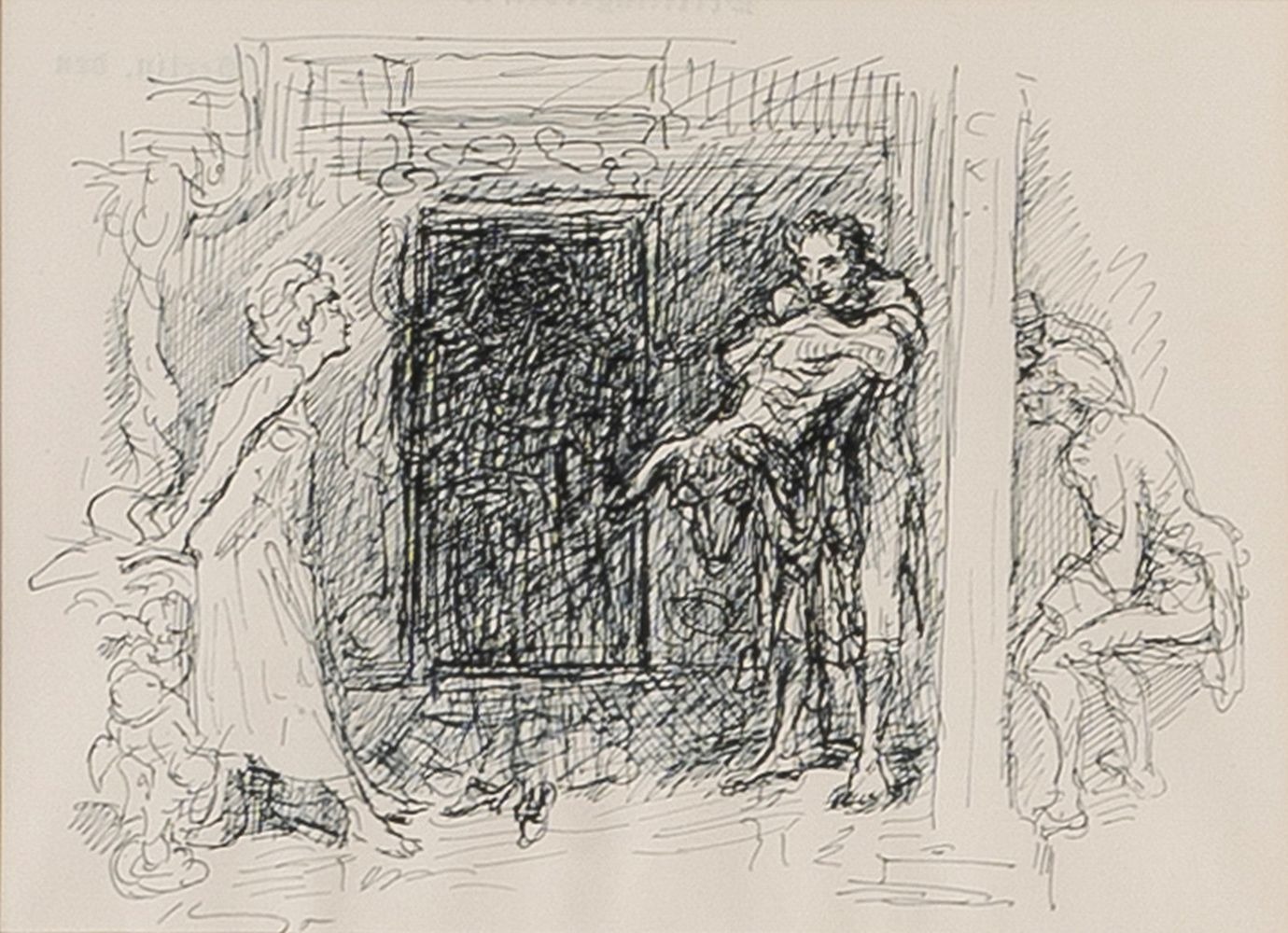
Max Slevogt, Das Eselein (“The Little Donkey”), pen drawing made before 1932. The prince sheds his donkey skin and reveals the human form it concealed. The image accompanies these tales of beast-men and beast-women, in which a skin separates two appearances and its destruction transforms the protagonists’ fate. Public domain.
Animal spouse tales: four complete stories
In this first entry, devoted to animal spouse tales, you can read four of the stories mentioned in Burning the Beast’s Skin: Disenchantment and Rebirth, in full and translated from their original languages. The first is The Girl Who Married a Snake, an Indian tale included in the Panchatantra, in the recension completed by the Jain monk Pūrṇabhadra in 1199. Within it is another very short story, moral and religious in character, Puṣpaka and Death, whose protagonist is a parrot; I have also kept this tale in full.
The second is Asinarius, the Tale of the Donkey, a medieval narrative poem from the German-speaking world, written in Latin and full of exuberance and burlesque humour. The translation is in prose: I have not retained the metre of the Latin couplets, to make it easier for contemporary readers to enjoy. Next comes The Little Donkey, a Grimm tale drawn directly from Asinarius, followed by an endearing and captivating animal musician in Hans My Hedgehog, a tale by the masters Jacob and Wilhelm Grimm. Outside Germany, where it is better known, this tale of a beast-man is not among the brothers’ most famous stories, but it is as enthralling as many others.
The Girl Who Married a Snake
Panchatantra · Pūrṇabhadra’s recension (1199) · India · Sanskrit · ATU 433B
In the city of Rājagṛha lived a Brahman named Devaśarman. His wife had no children and wept bitterly when she saw the neighbours’ little ones. One day the Brahman said to her:
“My dear, grieve no longer. Listen: while I was performing a sacrifice in the hope of obtaining a son, an unseen being said to me quite distinctly, ‘Brahman, you shall have a son endowed with beauty, strength, and good fortune surpassing all other men.’”
On hearing this, the Brahman’s wife felt her heart swell with immense joy.
“May those words come true without hindrance!” she said.
In time she conceived, and when her time came she gave birth to a snake. When she saw it, she ignored all the frightened people of the household who advised her to cast it away. She took it, bathed it, and with a mother’s affection laid it in a large, clean box. She nourished it with milk, fresh butter, and other food, and thus, well fed, the snake grew to maturity within a few days.
But one day the Brahman’s wife saw the wedding celebrations of a neighbour’s son and said to her husband, her face streaming with tears:
“It is plain that you hold me in no regard at all, since it does not even occur to you to celebrate my son’s marriage.”
The Brahman replied:
“Good woman, perhaps if I descend into the underworld and ask Vāsuki, king of the serpents, for a bride, I shall obtain one! Apart from him, foolish woman, who would give his daughter to this son of yours?”
But after speaking he saw his wife looking even more wretched. Out of love for her he took abundant provisions for the journey and set off to travel through foreign lands. After some months he reached a distant city called Kukkuṭanagara. A kinsman lived there, bound to him by mutual affection and knowledge of one another’s virtues. In his house he was welcomed with a bath, food, and the other attentions due to a guest, and there he spent the night.
At dawn he greeted his Brahman host and was preparing to leave when the latter asked:
“What brought you here? And where are you going now?”
“I have come in search of a suitable girl for my son,” he replied.
“If that is so,” said the other Brahman, “I have this daughter of incomparable beauty, and I myself am at your disposal. Take her for your son.”
After these words the Brahman took the girl with her attendants and returned home.
When the people of that region saw the girl’s extraordinary beauty, the incomparable splendour of her figure, and her exceptional charms, their eyes widened with delight.
“How can this be?” they said to her attendants. “Who has given this jewel of a girl to a snake?”
When they heard this, all her elder relations were distressed and said:
“She must be taken away from this spirit-possessed creature!”
But the girl replied:
“Enough of this disputing. Consider the saying:
Kings speak once;
good men speak once;
a maiden is given once.
These three things are done once only.
And again:
What Destiny has ordained,
arising from deeds formerly done,
cannot be altered by anyone:
witness what happened to Puṣpaka.”
Then they all asked her:
“Who was this Puṣpaka?”
The girl told his story.
Puṣpaka and Death
The god Indra had a parrot named Puṣpaka. He possessed extraordinary beauty and charm, excellent qualities, and an intelligence sharpened by the study of many learned treatises.
One day he rested on great Indra’s hand, his body thrilled with delight at the contact, and recited various wise sayings. Then he saw Yama, who had come to pay his respects at the appointed time. At the sight of him the parrot moved away.
All the assembled immortals asked:
“Sir, why did you move away when you saw him?”
“He harms all living beings,” the parrot replied. “How should I not move away at the sight of him?”
Hearing this, they all wished to reassure him and said to Yama:
“Out of consideration for us, you must not kill this parrot.”
“I know nothing of that,” said Yama. “In these matters Time is sovereign.”
So they went with the parrot to Time and made the same request.
“Death knows about that,” Time replied. “Ask Death.”
They did so, but at the mere sight of Death the parrot ceased to live. They were all distressed by what had happened and asked Yama:
“What has occurred?”
“It was ordained that he should die precisely at the sight of Death,” he told them.
On hearing this, they returned to their own dwellings.
The Snake’s Story Continues
“That is why I say, ‘What Destiny has ordained…,’ and the rest. Besides, I do not wish my father to be reproached for his daughter’s faithlessness.”
After speaking thus, the girl married the snake with the consent of her attendants. She began to care for him with great devotion, giving him milk to drink and performing every kind of service.
One night the snake came out of the large box prepared for him in the bedchamber and climbed into his wife’s bed.
“Who is this, in a man’s shape?” she exclaimed.
Thinking him a stranger, she rose with her whole body trembling, opened the door, and was about to flee. Then he said to her:
“My dear, stay. I am your husband.”
To convince her, he re-entered the body he had left in the box, came out again, and approached her. Seeing him resplendent with diadem, earrings, bracelets, armlets, and rings, she fell at his feet. Then they happily gave themselves to the pleasures of love.
His father, the Brahman, had risen before dawn and saw what was happening. He took the snakeskin from the box and, thinking, “Let him not enter it again,” burnt it in the fire. In the morning, with immense joy, he presented to everyone, together with his wife, that wonderfully handsome and enamoured son as his own child.
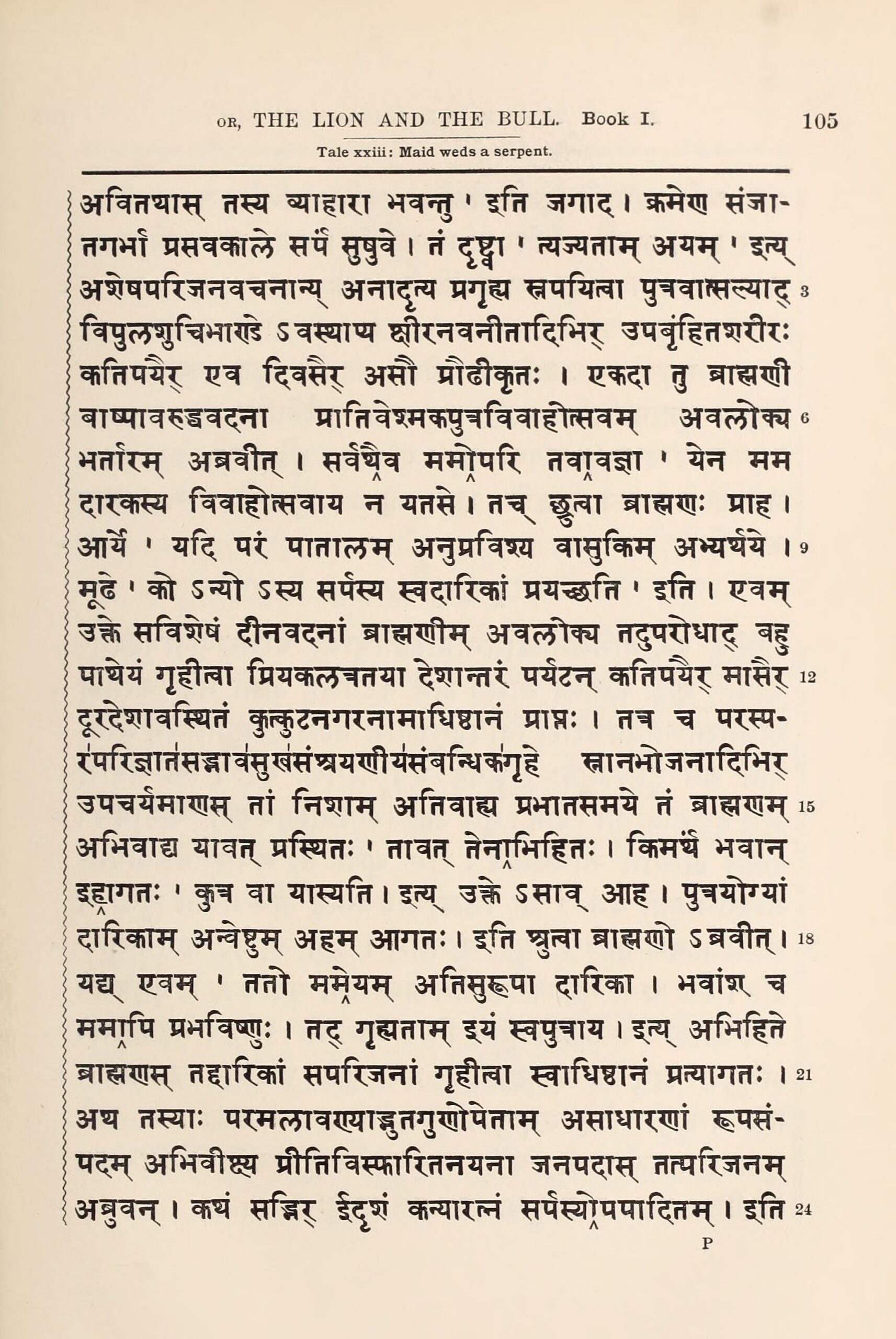
Pūrṇabhadra, Pañcatantra, tantra I, tales 23 and 24, Sanskrit text edited by Johannes Hertel (Cambridge, Massachusetts: Harvard University, 1908), pp. 104–107.
Asinarius, the Tale of the Donkey
Anonymous · German-speaking world · c. 1200 · Latin · ATU 430
There was once a king of an unknown region and city; no page preserves his name. He had been fortunate enough to obtain a wife his equal in nobility, a partner in his kingdom and a companion of his bed. Although the lofty majesty of power blessed them and abundant stores of wealth ennobled them, hostile Lucina denied them offspring: they cultivated the games of Venus in vain. Hence sorrow and lamentation tormented them both, because they had no heir to their kingdom.
At last the queen, pitying her afflicted husband, often repeated these words: “What are we doing? We accomplish nothing. I am weary of living, and ashamed of having so often devoted myself to the games of night. I am an unhappy woman, most like a barren field that swallows the seed cast upon it without hope of harvest. Rightly do I compare myself to a sack full of holes, which discharges elsewhere what it receives through its open mouth. Alas, what use are nobility, wealth, and the glory of a kingdom if the fates deny me an heir?” Thus she assailed the kindly deities with unceasing prayers, begging night and day to become a mother. She obtained what she sought, and before long became the mother of a little donkey: for her offspring was a handsome little donkey.
Oh, what a birth, when a woman brings forth a donkey! Oh, a marvellous thing, but more pitiable still! Seeing her offspring, the mother, who had formerly rejoiced at conceiving, now grieved at having given birth. She would rather not have been a mother than have been the mother of a donkey, and asked that he be given to the fish for food. But the king, learning of the mother’s unjust command, said, “By no means! Let this prodigious creature not die! Let the queen’s son not die! Instead, I command that this son of mine shall live. Whichever god gave him to me as heir, he shall be king upon the throne of my kingdom. His head shall bear his father’s diadem, and all his father’s glory is his due.” By the king’s command he was then nurtured with much affection, as befitted the noble offspring of a king.
He flourished and grew, raising his ears high; already he was becoming a young creature of good disposition. In his father’s kingdom he was already called and treated as a young lord, and every courtier feared him with reverence. He travelled through the towns and cities of the kingdom and delighted in games and amusements; but he delighted still more in the art of cithara-players and longed to learn it, if fortune favoured him. He frequently visited a man whom he knew to be skilled in that art, a celebrated master. He addressed him with these words: “Cithara-player, be my teacher! Teach your young lord the art you know, so that he may not be inferior to you in it.”
Thus he spoke, and the cithara-player replied, “What do you ask of your servant, my young lord? O king, why do you seek what does not suit you? Alas! You are mistaken, deceived; you cherish futile wishes. You cannot learn this art, for your fingers, my young lord, are monstrous. And if I may speak the truth with your permission, you seek what nature denies you. Without a hand you cannot distinguish the strings of the cithara; I think they will snap if you touch them with your foot. An ass brays in its own fashion, but never plays well: the sack-bearer’s voice is that singing hee-haw.”
The musician had spoken. The little donkey raged and wasted away, scarcely able to master the agitation of his heart. “Am I not descended from noble blood?” he said. “Do you not know that I am your king and lord? Where did you acquire, scoundrel, such presumption of speech that you are not afraid to address me so harshly? What do you think of me, glutton, buffoon? Do you perhaps deny that I am of imperial birth?” “I do not deny it, my young lord,” the other replied, “nor shall I ever deny it. Indeed, I believe and know that you are my lord.” “Then obey my commands promptly, if you wish to live in my father’s kingdom!” The musician replied, “My lord, restrain the fury of your mind. See, I willingly obey your commands.”
The cithara-player therefore began sweet melodies upon the lyre, and the teachable donkey answered with equal skill. In a short time he advanced so far in the art that he became a greater master than his teacher. Now he sang like a minstrel in a very clear voice, now he made sweet music with his misshapen thumb. One day, as he wandered beside the rivers, the water revealed his ugly face to him. Looking at his head and ears, he said, “Good heavens! I greatly wonder what this shape can mean!” Running his eyes over his legs and feet, he looked at himself, and his whole body displeased him. Gnashing his teeth, driven by cruel furies, he hissed these blasphemous words:
“Hardly worth a penny was whichever god formed me and gave me being! Shall I, a donkey, possess a king’s diadem? Can I be called both king and donkey? Far be it that a diadem should crown this donkey’s brow or clean purple cover an ass’s bristles! Let no golden medallion hang about my neck: this golden sceptre, I confess, does not suit this hand. Alas, when my father dies I shall be deprived of the honour of the kingdom and forced to suffer many troubles besides. It is better, then, to depart while my father lives, rather than be driven out afterwards by a violent hand.”
From among all his servants he sought one whose loyalty experience had proved. He explained everything he carried in his heart and commanded him to be his travelling companion. The servant agreed, giving his consent to his young lord, and swore to help him. The donkey loaded his musical instruments upon the servant, and by night the quadruped set out with the biped. They reached the shore of the nearby sea, and behold, a ship was there. The proper fare was paid, the sails were spread, and the surface of the deep was furrowed: the vessel flew before favourable winds. The sailor said, “My lord, it is glory enough for me to have carried so young a king!” The donkey began to wander far and wide over the immense sea, seeking a place in the world for refuge. At last he chose to visit the earth’s remotest bounds, where Phoebus plunges his weary horses into the sea.
There a king had raised the capital of his kingdom, illustrious in his lineage of virtues and in his ancestors. As report tells us, he had only one daughter and no other heir. If fortune favoured and the fates allowed it, her father had ordained that she should inherit his kingdom. The maiden had now completed the years of girlhood. Tender hair had grown upon her private parts, and her breasts already gave signs that she could scarcely lie alone in bed without a man. Arriving there, the donkey went to the royal palace, shouting and knocking as he spoke: “Let the door be opened, that the traveller may enter! A guest stands outside: open the doors!”
Hearing the noise of the donkey’s knocking, the gatekeeper said, “Why are you shouting? Who are you, and where do you come from? Why do you knock so insistently at the king’s doors? Why do you strike the gates with such impertinence?” The donkey answered, “Open quickly! An honourable minstrel stands outside.” With these words he began to play the cithara with his foot and sing a sweet melody with his mouth wide open. When the gatekeeper heard the sweet harmony, he leapt out to see who it was and what he was doing. Seeing the donkey’s rough and ugly shape, he marvelled that he could play so skilfully. In his amazement the man entered the king’s private chambers, wishing to report the wonders he had seen. “Illustrious king,” he said, “something new has arrived; if you wish to know it, I shall tell you. Outside the doors stands a most extraordinary minstrel; I do not believe another could be stranger. This rare minstrel, O king, is an ugly donkey who plays the cithara and sings at the same time. He asks to enter. If the king commands, let him come in.” The king answered, “Let him enter!”
Then the musician entered, plucking the strings with his donkey’s thumb and shaping new melodies. When the king saw him, he loosed the reins of laughter, and that mighty laughter knew no measure. The queen, laughing at her laughing husband, could not speak for laughter. Young and old of every rank guffawed, and the whole court rang with the noise. While everyone rejoiced and the donkey played, the day closed with the setting sun. At the customary hour the royal supper was prepared, and the palace company sat down to dine. The king and queen took their royal seats, and the daughter sat beside her mother.
Then those wearing the mantle of warriors were seated, while the servants sat lower down. One of the officers approached and ordered the donkey to take his place with the servants. “By no means!” said the little donkey. “I must not dine with serving-men. A servant’s rank does not suit me. I am no common donkey, nor a stable beast: rather, I am clothed in courtly nobility.” “Do you wish, then, to join the knights?” asked the officer. “By no means! That place does not please me either. Until now the royal table has readily received me as a companion and provided abundant dishes.” “What do you want me to do for you?” the steward answered. “Seat me at the king’s table,” said the donkey. Learning this, the king said, “Let the little donkey come here!” Called by the king’s voice, he came at once.
Then the king, smiling with a serene face, said playfully, “Little donkey, do you like our daughter?” Immediately the donkey lifted his head, turned his eyes upon the maiden, and answered, “Good heavens! What do you ask, O king? What do you endeavour to discover? Why should she not please me? Indeed she pleases me, pleases me greatly, I tell you! A man must be made of iron if she does not please him at all. Her fair face mingled with blushes delights me, as though I were looking at lilies mingled with roses. Her hair pleases me, her ivory neck delights me, and I confess that her whole body pleases me.” “Would you like to dine beside this maiden?” asked the king. The exiled little donkey answered:
“That pleases me. That, I tell you, enlarges this poor donkey’s heart. That seat and place suit me. I shall be content here as the maiden’s companion: that measure of honour will suffice.” “As you wish,” said the king. “Dine beside the maiden, and I command that the same food shall feed you both.” “O king,” said the donkey, “rightly do I thank you, for through you such glory comes to me.” He climbed a step and took an elevated seat, and the maiden placed him beside her as her fellow diner. During supper the donkey served her well, breaking up her bread and cutting her rolls. He lifted cups and goblets to offer her when she wished to drink, and held the napkin while she drank. Why recount each detail? I shall touch on everything briefly: the well-taught donkey did everything gracefully.
Her companion at table therefore pleased the maiden not a little, but, unless I am mistaken, he would please her still more. He pleased her at dinner; he would please her more in bed, when she married that beloved husband. The donkey’s goodness also delighted the king, for he was better mannered than a donkey ought to be. The knights likewise exalted him with praise, and the whole city proclaimed him worthy of commendation. When the exile had stayed there for some time, he thought of returning to his father’s home. Entering the king’s private chambers sadly, he began with lowered head: “One’s native land is usually sweeter than exile, and what pleases others pleases me as well. If I may speak without offence, O king, with my sword girded on I bid you farewell.”
The king replied, “There shall be no parting, nor shall I allow us to be separated except by the lot of death. I call Jupiter to witness that no permission remains and no opportunity to depart shall be given you. My son, are you not content with our honours? Are you not content to be my son? Tell me, my son, what is wrong? Why are you sad? From where does this little stream of sorrow flow? Tell me, I beg you! Here you shall not be an exile, nor shall you be considered a guest; you must not be less than any citizen. You shall have heaps of coins of every kind: by Hercules, I shall measure them out to you without measure. Do you seek clothes, horses, or other such things as a pleasure-loving man desires and pursues? I call the heavenly gods and all the rural deities to witness: if you wish, I shall even divide the kingdom with you.” But these promises did not bend the donkey: for love of his native soil he rejected everything.
“There is still one choice left to you, my son,” said the king. “If you reject it, you will always be a donkey. Do you wish our daughter to be given into your arms, to share the games of night with you?” Then the little donkey cried out as though waking from sleep: “This bargain alone pleases me, I confess! This will end my sorrow and anxiety, the doorway of joy, the gate of deliverance. If you prove your words with deeds, O greatest of kings, I shall be able to say that I am greater than Jupiter. Let Jupiter enjoy his Juno in heaven: on earth the royal maiden is enough for me. Keep everything that is yours, O king; reserve it all for yourself. Give me the maiden: I ask for nothing else. With this maiden alone I shall be content and shall not seek to depart, venerable king. Let her be my homeland, my honour, the glory of my kingdom, and wealth enough for me. I have answered you, king: by this you will keep a friend. Only deign to be my father-in-law!”
Royal majesty therefore summoned his daughter. She obeyed and appeared, and the king and father asked, “King’s daughter, do you wish to marry a young man? If you do, daughter, marry this man!” The maiden, her face suffused with its customary blush, lowered her eyes to the ground at her father’s words. Without speaking she briefly considered what answer she should give him. At last she opened the barriers of her mouth and burst into speech: “It is fitting that my father’s command should be fulfilled. Let my father’s appointed will be done, not mine. My father, I depend entirely upon your desire. If you wish, I am the wife of the man to whom you have promised me. Be his father-in-law, and let him be your son-in-law.” Then the king joyfully said to the donkey, “Take the maiden: be her husband, and let her be your wife!”
The donkey received the maiden from her father, and king and son-in-law appointed a solemn festive day. The city was adorned and shone with such honour that the city itself was more pleasing than heaven. A great crowd of entertainers swarmed in like bees, and each worked hard at his own art. One raised his legs overhead and lowered his head, walked in that fashion, and made his hands perform the work of feet. Then the people were invited and seated to eat; the whole day became a dance of rejoicing. When bright Hesperus brought the sleep-inviting hour when woman and man devote themselves to lawful Venus, the little donkey fearlessly entered the maiden’s chamber to caress his tender bride’s bosom. He therefore entered the chamber, where two lights had been placed at the king’s command. A servant had been stationed by night beneath a veil to see what the donkey and maiden would do. When everyone had left and no one was thought to remain, the door was secured with a bar.
At once the bridegroom laid aside his donkey’s clothing and, putting off his old skin, became a new man. The maiden saw the noble body of a handsome man who had formerly borne the ugly likeness of a donkey. Marvelling at her husband’s unbelievable beauty, she plunged headlong into the snares of Venus. Both clasped one another’s necks in their arms and surrendered mouth to mouth. He sprang immediately into bed, and the girl followed: what followed they know, and the bed itself knows too. Nor do I suppose the watcher could have remained unaware of what games were played that night and what they were like. For a time he assuaged the heat of desire, and she performed a wife’s part towards her husband. When rosy Aurora returned, driving away the darkness, he leapt from his bride’s embrace, clothed himself once more in the donkey’s garment, and became the same little donkey as before.
In the morning the father came and knocked at the door. “Come, daughter! Your father is outside: open!” She quickly drew back the bolts and greeted him. “Welcome, my father! Greetings! Father, rightly do I give you countless thanks, for through you I have married a beloved husband.” “Is this husband dear to you?” her father asked. With a cheerful face she answered, “In all the world no one is dearer to me than he. I truly love my husband with all my heart.” Yet she did not reveal her husband’s identity or that a man lay hidden beneath the ugly skin. After a little while the father took leave, left daughter and son-in-law, rose, and went outside. The servant who had lain beneath the curtain that night hurried after him.
The king had appointed him night watchman to spy upon what the two would do. Meaning to explain what he had heard and seen, he poured these words into his king’s ears: “Unconquered king, illustrious king, venerable king, graciously hear your servant’s words! Last night, as I lay beneath the curtain, I saw a most extraordinary thing. When this son-in-law of yours believed himself alone at night with his wife, he immediately stripped off the donkey’s covering and assumed an imperial appearance. What shall I tell you, my lord, of what he and she did? Know that they devoted the whole night to Venus. When the husband bade farewell to his wife and Venus, he clothed himself in his former skin again. Now, my lord, if you wish to verify what I suggest, you can prove it this coming night. Enter secretly the chamber where your daughter and son-in-law will rest. When you find the donkey skin there, take it without your son-in-law’s knowledge and give it to the fire. When the blazing fire has consumed that ugly garment, he will remain a man until the day of his death.” “Let it be so,” said the king. “Tonight I shall test your advice. Perhaps this night will give me what I have wished for.”
The king therefore entered the chamber in the darkness of night. Behold, daughter and son-in-law lay upon the bed. Since sleep is wont to steal upon lovers after Venus, both were overcome by deep slumber. Advancing softly, the king approached the bed and saw a beautiful body there. He immediately took away the donkey skin and departed without his son-in-law noticing. He ordered a furnace to be lit with abundant fuel, and at his command the skin became ashes in it. Wishing to know what the young man would do, the king remained awake all night before the door.
In the morning the son-in-law rose, satisfied with sleep, and wished to put on the donkey skin as before. Unable to find it, and tormented by great distress, he began anxiously to think of nothing but flight. He went outside, but the king barred his way. “Where are you hurrying, my son? What troubles you? What is the matter? That intention shall certainly be frustrated, and your journey entirely prevented. I do not want you to lament the loss of your donkey skin, for you are a handsome, well-formed man. Now, while I live, I share my kingdom with you; after my death, possess the whole of it alone.” His son-in-law answered, “I shall gladly do so and remain with you. I pray that this good beginning may have a good end.”
The kingdom was therefore divided in two: half was offered to the son-in-law, and one part remained with the father-in-law. After this division the wheel of the year had not yet turned full circle when the aged king fell beneath death’s sword. Then Neoptolemus became sole monarch of the kingdom and claimed it all for himself. He inherited his own father’s honour besides, and thus, king of kings, ruled the two kingdoms of two kings.
Anonymous, Asinarius, Latin text reproduced by Johannes Bolte and Georg Polívka in Anmerkungen zu den Kinder- u. Hausmärchen der Brüder Grimm, vol. III (Leipzig: Dieterich, 1918), pp. 154–165, lines 1–404.
The Little Donkey
Jacob and Wilhelm Grimm · Germany · KHM 144 · 1857 edition · German · ATU 430
There was once a king and queen who were rich and had everything they wished for, except children. The queen lamented this day and night, saying, “I am like a field in which nothing grows.”
At last God granted her wishes; but when the child came into the world, it did not look like a human child: it was a little donkey.
When the mother saw it, her wailing and crying began in earnest. She would rather have had no child at all than a donkey, and said it should be thrown into the water for the fish to eat. But the king said, “No. Since God has given him to us, he shall also be my son and heir, sit upon the royal throne after my death, and wear the royal crown.”
So the little donkey was brought up and grew, and his ears, too, grew beautifully tall and straight.
Otherwise he was of a cheerful disposition, jumping about and playing, and he especially delighted in music. He went to a famous musician and said, “Teach me your art, so that I can play the lute as well as you.”
“Ah, my dear young lord,” replied the musician, “you will find that difficult. Your fingers are not altogether suited to it and are much too large. I am afraid the strings will not bear it.”
No excuse was any use. The little donkey wanted to play the lute and play it he must. He was persistent and diligent, and in the end learnt to play as well as his master himself.
One day the young lord went walking thoughtfully and came to a spring. He looked into it and saw his little donkey’s shape in the mirror-clear water. This made him so sorrowful that he went out into the wide world, taking only one faithful companion with him. They travelled here and there and at last came to a kingdom ruled by an old king, who had only one daughter, but she was wonderfully beautiful.
“We shall stay here,” said the little donkey. He knocked at the gate and called, “There is a guest outside. Open up and let him in!”
When no one opened, he sat down, took his lute, and played it with his two forefeet most sweetly. The gatekeeper opened his eyes very wide, ran to the king, and said, “Outside the gate sits a little donkey who plays the lute as well as a trained master.”
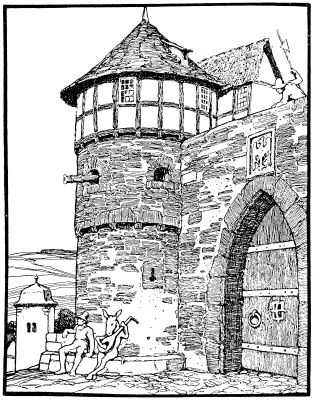
“Then let that musician come in,” said the king.
But when a little donkey entered, everyone began laughing at the lute-player.
They were going to seat the little donkey down below with the servants and feed him there, but he grew indignant and said, “I am no ordinary stable donkey. I am a noble one.”
“If that is so,” they said, “sit with the men-at-arms.”
“No,” he said, “I want to sit with the king.”
The king laughed and said good-humouredly, “Yes, it shall be as you ask. Little donkey, come here beside me.”
Then he asked, “Little donkey, how do you like my daughter?”
The little donkey turned his head towards her, looked at her, nodded, and said, “Exceedingly well. She is more beautiful than any girl I have ever seen.”
“Then you shall sit beside her, too,” said the king.
“That suits me very well,” said the little donkey. He sat down beside her, ate and drank, and knew how to behave neatly and politely. When the noble little animal had stayed at the king’s court for a good while, he thought, “What use is all this? You must go home again.” He let his head droop sadly, came before the king, and asked leave to depart.
But the king had grown fond of him and said, “Little donkey, what is the matter? You look as sour as a jug of vinegar. Stay with me, and I will give you whatever you ask. Do you want gold?”
“No,” said the little donkey, shaking his head.
“Do you want precious things and jewels?”
“No.”
“Do you want half my kingdom?”
“Oh, no.”
Then the king said, “If only I knew what would make you happy! Do you want my beautiful daughter for your wife?”
“Oh, yes,” said the little donkey. “I should certainly like to have her.”
All at once he was cheerful and in high spirits, for that was precisely what he had wished for. So a great and splendid wedding was celebrated.
That evening, when the bride and bridegroom were taken to their little bedchamber, the king wanted to know whether the little donkey would behave properly and politely, and ordered a servant to hide there. When the two were inside, the bridegroom bolted the door, looked around, and, believing they were quite alone, suddenly threw off his donkey skin and stood there as a handsome royal young man.
“Now you see who I am,” he said, “and you also see that I was not unworthy of you.”
The bride was delighted, kissed him, and loved him with all her heart. But as morning approached he sprang up, put on his animal skin again, and no one would have guessed who was hidden inside it.
Soon the old king came along as well. “Why,” he cried, “is the little donkey already awake? You must be very sad,” he said to his daughter, “not to have got a proper human being for a husband.”
“Oh, no, dear Father. I love him as much as if he were the handsomest of all, and I mean to keep him all my life.”
The king was astonished; but the servant who had hidden himself came and revealed everything.
“That cannot possibly be true,” said the king.
“Then keep watch yourself the following night, and you will see it with your own eyes. And do you know what, my lord king? Take away his skin and throw it into the fire. Then he will have to show himself in his true shape.”
“Your advice is good,” said the king. That evening, when they were asleep, he crept inside. As he approached the bed he saw, in the moonlight, a splendid young man resting there, and the discarded skin lying on the floor.
He took it away, had a great fire lit outside, and ordered the skin to be thrown into it. He himself stayed until it had burnt entirely to ashes. But because he wanted to see how the man deprived of it would behave, he remained awake all night and listened.
When the young man had finished sleeping, at the first light of morning, he got up and wanted to put on the donkey skin, but it was nowhere to be found. He was frightened and said, full of sorrow and anxiety, “Now I must find a way to escape.”
But as he went out, the king was standing there and said, “My son, where are you going in such a hurry? What do you intend? Stay here. You are so handsome a man that I will not have you leave me again. I give you half my kingdom now, and after my death you shall have it all.”
“Then I wish that this good beginning may also have a good ending,” said the young man. “I will stay with you.”
The old king gave him half the kingdom, and when he died a year later the young man had the whole of it. After his own father’s death he received another kingdom as well, and lived in complete splendour.
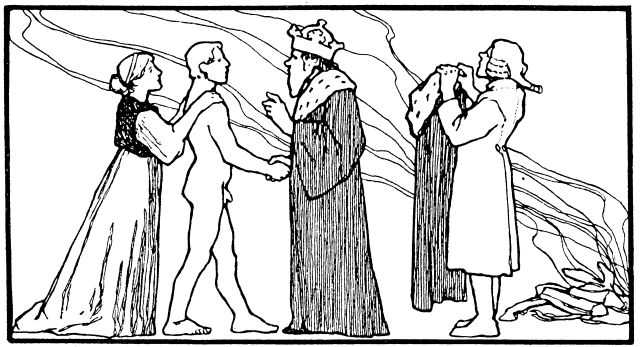
Jacob and Wilhelm Grimm, “Das Eselein”, Kinder- und Haus-Märchen, 7th ed., vol. II (Göttingen: Dieterich, 1857), no. 144, pp. 264–267.
Hans My Hedgehog
Jacob and Wilhelm Grimm · Germany · KHM 108 · 1857 edition · German · ATU 441
There was once a farmer who had money and property enough, but rich though he was, something was lacking in his happiness: he and his wife had no children. Often, when he went to town with the other farmers, they mocked him and asked why he had no children.
At last he grew angry, and when he came home he said, “I want a child, even if it should be a hedgehog!”
Then his wife had a child that was a hedgehog above and a boy below. When she saw it, she was frightened and said, “You see, you have put a curse on us!”
“What use is all that now?” said the man. “The boy must be christened, but we cannot invite anyone to be his godfather.”
“And we cannot christen him anything but Hans My Hedgehog,” said the wife.
When he was christened, the priest said, “With his prickles, he cannot be put in a proper bed.”
So a little straw was arranged behind the stove, and Hans My Hedgehog was laid upon it. He could not suckle at his mother’s breast either, for he would have pricked her with his spines. Thus he lay behind the stove for eight years. His father was tired of him and thought, “If only he would die!” But he did not die; he remained lying there.
Now it happened that there was a market in town, and the farmer wanted to go. He asked his wife what he should bring her.
“A little meat and a few rolls, things for the household,” she said.
Then he asked the maid, who wanted a pair of slippers and some clocked stockings. Finally he also said, “Hans My Hedgehog, what would you like?”
“Father,” he said, “please bring me some bagpipes.”
When the farmer came home, he gave his wife what he had bought her, the meat and the rolls; then he gave the maid the slippers and stockings, and finally went behind the stove and gave Hans My Hedgehog the bagpipes.
When Hans had the bagpipes, he said, “Father, go to the smithy and have my cockerel shod. Then I will ride away and never come back.”
The father was glad to be rid of him and had the cockerel shod. When it was ready, Hans mounted it, rode away, and took some pigs and donkeys with him, intending to herd them in the forest.
In the forest the cockerel had to fly with him up a tall tree. There he sat watching the donkeys and pigs, and there he stayed for many years until the herd was very large, and his father knew nothing of him. As he sat in the tree, he played his bagpipes and made very beautiful music.
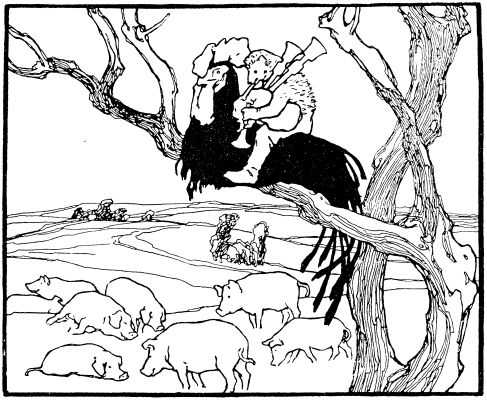
Once a king drove past who had lost his way. He heard the music, marvelled at it, and sent his servant to look around and see where it came from. The servant looked but saw nothing except a little animal sitting high in a tree. It looked like a cockerel, with a hedgehog sitting on it and making the music. The king told the servant to ask why he was sitting there and whether he knew the road to the king’s country. Hans came down from the tree and said he would show the way if the king would promise, in writing, to give him whatever first came to meet him at the royal court when he returned home.
The king thought, “I can easily do that. Hans My Hedgehog will not understand, and I can write whatever I like.” He took pen and ink and wrote something down. When it was done, Hans showed him the way, and he arrived home safely. When his daughter saw him from afar, she was so delighted that she ran to meet him and kissed him.
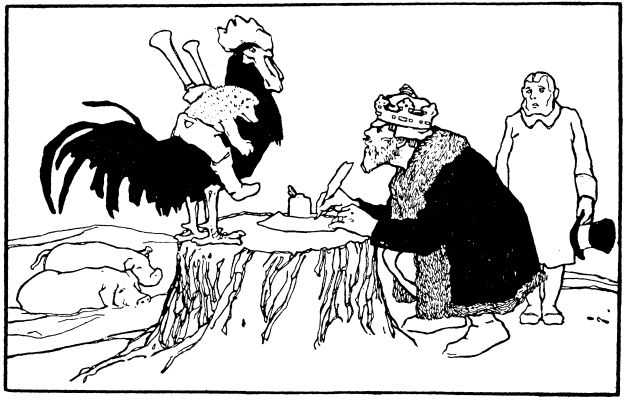
Then he remembered Hans My Hedgehog and told her what had happened: he had been asked to promise a strange animal in writing whatever first met him at home; the animal rode on a cockerel as though on a horse and made beautiful music; but he had written that it should not have it, since Hans My Hedgehog could not read. The princess was glad and said that was a good thing, for she would never have gone with him.
Meanwhile Hans herded his donkeys and pigs, always cheerful, sitting in the tree and playing his bagpipes. Now another king came driving along with his servants and runners. He had lost his way and could not find his way home, for the forest was very large. He too heard the beautiful music from afar and told his runner to find out what it was.
The runner went beneath the tree and saw the cockerel sitting there with Hans My Hedgehog on its back. He asked what he was doing up there.
“I am herding my donkeys and pigs. But what do you want?”
The runner said that they were lost and could not return to their kingdom, and asked whether he would show them the way. Hans came down from the tree on his cockerel and told the old king that he would show him the way if he would give him as his own whatever first came to meet him before his royal castle when he returned home.
The king said yes and signed a written promise to Hans My Hedgehog: he should have it. Then Hans rode ahead on his cockerel and showed the way, and the king returned safely to his kingdom. When he entered the courtyard, there was great rejoicing.
He had an only daughter, who was very beautiful. She ran to meet him, threw her arms round his neck, kissed him, and rejoiced that her old father had returned. She also asked where he had been for so long. He told her that he had lost his way and had almost never returned, but while travelling through a great forest he had found someone, half hedgehog and half man, sitting astride a cockerel in a tall tree and making beautiful music. That creature had helped him and shown him the road. In return, he had promised him whatever first met him at the royal court, and that was she, and now he was very sorry.
But she promised that, for love of her old father, she would gladly go with him when he came.
Hans My Hedgehog continued herding his pigs. The pigs had more pigs, and they became so numerous that the whole forest was full of them. Then Hans no longer wished to live in the forest. He sent word to his father that all the stables in the village should be cleared, for he was coming with such a great herd that anyone who wanted to slaughter pigs could do so. His father was distressed when he heard this, for he thought Hans My Hedgehog had been dead for a long time.
But Hans mounted his cockerel, drove the pigs before him into the village, and let them be slaughtered. Oh, what a butchering and chopping there was! It could be heard two hours’ journey away. Afterwards Hans said, “Father, have my cockerel shod once more at the smithy. Then I will ride away and never return as long as I live.”
The father had the cockerel shod and was glad that Hans did not mean to return.
Hans rode to the first kingdom. There the king had ordered that if anyone came riding on a cockerel and carrying bagpipes, everyone should shoot, strike, and stab at him so that he could not enter the castle. When Hans came riding up, they charged him with bayonets, but he spurred his cockerel, flew up over the gate, and landed before the king’s window. He called to him to give him what he had promised, or he would take both his life and his daughter’s.
The king spoke kindly to his daughter and asked her to go out to him to save both their lives. She dressed in white, and her father gave her a carriage with six horses, splendid servants, money, and property. She got in, and Hans, with his cockerel and bagpipes, sat beside her. They took their leave and drove away, and the king thought he would never see her again.
But things turned out differently. When they were a little way from the town, Hans took off her beautiful clothes and pricked her with his hedgehog skin until she was covered in blood.
“That is the reward for your deceit,” he said. “Go away. I do not want you.”
He drove her home, and she was disgraced for the rest of her life.
Hans rode on with his cockerel and bagpipes to the second kingdom, where he had also shown the king the way. That king had ordered that if someone like Hans arrived, they should present arms, admit him freely, shout “Long live!” and bring him into the royal castle. When the king’s daughter saw him, she was frightened, for he looked exceedingly strange. But she thought there was no help for it: she had promised her father.
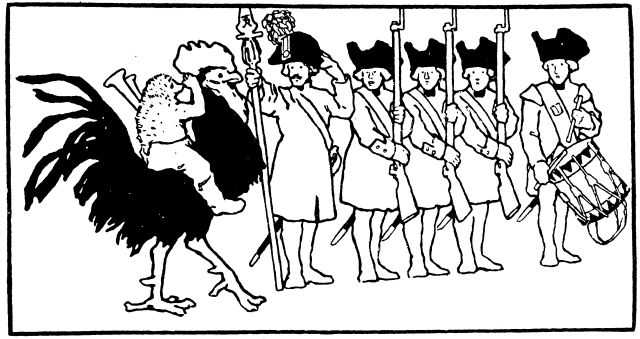
She welcomed Hans and was married to him. He had to come to the royal table, and she sat beside him, and they ate and drank.
When evening came and they were going to bed, she was very afraid of his spines. But he told her not to be afraid, for she would suffer no harm. He also told the old king to appoint four men to keep watch outside the chamber door and build a great fire. When he entered the chamber and was about to go to bed, he would crawl out of his hedgehog skin and leave it in front of the bed. The men must then spring forward, throw it into the fire, and stay beside it until the fire had consumed it.
When the clock struck eleven, Hans entered the chamber, stripped off his hedgehog skin, and left it before the bed. The men came, quickly took it, and threw it into the fire. When the fire had consumed it, he was released from enchantment and lay in bed in an entirely human shape, but coal-black, as though burnt. The king sent for his physician, who washed him with good ointments and anointed him with balsams. Then he became white and was a handsome young gentleman.
When the king’s daughter saw this, she was glad. Next morning they rose joyfully, ate and drank, and then the wedding was celebrated in earnest. Hans My Hedgehog received the kingdom from the old king.
After some years he travelled with his wife to his father and said he was his son. But his father said he had none. He had had only one, but he had been born like a hedgehog with spines and had gone out into the world. Then Hans made himself known. The old father rejoiced and went with him to his kingdom.
My tale has come to its end
and goes past Gustchen’s house, my friend.
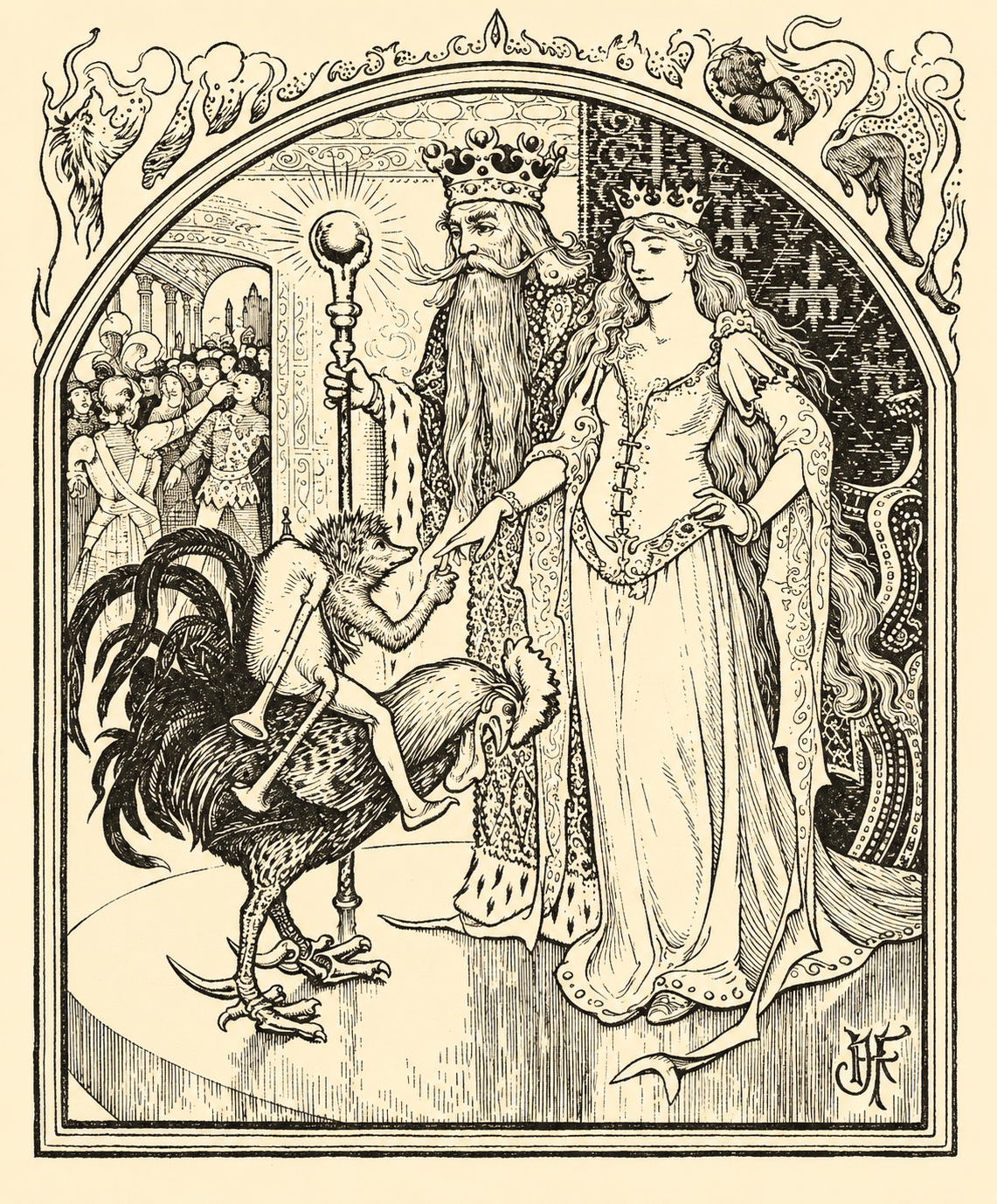
Jacob and Wilhelm Grimm, “Hans mein Igel”, Kinder- und Haus-Märchen, 7th ed., vol. II (Göttingen: Dieterich, 1857), no. 108, pp. 114–119.
© Arnau Folch / Llegendàrium. This article may be shared by linking to the original publication. Reproduction, translation, adaptation or distribution in full is not permitted without prior authorisation.
