


The Order of the Hatchet of Tortosa: Evolution and Parallels — Part II
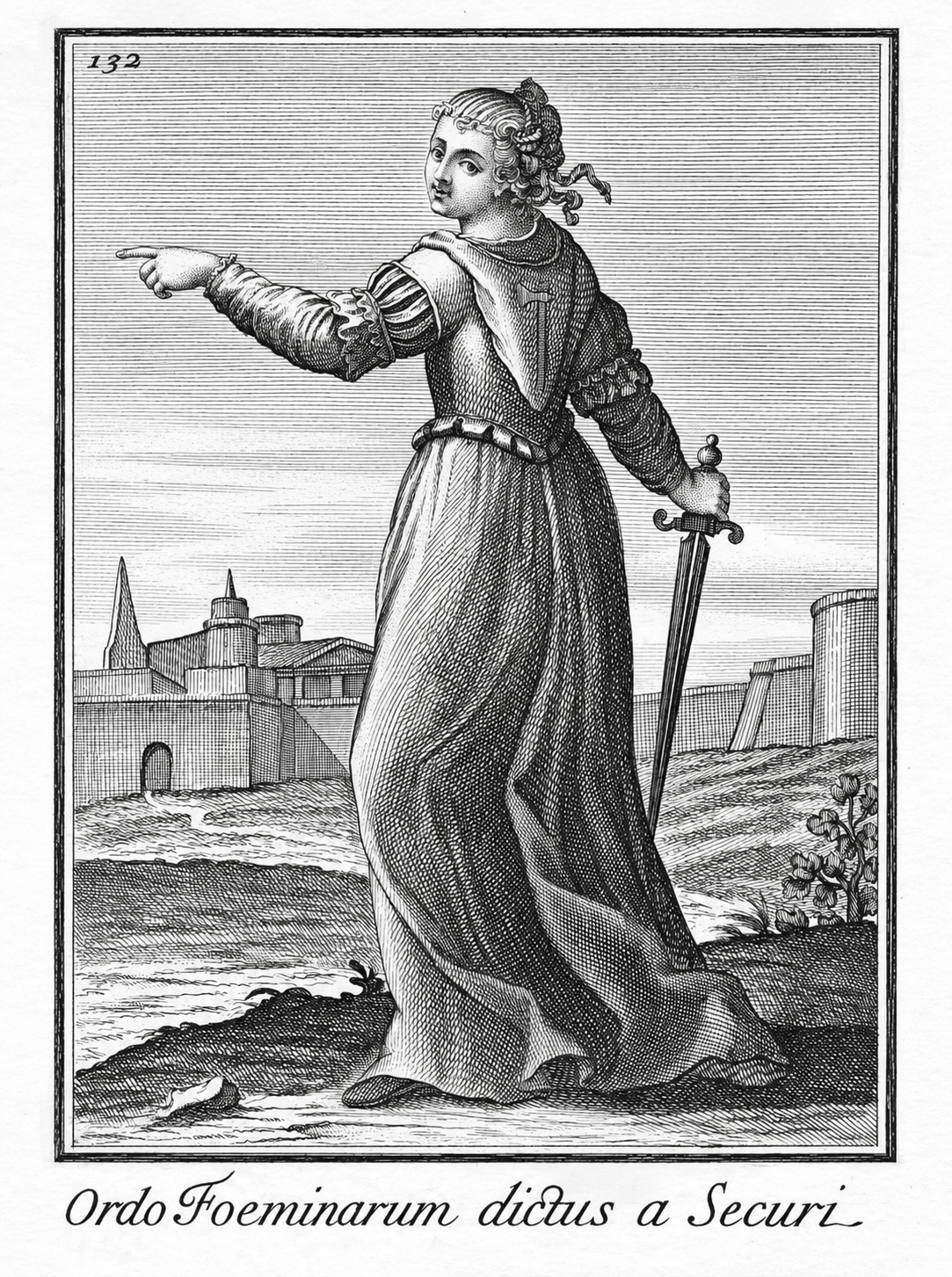
A lady of the Order of the Hatchet in an engraving by Filippo Bonanni (1711), with the inscription “Ordo Foeminarum dictus a Securi”, The women’s order known as the Order of the Hatchet.
The legend of the Order of the Hatchet of Tortosa changed over the centuries. The account recorded by Cristòfor Despuig developed into a story of women warriors and the foundation of a female military order. In this second article, we will trace that evolution through the authors who transmitted the legend and compare it with other stories of women defending besieged cities. If you have not yet read it, Part I provides an English translation of Despuig’s account, its historical context, and an examination of the customs and privileges associated with the women of Tortosa.
As we have seen, Despuig’s testimony alone does not establish that a medieval honorary order was founded, or that those honours were granted in the twelfth century. It does, however, preserve the memory of customs and privileges that had survived into the fifteenth century, some rooted in popular practice and others with economic and legal implications. The author probably knew the legend through oral transmission, drawing on people close to him, including his mother, although we cannot establish with certainty whether the story explained those practices or whether the practices helped shape the story (Villanueva 1806, Letter XLIII; Massip 1967).
Despuig is measured in his language and never mentions the foundation of an order. The later association of the emblem with religious and military habits encouraged this interpretation. Successive authors introduced increasingly elaborate, heroic and spectacular details. In this case, we can trace the legend’s growth chiefly through its transmission in learned writing, particularly historical works and surveys of military orders (Massip 1967).
Below, I bring together some of the most significant versions to examine how this image of the Order of the Hatchet emerged and how it continues to coexist with the earliest account.
The Order of the Hatchet: How a Legend Grew
The first development is the connection between the order and devotion to Our Lady of the Holy Girdle. In his Historia de la antigua Hibera (1626), the Tortosa historian, printer and musician Francesc Martorell i de Luna (1586–1640) offers what is essentially a Spanish translation of Despuig’s version, which, we should remember, had remained unpublished. He emphasises the Virgin’s importance and the devotion of Tortosa’s women: “I have no doubt that many were devoted to Our Lady and that, as they prayed, the Mother of God put this most judicious plan into their minds.” Born only twelve years after Despuig’s death, Martorell thus takes up the legend where his predecessor had left it (Martorell 1626; Massip 1967).
The musician wrote Historia de la antigua Hibera as a secular history of Tortosa, alongside a volume recounting its religious history, Historia de la Santa Cinta. An important detail in understanding this stronger devotional emphasis is that both works were partly financed by the cathedral chapter and dedicated to the municipal council. Although born in Tortosa, Martorell was then living in Lleida, where he worked as a cathedral musician. He used these books to gain access to Tortosa’s upper social circles and, on returning to the city on the Ebro, established himself as a printer with considerable support. For some two hundred years, his work served as Tortosa’s “official history” and was much more widely read than Despuig’s. Later writers discussing the order cited Martorell rather than Despuig, whose work remained neglected until the nineteenth century (Enciclopèdia Catalana, “Francesc Martorell i de Luna”).
The next work to add details to the legend was Poblacion general de España (1645), by the Portuguese historian and geographer Rodrigo Mendes Silva (1606–1670), who came from a family of Jewish converts to Christianity. Mendes Silva was born in Portugal, as were all his family except his maternal grandfather, who came from Castile. He and other family members were tried by the Inquisition. In 1635, he moved with his family to Madrid, where he became a chronicler of Spain. His work displays considerable erudition and extensive reading, and Francesc Martorell is among the many authors he cites. Yet Mendes Silva introduces crucial shifts that take the narrative away from Martorell: he explains that the citizens defended the city with the help of their courageous wives, who thereby earned substantial privileges. These included wearing a crimson or scarlet axe as a heraldic badge on a scapular called a Passatiempo, in the manner of a military order, and taking precedence over men in wedding processions. In Mendes Silva’s account, the women assume a more active role as combatants, and the term “military order” appears (Mendes Silva 1645; Massip 1967).
A few years later, the story was distorted further. The Jesuit scholar Andrés Mendo (1608–1684), who taught at universities including Oviedo and Salamanca, published De ordinibus militaribus in 1657, twelve years after Mendes Silva’s Poblacion general de España. Mendo treats the legend as established fact and, although he cites Martorell as his principal source, develops it into a fully fledged martial narrative: “Even the women are courageous in Spain. They attacked the Moors in the Catalan city of Tortosa, and all the women living there who could bear arms laid aside their women’s clothes, put on men’s clothing and took up weapons. With great determination they fought the Moors and put them to flight. In memory of this victory, Ramon Berenguer, the last Count of Barcelona, established a congregation or militia of women, which he called the Order of the Hatchet, because they wore a crimson hatchet on their heads.” (Mendo 1657; Massip 1967).
A century after Despuig composed his unpublished account, the women of Tortosa were already wielding weapons like Amazons and fighting the Muslims, a considerable departure from the Renaissance gentleman’s original version. The eighteenth century would take this transformation further still.
The Order of the Hatchet: Eighteenth-Century Elaborations and Misunderstandings
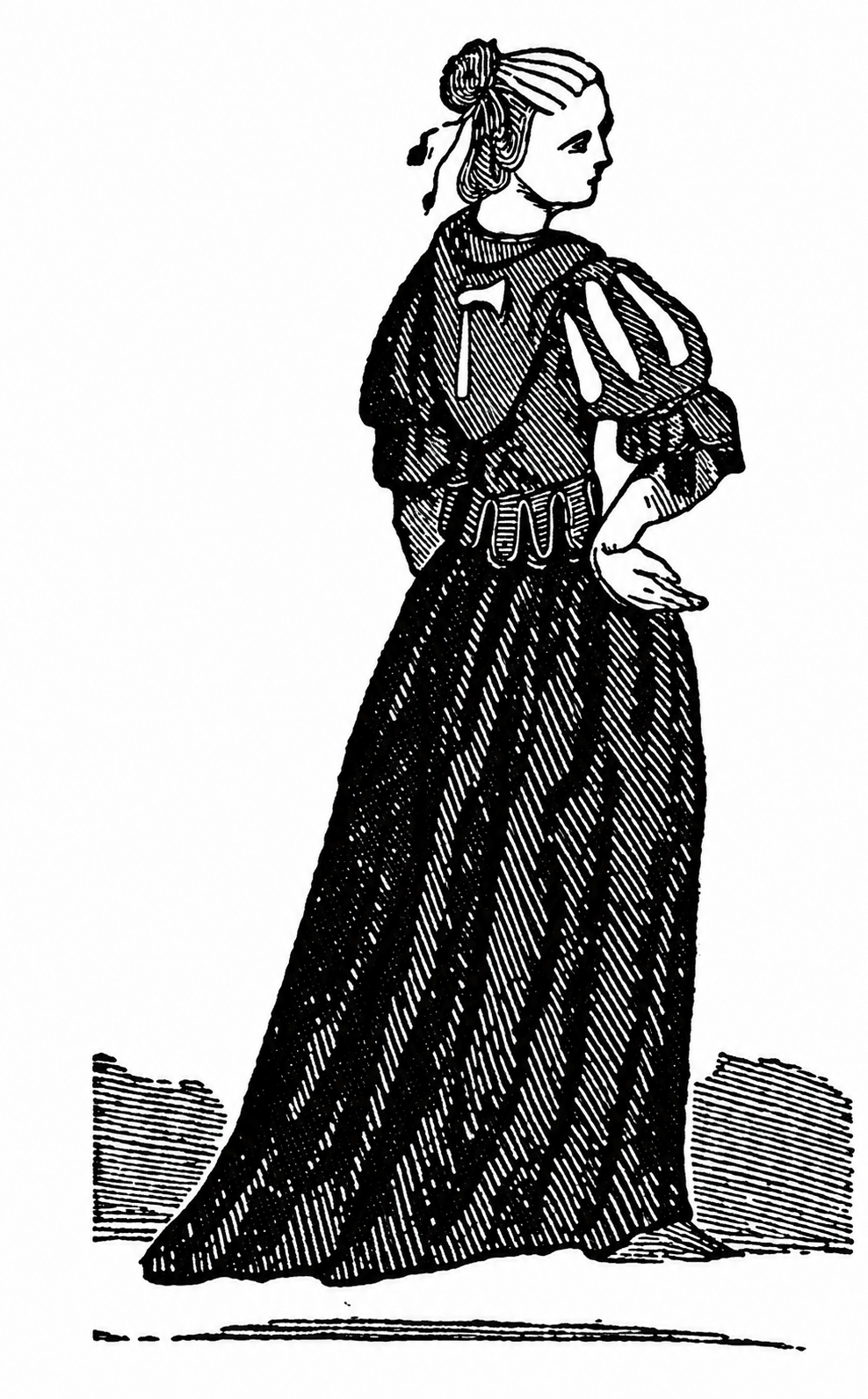
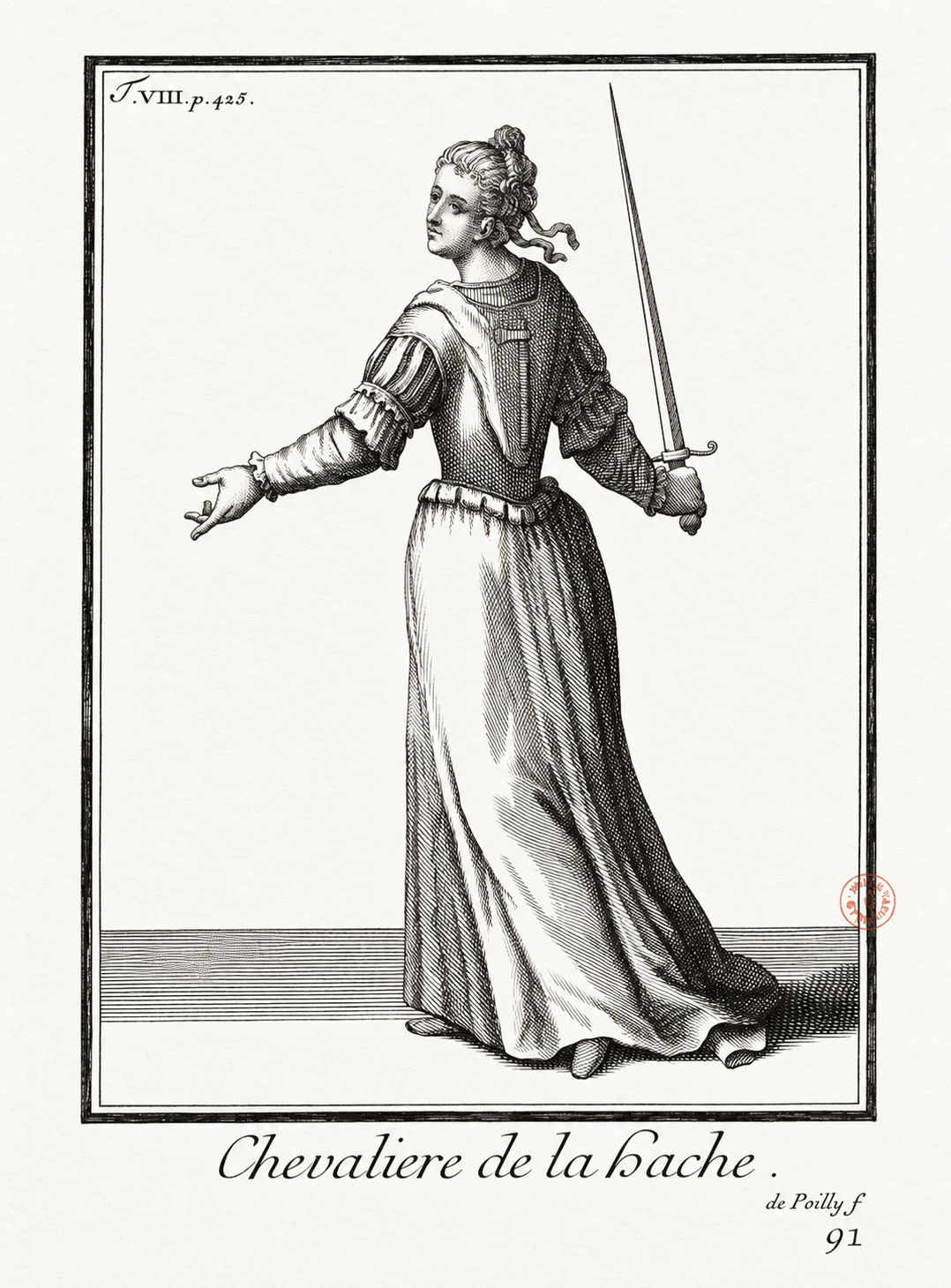
In 1692, Abbot Bernardo Giustiniani, a member of one of Venice’s most prominent families, published Historie cronologiche dell’origine degl’ordini militari. Its second part contains, in Italian, the most elaborate version of the legend of the order, which he calls the “Company of the Ladies of the Hatchet, known as the Passatemps, in Tortosa in Catalonia”. At the beginning of his chapter, we encounter for the first time an engraving of a woman armed with a sword and wearing a hood bearing the axe emblem: a clear visual representation of the supposed order, which Despuig had never mentioned (Giustiniani 1692, Part II).
Giustiniani presents the women as “great warriors”: “And behold, the flame of courage has died in the citizens’ hearts, only to blaze more fiercely in those of the Widowed Ladies. Wise and brave, they resolve together to shed their blood and step forward to win their freedom and that of their homeland against those barbarous beasts, while husbands, fathers and kinsmen lack the strength to preserve it. They cast their skirts to the ground, stripped off their women’s garments and, setting aside the modesty of their sex, grasped their weapons and donned their armour. With hearts beyond human strength, more than manly in courage, they seemed so many Athenas, possessed of Hercules’ spirit for overcoming monsters.” The narrative continues at length as an idealised heroic epic. The women are called “the Amazons of Tortosa”, shed copious Saracen blood, help those in need and perform deeds of great courage (Giustiniani 1692, Part II).
Written in a Baroque style, the account does not spare its readers the gruesome details: “The piercing cries, the groans of the wounded and the shrieks of the dying, trembling beneath the chargers’ iron-shod hooves, deafened the air. The fearless voices of the Women Warriors called their companions into battle and urged them to charge on horseback; victorious, they trampled the Moors amid acclamations and cries of triumph. Many-eyed Fame watched so heroic an effort and, witnessing so glorious an undertaking in battle, flew from tongue to tongue, carrying the news throughout the world.” Giustiniani was also familiar with the works of Rodrigo Mendes Silva and Andrés Mendo, both of whom he cites. He observes that, “without wishing to challenge Father Mendo’s authority, confusion may easily arise, because the same Spanish word, hacha, means either a torch or a battle-axe” (Giustiniani 1692, Part II).
The Catalogo degli ordini equestri e militari esposto in imagini e con breve racconto (1711), by the Italian Jesuit scholar Filippo Bonanni (1638–1723), follows the same path: “The women, especially the widows, rallied to defend the city, cast off their women’s clothing and took up arms, confronting the enemy and wreaking havoc among the barbarians—the Saracens—before returning victorious to the city.” Bonanni also discusses the ambiguity between a torch and a battle-axe, a linguistic misunderstanding originating with Mendo: “[Ramon Berenguer established an order] called the Acha, because its emblem was a flame or an axe, since in Spanish Acha means both.” Another point of interest is that the book again includes engravings of the various orders, among them a full-length figure representing the Order of the Hatchet. Here we should distinguish the two homonyms. The Diccionari català-valencià-balear connects Catalan atxa, meaning “axe”, with French hache, of Germanic origin, and atxa, meaning “large candle” or “torch”, with Spanish hacha, derived from Latin facula. Authors unfamiliar with Catalan fell into this confusion (Bonanni 1711; Alcover and Moll, DCVB, s.v. “atxa”).
Published in Paris in 1719, Maximilien Bullot and Pierre Hélyot’s Histoire des ordres monastiques, religieux et militaires also includes the order. Here its members are called “Chevalières de la Hache”, or female knights of the Hatchet. The account summarises Giustiniani: “The first [women’s order] is that of the Hatchet or Passatemps, established in Tortosa by Ramon Berenguer, Count of Barcelona, around the year 1149.” (Hélyot and Bullot 1719, vol. VIII). Reprinted several times during the nineteenth century, this work became one of the foundations for subsequent retellings of the legend, including the black habit absent from earlier accounts. The heroic version reappears in Poblacion general de España (1747–1748), by Juan Antonio de Estrada (1695–?), a soldier, administrator and historian from Melilla. Writing about Tortosa, he states that its women enjoyed substantial privileges for having bravely defended the walls against the Moors (Estrada 1747).
We also find the epic version in the first volume of the heraldic work Adarga catalana (1753), by Francesc Xavier de Garma i Duran (1708–1783), an archivist of the Crown of Aragon who was born in Extremadura and had lived in Barcelona from an early age. He writes: “Don Ramon Berenguer IV, the last Count of Barcelona, in recognition of the courage with which the matrons of the city of Tortosa defended that stronghold against the Muslims in 1149, established in the following year the chivalric Order of the Hatchet for the women of that city. Its badge was an axe gules, set upright upon a kind of shoulder cape.” (Garma i Duran 1753, vol. I). Some writers of the Catalan Renaixença would draw on this work in their search for legends from which to construct a Catalan mythical imagination.
Through its transmission in learned writing, the legend had acquired a character entirely different from that of the earliest version. By the end of the eighteenth century, it had become a literary and heraldic curiosity, filled with conventions drawn from classical, Baroque and medieval chivalric traditions (Massip 1967).
Villanueva’s Interpretation of the Order of the Hatchet
The Dominican friar Jaime Villanueva y Astengo (Xàtiva, 1765 – London, 1824), a member of the Royal Academy of History like his brother Joaquín, was a progressive scholar influenced by Enlightenment thought. From 1802 onwards, he travelled through archives, cathedrals and monasteries to study and copy early documents as part of a project developed with his brother Joaquim Llorenç. In 1820, he left the religious order to pursue this work with greater personal freedom. These investigations produced his principal work, the Viage literario a las iglesias de España, published in twenty-two volumes between 1803 and 1852, some appearing after his death. Originally conceived as a study of early ecclesiastical rites, it eventually assembled extensive documentation on history, art, inscriptions, cultural heritage and, also, legends and folklore. His connections with liberal circles drove him into exile in 1823, and he died in London the following year.
In the Viage literario, Villanueva discusses the legend of the Order of the Hatchet during his visit to Tortosa. After almost two centuries, he was among the first to return to Despuig’s original account. He follows the Tortosa gentleman’s narrative structure closely, again invoking Numantia and Saguntum as literary precedents: “the inhabitants resolved to surrender the city, first doing as the people of Numantia and Saguntum had done: burning their valuables and killing their wives and children”. Villanueva sweeps aside the rigid, idealised and ornate eighteenth-century versions. At the same time, he finds it striking that no document predating Despuig survives, nor any formal grant or privilege. Nevertheless, he writes that “I consider the establishment of this axe emblem certain”. Historians were already questioning whether the legend was authentic or a fabrication, like so many circulating at the time, including the Dragon of Sant Llorenç del Munt and the versions of the Llibre dels fets d’armes. Villanueva, however, accepts its authenticity (Villanueva 1806, Letter XLIII).
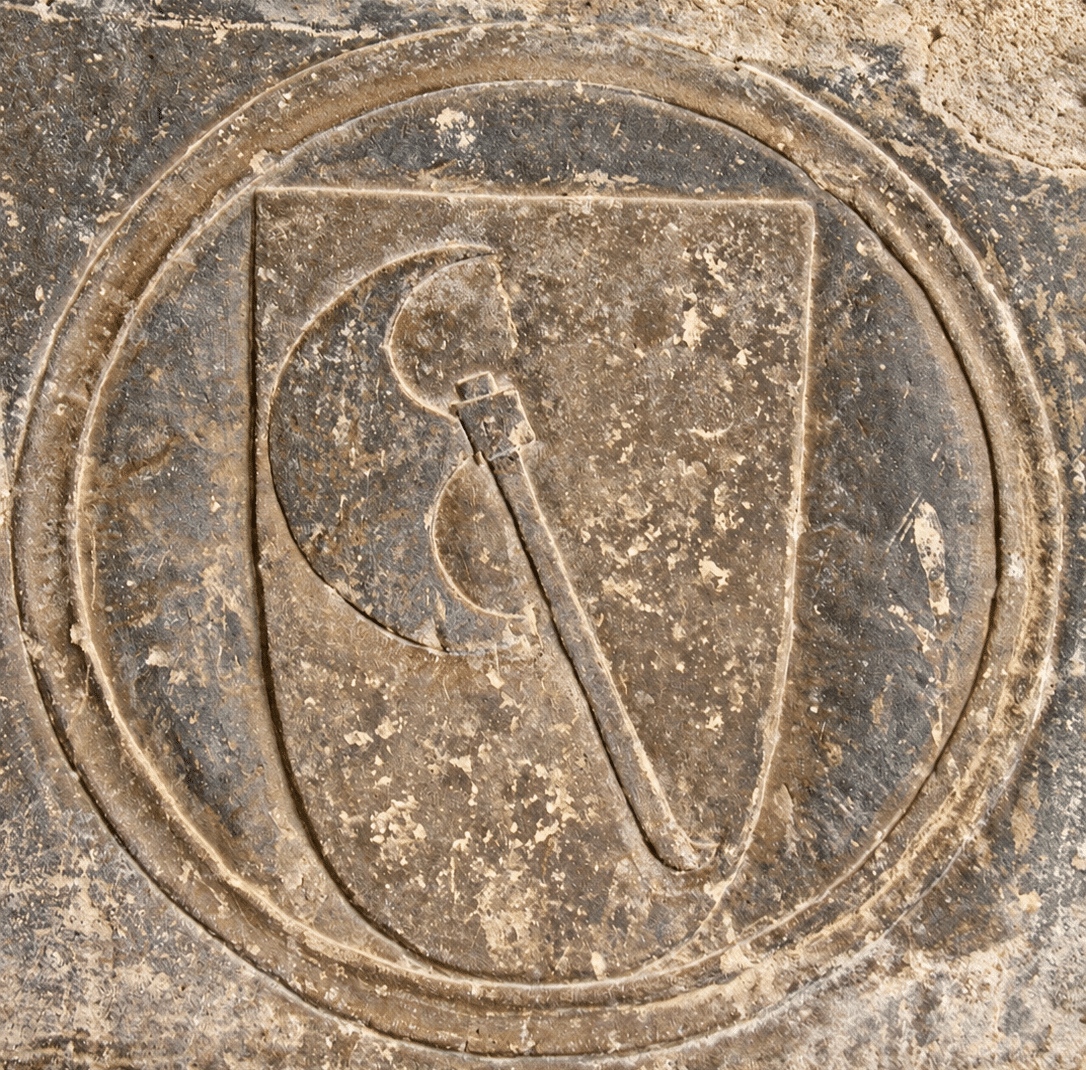
More significant still is Villanueva’s reference to twelfth-century tombs bearing reliefs of the axe emblem and shield. He uses these to trace the customs back to that period while denying that an order existed. It is worth reproducing passages from his discussion, since this is the most valuable account after Despuig’s and helps disentangle the confusion that had accumulated. The following English translation retains the omissions in the selected Spanish text (Villanueva 1806, Letter XLIII).
The Axe Carved in Tortosa Cathedral
Despite this silence, which carries considerable weight under the principles of historical criticism, I consider the establishment of this axe emblem certain, as well as its use down to the period I have indicated. As evidence, it will suffice to note that several tombs bearing an axe in relief have been recovered from the ruins of this church’s old cemetery, which I discussed in my previous letter. Since this cemetery was already in use in the twelfth century, it is clear that the emblem was used, for it was even carved upon tombs.
That these were not family arms but a public emblem is demonstrated by the ancient stone preserved in this cathedral’s cloister, in the corner immediately beside the chapel known as Santa Candia. The accompanying drawing is a somewhat rough copy, but accurate in its dimensions and figures, apart from the corner ornaments, whose paint is scarcely visible on the original. Nevertheless, they must have been more or less as shown in the copy.
The stone contains three ovals and, within them, three shields, whose interpretation requires some discussion.
The first oval, painted a strong vermilion, contains a shield with a golden field and a tower in relief, with one door, two windows and five battlements. The body of the tower is bronze-coloured, while the openings of the door and windows and the spaces between the battlements are golden.
Comparison with the shields surviving on buildings from the time of the conquest shows that these are the city’s arms, granted by the conquering count as a token of its inhabitants’ steadfastness. […]
This shows that the shield under discussion was made when the city’s seal bore only the tower, without the addition of an image or inscription, or the crown and palm granted by Philip IV in 1654.
The second oval contains a painted image of Our Lady, whose outlines have been faithfully reproduced in the copy. […]
We therefore have two shields belonging to the city’s public institutions, its secular and ecclesiastical bodies, and consequently the stone cannot concern a private family. Since the third shield, depicting the axe, is carved into the same stone, we must conclude that it too belongs to the public sphere and represents something shared by the city. I can find nothing to which it might refer other than the tradition of the axe we are discussing.
To show that this conjecture is not arbitrary, you should know that, in the thirteenth century, the place where the stone stands was used for meetings of the general council. […]
There is therefore no difficulty in supposing that the stone was placed in its present location to confer greater authority and dignity on a setting intended for solemn public proceedings attended by the ecclesiastical and civil estates. Since the stone must on these grounds be regarded as a public monument, the shield bearing the axe must likewise be interpreted as representing the noble or military estate.
Although there is no evidence that this emblem represented the courage of women to the exclusion of men, and although it might have symbolised the courage with which the inhabitants of Tortosa defended themselves in general, I consider the tradition that it was granted to the women highly plausible. For Pliny maintains (Book VII, chapter 56) that the Amazon Penthesilea invented the axe, which is why poets called the Amazons securigerae, meaning armed with axes. It therefore seems that this emblem of courage was chosen with reference to the women, who are still called Amazons here.
This also reveals Mendo’s error when he writes in De ordinibus militaribus: “militiam formavit, dictam de la hacha, quia in capite gestabant purpuream facis formam”. For facis means “torch”, and he should, if anything, have written falcis. Yet even that would not be appropriate, since falx is the curved agricultural implement we call a sickle.
The axe is therefore a securis, a military weapon. It was gules, as Garma states—that is, red—painted or depicted upon a kerchief or something like a small scapular called a pasatemps. Because of the supposed connection between this word and the Latin pastinum, denoting something like a hoe, a scholar of this city argued that the axe should be understood as an agricultural implement rather than the weapon usually depicted. He therefore maintained that it should be called not a hacha de desarmar, an axe for disarming, but a hacha de desermar, an axe for bringing wasteland into cultivation.
Yet this conjecture carries no weight against the monuments cited. Even if the women had appeared on the walls armed with farming tools to frighten the Moors with their clatter, which is the most that could be conceded, it would still be true that this distinction was granted in recognition and remembrance of their courage. No one would claim that courage is symbolised by a hoe.
The axe depicted by writers on military orders is smaller and less curved than the one shown on this stone. They also represent it upright rather than inclined, as it is here. These, however, are minor variations, and in every case it is a military weapon.
I have deliberately avoided calling it the Order of the Hatchet, and I do not regard it as such, although Italian, French and Spanish writers unanimously give it that name. No foundation charter, statutes or anything of the kind was issued. It was simply a badge or emblem intended to preserve the memory of an event that remains glorious for women and for this city.
(Villanueva 1806, Letter XLIII. English translation of selected passages from the Spanish original.)
Continuing Confusion in the Nineteenth and Twentieth Centuries
Villanueva brings order to the accumulated accounts of the legend, but his interpretation would find little popular favour. I will not list every nineteenth-century author who discusses the story, since most repeat one another.
One writer who further complicated the subject was Daniel Fernández i Domingo (Tortosa, 1829–1885), a physician, teacher, journalist and historian who participated actively in his city’s cultural and political life, teaching French and holding municipal office. His principal historical work, Anales ó historia de Tortosa (1867), remained a standard reference for local history for several decades, at least until some time after the Spanish Civil War, when Bayerri’s work superseded it. Fernández writes:
“The citizens of Tortosa proved rather demanding, for they established certain laws contrary to canon law and consequently had to amend and restrict them. Once Tortosa’s laws and privileges had been settled, a council was held at which it was decided that the women should request whatever reward they wished in recognition of the successful outcome of their manly counsel. They agreed that a distinctive badge should be instituted, in the manner of a military order, to perpetuate so glorious a feat. This order was called the Order of the Hatchet. Its dress consisted of a green gown with a shoulder cape worn over it, bearing a battle-axe of crimson or scarlet. This distinguishing garment was originally called a pasatiempo. Don Cristóbal Despuig attests to the existence of this order in his colloquies or dialogues. Referring to the Reverend Father Master Friar Baltasar Sorio, he states that the latter had seen some of these habits in various houses in the city and that Lady Francisca Despuig had worn one in her youth. Other privileges were granted to the women: when the bridegroom went to the bride’s house to take her to Mass, the women accompanying her were to walk ahead of the men, even if royal or municipal officials were present; they were to pay no duties on their veils; and, if they outlived their husbands, all the clothing and jewellery their husbands had given them was to remain their own property, whatever its value.”
(Fernández y Domingo 1867; translated from the Spanish.)
He continues to describe an order, mentions a green gown that we have encountered nowhere else, and claims that Despuig’s mother had worn it. As I noted in the introduction to the previous article, ten years after Fernández’s book appeared, Fidel Fita and the Renaixença publishing house published Despuig’s Col·loquis, bringing them to a new readership and finally rescuing them from obscurity. The original version could now circulate among other readers and researchers. During the twentieth century, two approaches would coexist: some writers continued trying to distinguish the legend from the customs associated with the axe and from subsequent inventions, while others further exaggerated and embellished the fabricated version, adding details of their own.
Among the former, I consider Enric Bayerri i Bertomeu (Tortosa, 1882–1958) the most significant: a local historian, archivist and journalist devoted to studying Tortosa’s past. A Carlist in his political convictions, he directed the city’s Museum-Archive, where he developed the library and newspaper collections, and became Tortosa’s official chronicler in 1941. His principal work, Historia de Tortosa y su comarca, published in eight volumes between 1933 and 1960, assembles extensive documentary material on the city and its surrounding territory, moving beyond Fernández’s more amateur approach. His conclusions largely agree with Villanueva’s: he treats the legend as a fantasy without historical foundation while maintaining that the customs associated with the axe did exist. Bayerri also introduced testimony from the Notes Antigues of Canon Miquel Macip, a scholar active in the early decades of the seventeenth century. This manuscript described an image of a city procurator’s wife kneeling at an altar in the family chapel of Sant Francesc, wearing the garments described by Despuig and a crimson axe on a scapular. Macip interpreted this clothing as a privilege granted by the conquering count and explicitly referred to Despuig and the Llibre de la Cinta. Since he wrote after Despuig, however, his account takes us little further (Bayerri, cited in Massip 1967).
Other local authors who approached the subject perceptively include Jesús Massip i Fonollosa, whose article “La destral carmesí, privilegi de la dona tortosina” (1967) appeared in the programme for the Festes de la Cinta. Salvador Blanch Balagué also contributed several articles on the subject to the same festival programme during the 1970s. In 1968, Ramon Miravall published Tortosa i l’orde de l’aixa, a short book combining history with legendary narrative (Massip 1967; Blanch Balagué 1973a and 1973b; Miravall 1968). The coexistence of history and legend is also apparent in contemporary scholarship. In her study of women’s presence in medieval Tortosa, Victòria Almuni Balada devotes a section to the Order of the Hatchet and emphasises its multiple interpretations. Her overview includes the women’s armed defence and an identifying costume consisting of a black dress with a red axe, while placing the account within the realm of legendary tradition (Almuni Balada 2019, pp. 13–14). As we have seen, however, the black dress is a later addition.
Among those who amplified the fantasy and perpetuated the confusion, Joan Amades is probably the most prominent. In his characteristic manner, he constructs a kitsch collage from disparate sources, although in Rondallística he attributes the account to an informant, Pere Mulet, in 1935, and later repeats it in the Costumari. Amades borrows ideas from the Lombard legend mentioned in the previous article and adds episodes of his own: “An old spinner winding skeins heard the reels repeating as they turned: ‘The Moors are coming! The Moors are coming! The Moors are coming!’ She spread the word among the women, who immediately took up arms and went out with axes. To look like men and strike greater fear into the Moors, they tied their hair beneath their chins, so that from a distance they resembled bearded warriors.” Meanwhile, new details had emerged, largely through the influence of Romantic writers and an oral tradition drawing on their works that probably circulated locally. These included the black habit worn with the scapular bearing the crimson axe, and the name of a leader, Marina de Miravall, likewise apocryphal (Amades 1982, pp. 1184–1185; Amades 2005, p. 256).
The folklore motif is not confined to the Lombard legend: it is a recurring theme found since antiquity. The story of Triaria, for example, who disguised herself as a soldier and took part in the capture of Terracina, already presents the figure of an armed woman dressed as a man. In his Histories (AD 100–110), Tacitus describes her as “ultra feminam ferox”, a fierce woman. Better known still is Joan of Arc, who wore men’s clothing and carried weapons, although she did not herself engage in acts of violence. The women of Tortosa, however, overcome the attackers through cunning and ingenuity rather than the force of arms associated with Penthesilea’s axe-wielding Amazons or Triaria. A more appropriate comparison therefore requires us to turn to a different kind of legend (Tacitus, Histories, III, 33 and 77; Pliny, Natural History, VII, 201).
Folklore Motifs and Related Legends: The Example of Orihuela
To bring these threads together, we need to examine the folklore motifs underlying Despuig’s account, without the later Baroque and Romantic additions, and compare them with legends of castles and cities besieged by a stronger enemy who is defeated through the defenders’ ingenuity. Such stories are abundant throughout Catalonia, Spain and Europe more broadly. Their central device is the manipulation of what the adversary can see, hear or learn from outside the walls. The defenders turn their weakness into an appearance of strength, and the enemy makes decisions on the basis of that deceptive impression. In some versions, a tunnel allows food to be brought in, persuading the enemy that the defenders can withstand a prolonged siege. At Montsoriu Castle, for example, the legend of the trout banquet tells how the lord of the castle invites the besieging Moorish king to dine and serves him fresh fish brought in through such a tunnel. As Xavier Roviró records from local informants, a story told in Centelles likewise describes the castle’s inhabitants receiving their enemies with fresh fruit and fish after a long siege (Roviró 2000; Diputació de Barcelona, “Llegenda – El convit de les truites” and “Llegenda del castell de Sant Esteve”).
Perhaps the best-known European example is the legend of Dame Carcas, the Saracen defender of Carcassonne against Charlemagne. When supplies run low, she has a pig fed with the remaining wheat and thrown from the walls. The attackers interpret the grain-filled animal as evidence that the city still has food to spare. This is motif K2365.1, in which the besieged induce the enemy to withdraw by making them believe they possess abundant provisions (Ville de Carcassonne, “Dame Carcas”; Thompson 1955–1958, K2365.1).
Stories involving animals and torches are also common. A tradition associated with the castle of Sant Martí de Centelles, likewise recorded by Roviró and the Grup de Recerca Folklòrica d’Osona, tells how fifty billy goats with burning brands attached to their horns put the Saracens to flight by convincing them that a large force is approaching. This story is extremely widespread, with numerous versions across the Iberian Peninsula. Some even reverse the opposing sides: in one, Christians drive the animals uphill towards a castle occupied by Muslims; in another, the animals are released from the fortress against its besiegers. A local version associated with the castle at Guardiola de Berguedà replaces the herd with a mule laden with rockets and firecrackers. Motif K2368.2, in which the sounds of a simulated battle frighten the attackers, offers a close parallel to this version (Roviró 2000; Diputació de Barcelona, “Llegenda del castell de Sant Esteve” and “Llegenda del castell dels Moros”; Thompson 1955–1958, K2368.2).
The closest parallels, however, are those in which women organise both the defence and the deception, outwitting the attackers. In Despuig’s account, the women propose taking to the walls with spears, gleaming weapons, banners and drums to create the impression of a fighting force. At the same time, two men are to allow themselves to be captured and spread the news that substantial reinforcements entered the city during the night. The display on the walls lends credibility to this false information while the men prepare a sortie against the besiegers. Relevant motifs include K1837, a woman dressed as a man, and its more specific variant K1837.6, a woman as a soldier. There is also K2368, in which the enemy overestimates its opponents and withdraws, and K2368.4, describing the abandonment of a siege because the attackers believe the defenders have received reinforcements (Thompson 1955–1958, K1837, K1837.6, K2368 and K2368.4).
I have already discussed the Lombard women, but the closest parallel is found in Orihuela. The legend of Theodemir tells how, having lost many of his fighting men, the ruler stations women on the walls so that they will be mistaken for warriors. Some versions give them hair arranged as beards, as in the Germanic legend, and reeds made to resemble weapons. The deception allows him to negotiate favourable terms of surrender. Eva Lapiedra has studied the episode’s transmission in Arabic sources and in Latin and Romance chronicles, documenting the motif’s circulation in antiquity and the Middle Ages. The outcome nevertheless differs from that of Tortosa: in Orihuela, the appearance of strength facilitates an agreement; in Tortosa, it accompanies a victorious military sortie (Lapiedra Gutiérrez 2014, pp. 349–369; Paul the Deacon 1907, I, 8).
The defence of a city by women also has ancient parallels that broaden the comparison. Plutarch relates how the women of Argos, led by the poet Telesilla, took up arms and defended the walls against the Spartans. Unlike the stories of Triaria or Penthesilea, this account connects the memory of victory with a celebration in which women and men exchanged clothing. Here, however, the women do engage in combat: their action is more than a deception intended to make the attackers mistake them for men. The point of connection is a community saved by women and the subsequent preservation of their achievement through commemorative practices. To conclude these two articles, I reproduce the episode in full.
The Women’s Defence of Argos
Of all the deeds women have performed for the benefit of their community, none is more famous than their struggle against Cleomenes in defence of Argos, undertaken at the urging of the poet Telesilla.
She is said to have come from a distinguished family but to have suffered from poor health. She therefore sent to consult the god about her condition. The oracle replied that she should devote herself to the Muses. Following the god’s advice, she took up poetry and music, soon recovered from her ailments and won great admiration among the women for her poetic art.
When Cleomenes, king of the Spartans, advanced against the city after killing many Argives—though certainly not seven thousand seven hundred and seventy-seven, as some fabulous accounts maintain—the younger women were moved by a divinely inspired boldness to attempt to repel the enemy and save their homeland. Under Telesilla’s command, they took up arms, occupied the battlements and defended the entire circuit of the walls, to the astonishment of their enemies.
They succeeded in driving back Cleomenes, inflicting heavy losses, and also expelled the other king, Demaratus, who, according to Socrates, had entered the city and occupied the Pamphyliac quarter. Thus the city was saved. The women who had fallen in battle were buried beside the Argive road, and the survivors were granted the privilege of erecting a statue of Ares to commemorate their extraordinary courage.
Some say the battle took place on the seventh day of the month now called the Fourth Month, but formerly known to the Argives as Hermaeus. Others place it on the first day of that month. On its anniversary, they still celebrate the festival of the Hybristica, during which women are dressed in men’s tunics and cloaks, and men in women’s dresses and veils.
To make up for the shortage of men, they did not marry the women to slaves, as Herodotus relates, but to the best men of the neighbouring subject communities, whom they granted Argive citizenship. It was said that the women despised these husbands and deliberately treated them with indifference in their marital relations, considering them their inferiors. For this reason, the Argives passed the law requiring married women to wear beards when sharing a bed with their husbands.
(Plutarch, Bravery of Women, 4, 245c–245f. English version based on the modern adaptation reproduced in this article.)
The history of the legend traced across these two articles shows how a single narrative can change until it acquires a meaning quite different from that of its earliest surviving account. Despuig probably drew on oral tradition and on the memory of customs and legal privileges preserved in Tortosa, although we cannot establish with certainty how these related to the events described in the legend. From his account onwards, transmission through learned writing enlarged the story until, between the seventeenth and nineteenth centuries, it expanded into battles fought by women, Amazonian exploits and the foundation of a military order. Villanueva and later scholars recovered the meaning of the earliest narrative and distinguished the commemorative emblem from the supposed order. Yet this recovery did not erase the embellishments. Both versions coexist today, and the modern world seems, understandably, to favour the more spectacular one, in which the women fight and an order is founded, even though it differs from Despuig’s account.
In the next article devoted to Tortosa, I will examine the other legend associated with the city’s defence: that of the Portal del Romeu and the pilgrim who drives back the attackers at its gate.
© Arnau Folch / Llegendàrium. This article may be shared by linking to the original publication. Reproduction, translation, adaptation or distribution in full is not permitted without prior authorisation.
